Scare
p. 151 · Read in the full issue
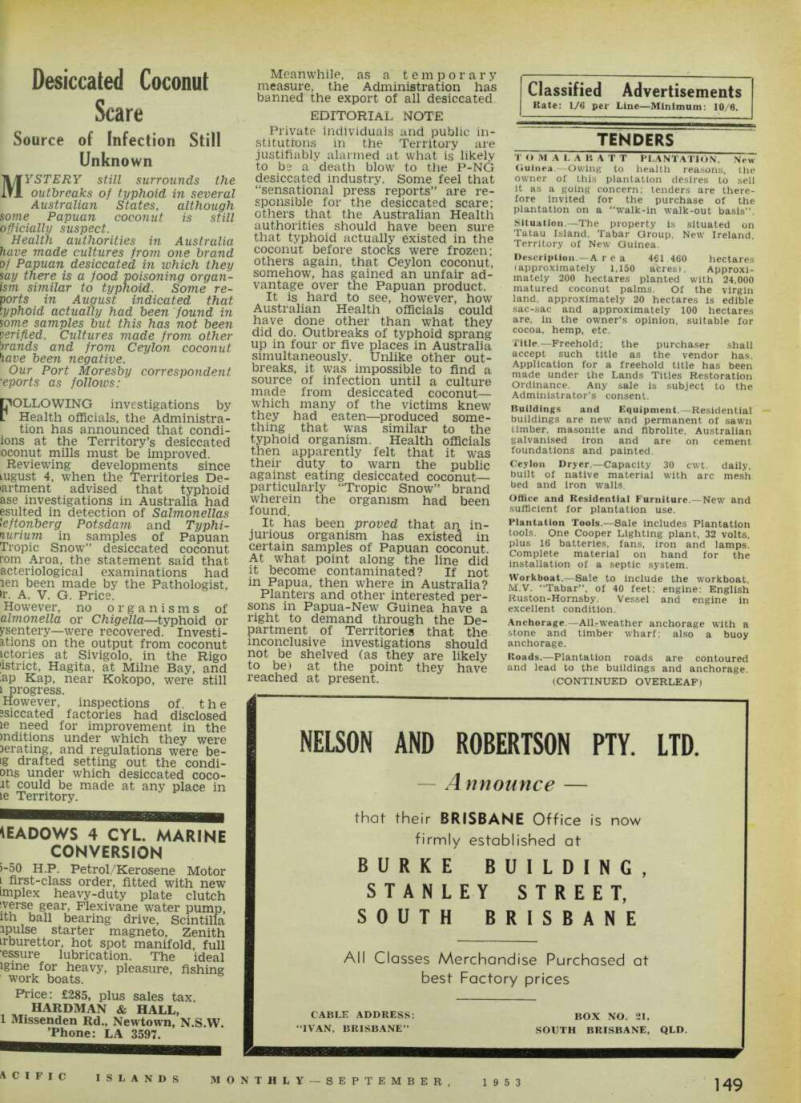
Desiccated Coconut Scare Source of Infection Still Unknown
MYSTERY still surrounds the outbreaks of typhoid in several Australian States, although some Papuan coconut is still officially suspect.
Health authorities in Australia have made cultures from one brand of Papuan desiccated in which they say there is a food poisoning organ ism similar to typhoid. Some re ports in August indicated that typhoid actually had been found in some samples but this has not been verified. Cultures made from other brands and from Ceylon coconut have been negative.
Our Port Moresby correspondent ■eports as follows: FOLLOWING investigations by Health officials, the Administra tion has announced that condi ions at the Territory's desiccated oconut mills must be improved.
Reviewing developments since Lugust 4, when the Territories De partment advised that typhoid ase investigations in Australia had esulted in detection of Salmonellas 'eftonberg Potsdam and Typhi nurium in samples of Papuan Tropic Snow” desiccated coconut rom Aroa, the statement said that acteriological examinations had len been made by the Pathologist, >r. A. V. G. Price.
However, no organisms of almonella or Chigella —typhoid or ysentery—were recovered. Investi ations on the output from coconut ictories at Sivigolo, in the Rigo istrict, Hagita, at Milne Bay, and ap Kap, near Kokopo, were still i progress.
However, inspections of. the ssiccated factories had disclosed le need for improvement in the mditions under which they were Jerating, and regulations were be ig drafted setting out the condi ons under which desiccated coco it could be made at any place in le Territory.
Meanwhile, as a temporary measure, the Administration has banned the export of all desiccated
Editorial Note
Private individuals and public in stitutions in the Territory are justifiably alarmed at what is likely to be a death blow to the P-NG desiccated industry. Some feel that “sensational press reports” are re sponsible for the desiccated scare; others that the Australian Health authorities should have been sure that typhoid actually existed in the coconut before stocks were frozen; others again, that Ceylon coconut, somehow, has gained an unfair ad vantage over the Papuan product.
It is hard to see, however, how Australian Health officials could have done other than what they did do. Outbreaks of typhoid sprang up in four or five places in Australia simultaneously. Unlike other out breaks. it was impossible to find a source of infection until a culture made from desiccated coconut— which many of the victims knew they had eaten —produced some thing that was similar to the typhoid organism. Health officials then apparently felt that it was their duty to warn the public against eating desiccated coconut— particularly “Tropic Snow” brand wherein the organism had been found.
It has been proved that ap, in jurious organism has existed in certain samples of Papuan coconut.
At what point along the line did it become contaminated? If not in Papua, then where in Australia?
Planters and other interested per sons in Papua-New Guinea have a right to demand through the De partment of Territories that the inconclusive investigations should not be shelved (as they are likely to be) at the point they have reached at present.