120 Lost When Small French
pp. 143-145 · Read in the full issue
Ship Mysteriously Disappears
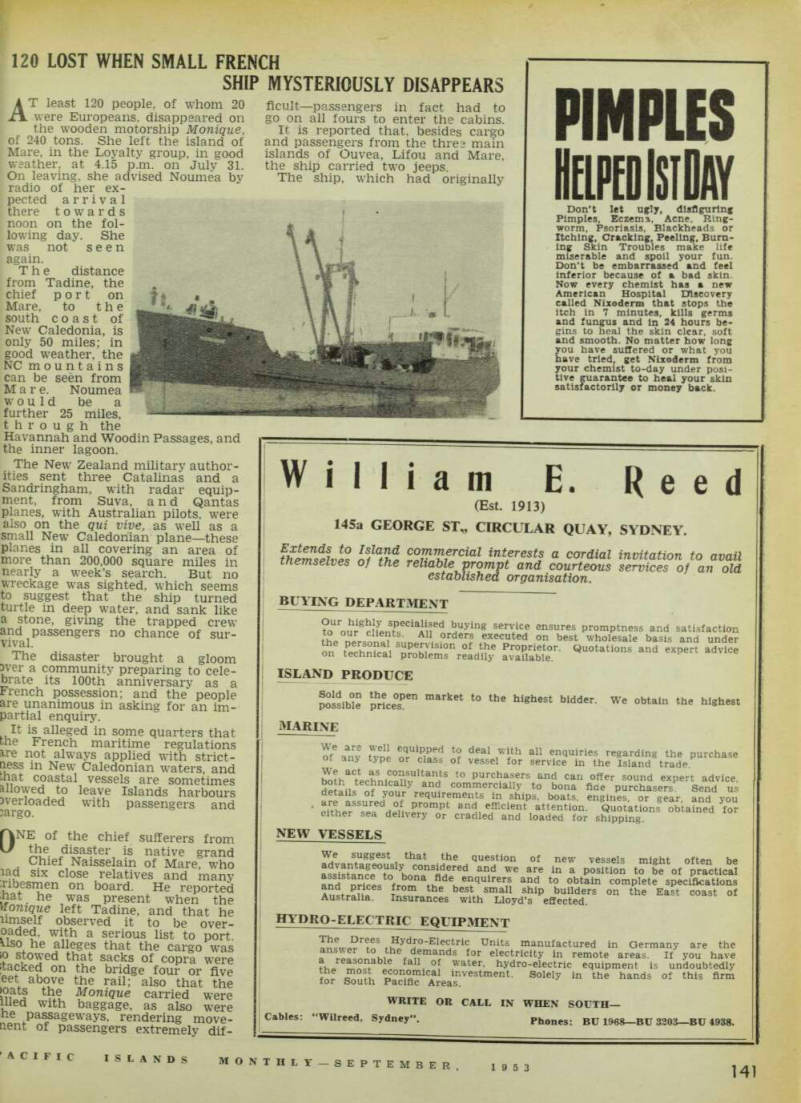
AT least 120 people, of whom 20 were Europeans, disappeared on the wooden motorship Monique, of 240 tons. She left the island of Mare, in the Loyalty group, in good weather, at 4.15 p.m. on July 31.
On leaving, she advised Noumea by radio of her ex
pected arrival there towards noon on the fol lowing day. She was not seen again.
The distance from Tadine, the chief port on Mare, to the south coast of New Caledonia, is only 50 miles; in good weather, the NC mountains can be seen from Mare. Noumea would be a further 25 miles, through the
Havannah and Woodin Passages, and the inner lagoon.
The New Zealand military author ities sent three Catalinas and a Sandringham, with radar equip ment, from Suva, and Qantas planes, with Australian pilots, were also on the qui vive, as well as a small New Caledonian plane—these planes in all covering an area of more than 200,000 square miles in nearly a week’s search. But no wreckage was sighted, which seems to suggest that the ship turned turtle in deep water, and sank like a stone, giving the trapped crew and passengers no chance of sur vival.
The disaster brought a gloom 3ver a community preparing to cele brate its 100th anniversary as a French possession; and the people are unanimous in asking for an im partial enquiry.
It is alleged in some quarters that the French maritime regulations ire not always applied with strict ness m New Caledonian waters, and -hat coastal vessels are sometimes allowed to leave Islands harbours overloaded with passengers and Jargo.
ONE of the chief sufferers from the disaster is native grand Chief Naisselain of Mare, who aad six close relatives and many ribesmen on board. He reported hat he was present when the Komque left Tadine, and that he umself observed it to be over paded, with a serious list to port Uso he alleges that the cargo was ip stowed that sacks of copra were [tacked on the bridge four or five eet above the rail; also that the oats the Monique carried were Hied with baggage, as also were he passageways, rendering move nent of passengers extremely dif
ficult—passengers in fact had to go on all fours to enter the cabins, It is reported that, besides cargo and passengers from the three main islands of Ouvea, Lifou and Mare the ship carried two jeeps The ship, which had originally
been bought in Auckland, NZ, by Mr. Louis Houssard, of Noumea, to gether with a sister ship, the Rosalie, for the Caledonian coastal trade, was stoutly built; but her displace ment was only 240 tons.
The New Caledonian Governor, Monsieur Angemarre, has received from the French Minister concerned a cable expressing his Government’s sorrow and sympathy with the families and relatives of those miss ing, adding that he wished to thank all those who took part in the ex tensive search, notably the Aus tralian and New Zealand airmen who gave such magnificent co operation.
Although local seamen were unanimous, after the first few days, in regarding the ship as lost, it was decided to postpone official mourning in the territory until September 1. This mourning period was then designed to last for eight days.
On August 11, leaders of the community under the presidency of the Governor, and including mem bers of the General Council, and captains and others engaged in the maritime industry, met to discuss the disaster. Later it was announced that an official enquiry would be held. The hope was expressed in Noumea that magistrates and others with legal qualifications should sit on the commission, as well as French officials of the administra tive and maritime services.
BESIDES the personal losses of grand Chief Naisseline, grand Chief Boula, of Lifou, lost his daughter, aged four, and her uncle.
The Prptestant church in the Loyalties is hard hit, having lost three native pastors, two of them with their wives and children. The Protestant Mission’s whits nurse on Lifou, Mile. Juliette Roche, who was booked to leave for a holiday in France by the next Air France plane, after seven years in the Colony, is among the missing. „ .The white passengers included sister Mane-Jeanne, of the Catholic Mission; a gendarme sergeant lamed Pelissou, his wife and child, vho were about to return to prance; Mrs. Charles Ohlen (wife £ the Monique’s captain); Mr. ienn Cubadda, a Lifou trader; Mr. lobert Parazols, a surveyor who had )een doing Government work on jifou; a Government radio operator lamed Monnier, who had been tationed on Ouvea; Madame .jemarle, wife of the gendarme on Jare; and descendants of a well mown pioneer family in M and Jme. Henri de Greslan, of Noumea nd their four children. M. de »reslan was a retired radio operator mo had formerly lived on Mare, mere he had been visiting old nends. 6 The Natives of the Loyalty Group re so upset by the disaster that mny say they have abandoned neir intention of visiting Noumea
for the centenary celebrations, September 24-27. They draw attention to the fact that the Monique reached Mare from Lifou on the morning before the disaster five hours behind her radioed arrival
time; and confirm that the night of the disaster was fine, with only a slight breeze, The length of the Monique was 104 feet; beam 22 feet; and she had two 275 hp engines