News Of The Small-Ships
pp. 116-129 · Read in the full issue
Gatty Fishes Again—A Trim
38’ x 10’ cruiser sailed from Suva, August 12, to commence a fishing venture on the Macuata coast of Vanua Levu. The cruiser is Marau, powered with a Grey Marine engine and capable of 9 knots. Cap tain W. P. Sinclair, of Suva, is in command, and Mr. J. McFadyen as engineer. The enterprise is financed and headed by Mr. Harold Gatty, of the successful Fiji Airways and not so successful South Seas Marine Products tuna fishing enterprise.
From the experience gained in that unsuccessful 1949 operation the present plans evolved, and the men responsible believe that this more modest venture will succeed.
Two kinds of fishing are planned —lampara fishing, and mullet net ting. In the first method, powerful lamps attract the fish, mainly mackerel, which are then encircled with a special net, perhaps 50 fathoms long and 12 fathoms deep, laid out from a small boat. The mullet are taken by a different type of net.
The fish will be flown in plastic containers to the Suva market; if there is a surplus a cannery will be established, probably at Labasa.
In addition to Marau, a small launch and three dinghys will be employed with probably 12 Fijian operatives.
C a p tain Sinclair and Mr.
McFadyen were associated with South Seas Marine Products. Mr.
McFadyen returned to Fiji from USA early in August to join the new enterprise.
Mr. McFadyen went to New South Wales in the Senibua when the tuna clipper was purchased by Wilbur Ellis Co. of San Francisco late in 1950 from SSMP. In March, 1952, when the American owners decided to take her north to the US, Captain Prosser, retired Union Steam Ship Co. master, remembered in Matua during the war years, was engaged, with Mr. Arthur Evans, now of Tuvalu, as Mate. Mr.
McFadyen was chief engineer.
The vessel was half-way between Pago and Honolulu when a leak developed, eventually causing a serious fusing of the electrical cir cuits which set fire to the clipper.
Only after dumping valuable nets and equipment was it brought under control.
Mr. McFadyen spoke highly of the tenacity and courage of Cap tain Prosser, a man in his late 70’s, during this incident when all ex cept the skipper were ready to take to the boats.
Senibua was brought safely to Honolulu after wiring had been re placed with bare wire enclosed in rubber hoses that were split and tied round the conductors. Two
months were spent repairing in Honolulu.
T A GIMA UCI A INQUIRY The Fiji Marine Board, after holding a preliminary inquiry into the loss of the 9-ton cutter Tagimaucia, which capsized and foundered near the
Naselai Reef, south-eastern Viti Levu on July 1, recommended that a formal inquiry be held.
In the opinion of the Board, the foundering of the ship and the loss of a man’s life might have been averted if the Master had main tained a course further away from the reef. The vessel was carrying one person in excess of the number permitted by its certificate.
Radio Contact With Suva
—There is some confusion regarding frequencies on which small ships, using telephony, may contact Suva.
This is due to the fact that these facilities are provided by two organ isations—the Fiji Post Office and Cable & Wireless Ltd.
The Post Office maintains con
tact with vessels trading within the group, listening and replying on 6300 kc/s at 0230 and 2130 GMT, with speaker-watch at other times during normal daytime business hours.
Cable & Wireless maintain contact with vessels outside the Group— approaching or leaving. This station listens on 6280 kc/s and replies on 5887.5 kc/s at 0400 and 2300 GMT.
Additionally, the Suva Harbour Master, on request, Will maintain contact with vessels approaching the port and desiring to enter at night or on holidays, etc. His station replies on 6200 kc/s to calls, and would doubtless listen on any other ship frequency available. Re quests are lodged through the other stations. (oter)
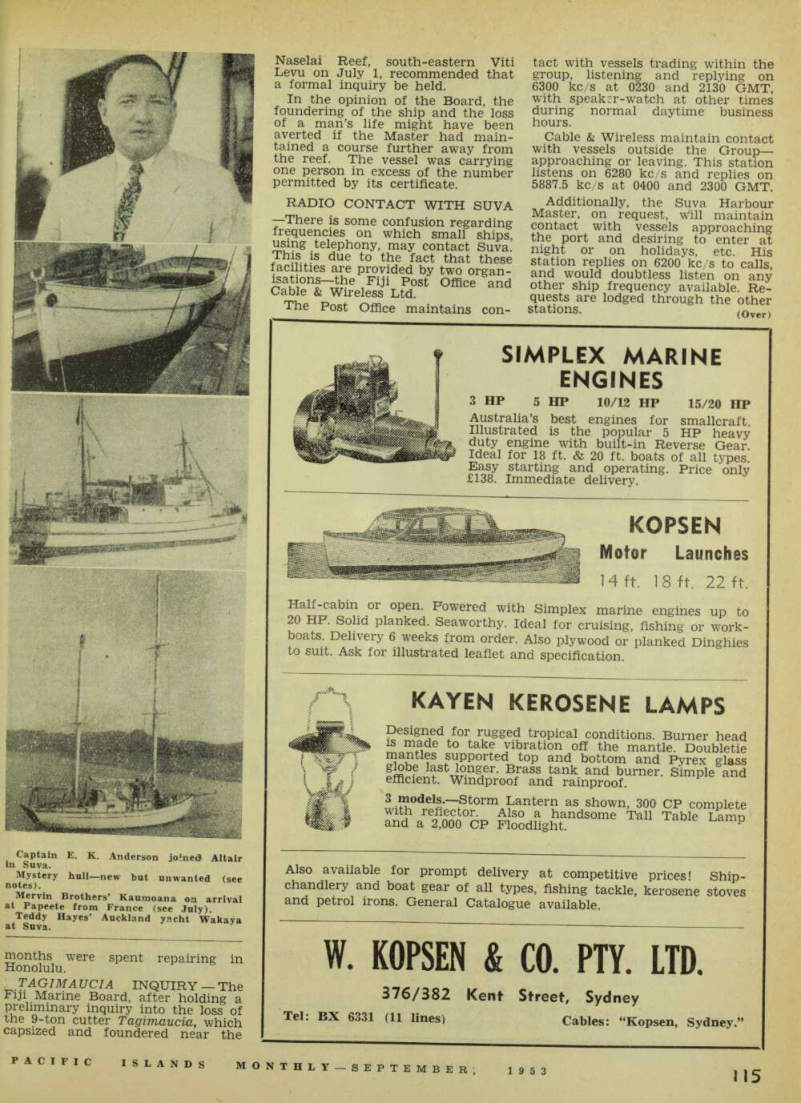
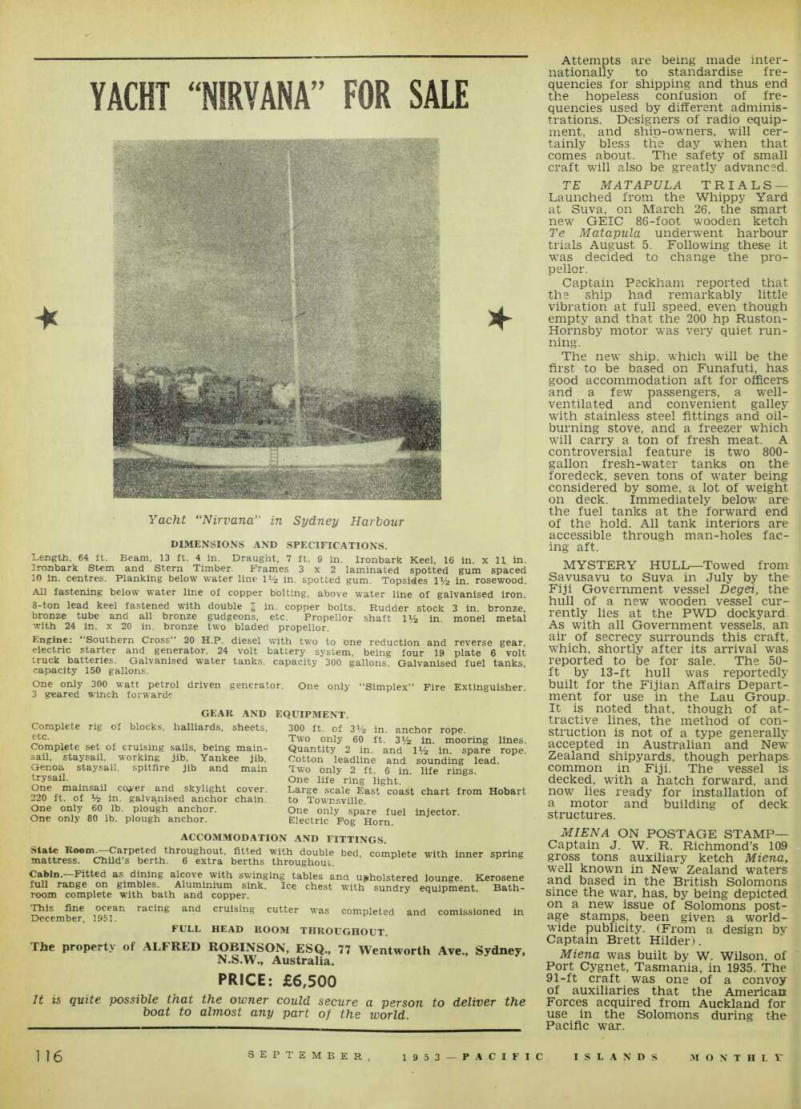
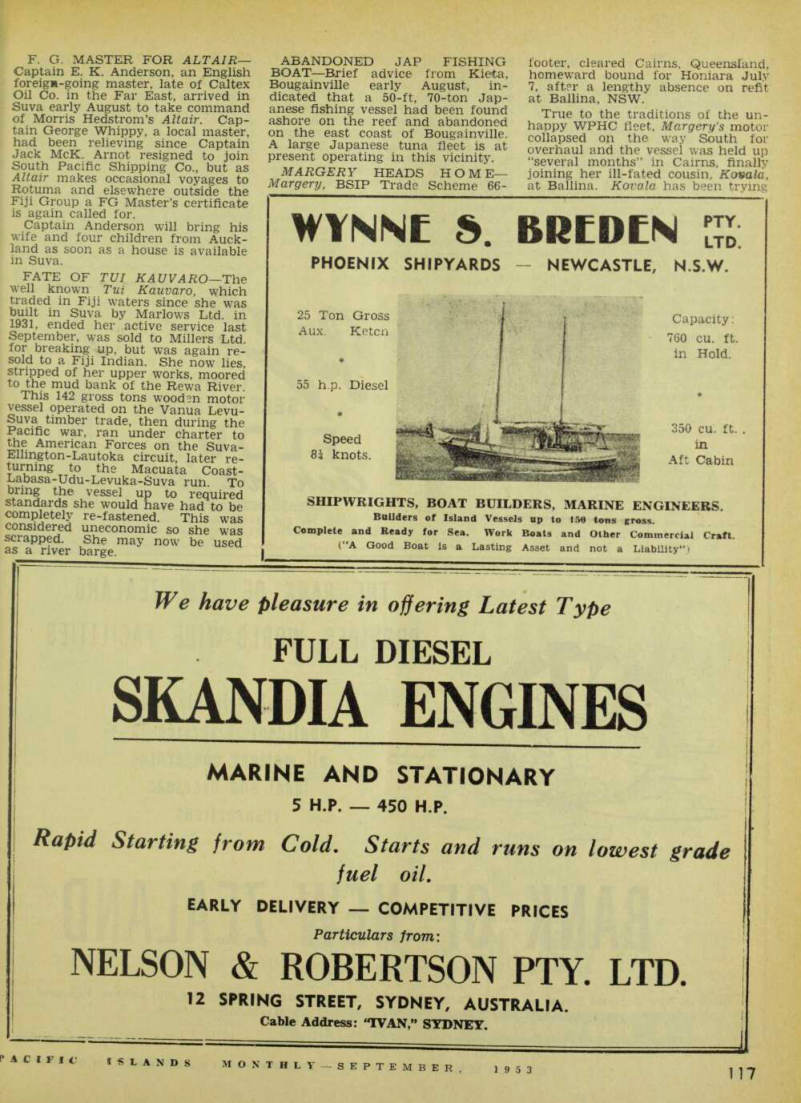
Captain E. K. Anderson joined Altair in Suva.
Mystery hull—new but unwanted (see notes), Mervin Brothers’ Kaumoana on arrival at Papeete from France (see July).
Teddy Hayes’ Auckland yacht Wakava at Suva.
Attempts are being made inter nationally to standardise fre quencies for shipping and thus end the hopeless confusion of fre quencies used by different adminis trations. Designers of radio equip ment, and ship-owners, will cer tainly bless the day when that comes about. The safety of small craft will also be greatly advanced.
Te Matapula Trials—
Launched from the Whippy Yard at Suva, on March 26, the smart new GEIC 86-foot wooden ketch Te Matapula underwent harbour trials August 5. Following these it was decided to change the pro peller.
Captain Peckham reported that the ship had remarkably little vibration at full speed, even though empty and that the 200 hp Ruston- Hornsby motor was very quiet run ning.
The new ship, which will be the first to be based on Funafuti, has good accommodation aft for officers and a few passengers, a well ventilated and convenient galley with stainless steel fittings and oil burning stove, and a freezer which will carry a ton of fresh meat. A controversial feature is two 800gallon fresh-water tanks on the foredeck, seven tons of water being considered by some, a lot of weight on deck. Immediately below are the fuel tanks at the forward end of the hold. All tank interiors are accessible through man-holes fac ing aft.
MYSTERY HULL—Towed from Savusavu to Suva in July by the Fiji Government vessel Degei, the hull of a new wooden vessel cur rently lies at the PWD dockyard As with all Government vessels, an air of secrecy surrounds this craft, which, shortly after its arrival was reported to be for sale. The 50ft by 13-ft hull was reportedly built for the Fijian Affairs Depart ment for use in the Lau Group.
It is noted that, though of at tractive lines, the method of con struction is not of a type generally accepted in Australian and New Zealand shipyards, though perhaps, common in Fiji. The vessel is decked, with a hatch forward, and now lies ready for installation of a motor and building of deck structures.
Mien A On Postage Stamp—
Captain J. W. R. Richmond’s 109 gross tons auxiliary ketch Miena, well known in New Zealand waters and based in the British Solomons since the war, has, by being depicted on a new issue of Solomons post age stamps, been given a world wide publicity. (From a design bv Captain Brett Hilder).
Miena was built by W. Wilson, of Port Cygnet, Tasmania, in 1935. The 91-ft craft was one of a convoy of auxiliaries that the American Forces acquired from Auckland for use in the Solomons during the Pacific war.
F. G. MASTER FOR ALT AIR — Captain E. K. Anderson, an English foreigM-going master, late of Caltex Oil Co. in the Far East, arrived in Suva early August to take command of Morris Hedstrom’s Altair. Cap tain George Whippy, a local master, had been relieving since Captain Jack McK. Arnot resigned to join South Pacific Shipping Co., but as Altair makes occasional voyages to Rotuma and elsewhere outside the Fiji Group a FG Master’s certificate is again called for.
Captain Anderson will bring his wife and four children from Auck land as soon as a house is available in Suva.
Fate Of Tui Kauvaro— The
well known Tui Kauvaro, which traded in Fiji waters since she was built in Suva by Marlows Ltd. in 1931, ended her active service last September, was sold to Millers Ltd. for breaking up, but was again re sold to a Fiji Indian. She now lies, stripped of her upper works, moored to the mud bank of the Rewa River.
This 142 gross tons wood Bn motor vessel operated on the Vanua Leva- Suva timber trade, then during the Pacific war, ran under charter to the American Forces on the Suva- Ellmgton-Lautoka circuit, later re turning to the Macuata Coast- Labasa-Udu-Levuka-Suva run. To bring the vessel up to required standards she would have had to be completely re-fastened. This was considered uneconomic so she was scrapped. She may now be used as a river barge.
Abandoned Jap Fishing
BOAT—Brief advice from Kieta, Bougainville early August, indicated that a 50-ft, 70-ton Japkeen found °ili h^ re f n< xj abar )doned a ll coast °f Bougainville.
nrpipn^ 6
present opeiatmg in this vicinity.
Margery Heads Home —
Margery, BSIP Trade Scheme 66-
footer, cleared Cairns, Queensland, homeward bound for Honiara July 7, after a lengthy absence on refit at Ballina, NSW.
True to the traditions of the un happy WPHC fleet, Margery’s motor collapsed on the way South for overhaul and the vessel was held up “several months” in Cairns, finally joining her ill-fated cousin, Kovala, at Ballina. Kovala has been trying
to reach Honiara for the past 4 years.
Last Out—First In—Captain
N. W. Macdonald, master of BSIP’s Kurimurau, at present on leave in Suva, piloted the tanker Binta to the new Vuda Point Vacuum Oil Co. terminal near Nadi in early August with the first consignment of aviation gasoline. In 1945, Cap tain Macdonald piloted the last tanker out from the former wartime American base then established in the same area.
Matai As A Cable-Ship
NZGS Matai, former light-house tender on the New Zealand coast, wartime Na* a 1 auxiliary and RNZAF supply ship in the Islands, is to recommission in August as a cable-ship. This 1,050 gross tons, twin-screw clipper-bowed steam ship has been used on a number of cable repairing tasks since the war but has been laid up in Welling ton for months. By a joint NZ- Australian-UK agreement the vessel will now become a permanent cable ship. First task will be urgent re pairs to cables leading from New Zealand to Australia and Fiji.
Cargo Shed At Suva—The
second of two quonset-type cargo sheds, located at the south end of the Suva wharves, was nearing com pletion in August. Both are 101 feet wide, but this second shed measures 44 feet from front to back, which is 11 feet less than the first, completed early this year. With
broad openings front and back and no doors it remains to be seen what will happen to them if and when another hurricane strikes Suva. These sheds are used for the handling of inter-island cargoes.
Lautoka For Ship-Break
ERS—Pacific Shipowners Ltd. of Suva (a subsidiary of W. R.
Carpenter & Co.) have sold their 33-year-old 6,676 gross ton vessel Lautoka to a firm of Japanese ship breakers.
Better known to some as the Salamaua (prior to that she was respectively Milverton and Glen tara) the old ship now ends a very
chequered career. She was pur chased by her present owners in 1934. Price paid by the breakers is reported to be £82,000.
Capt. D. K. Matheson For
RANNAH —WeII remembered in the Islands as former master of Tagua and Rawhiti, he joined Mr. D. C.
Brown’s recently acquired 9-years old freezer-ship Rannah in Auck land at the beginning of August.
The vessel was expected to change from New Zealand back to Fiji Registry in August. Prior to pur chase by her last owners she had been registered in Suva by her Syd ney owners, although never calling
. She was then running to the British Solomons from Aus tralia..
Honolulu-Tahiti Race—
Three yachts seem to have finally entered in the Honolulu-Tahiti Race. They were Tucker McClure’s 61-ft ketch Chiriqui (of Los Angeles) Spencer Murfey’s 14-ton yawl Silhouette 11, and Walter Johnsons 9-ton sloop Mistress The names do not tally with the starters reported from Papeete last month—
Primavera, Chiriqui and Temptress.
Winner on corrected time was Mistress, which arrived just behind Silhouette, 23 days and some hours out of Honolulu. Chiriqui, seemingly having struck trouble, was reported
at Bora Bora. Silhouette seems to have left Honolulu two days after Mistress and overtook her, to make fastest time of 21 days and 1 hour.
It is not known whether Primavera and Temptress also started.
Te Matapula on harbour trials, with sails not yet bent, and, below, Mate Malcolm Sword, Captain Peckham, and chief engineer J. Peckham.
Harold Gatty’s fishing launch Marau and, below. Captain W. P. Sinclair and engineer J. McFadyen.
Manuriki:
Samarai To
Sydney—The 33
ft yacht Manuriki, of Papua, form erly the Sydney yacht Temptress, is here shown sailing out of Samarai harbour, Eastern Papua, for Cairns and Sydney, on August 16. The Manu riki is owned by Dr. W. E. Smythe (inset), a keen yachtsman, who is on nine months’ leave from the Territories Public Health Depart ment. He was accompanied b y Ron Leadbitter and Frank Camp bell, who were happy to get a free trip, provide a crew, in return for a trip South.
With winds
reasonably fav ourable, the yacht was expected in Cairns about a week later.
Late r: Manuriki encountered fierce gales soon after she left Samarai and four days out went up on Bougainville Reef, about 100 miles east of Cooktown, Qld., while the three exhausted men were sleep ing.
The sloop was subsequently re ported overdue at Cairns and an intensive air and sea search failed to find any trace of her until Sep tember 1, when a RAAF bomber from Townsville located the men sheltering on the war-time wreck of the 6,000-ton freighter Atlas nearby.
Dr. Smythe used a mirror to signal the bomber, which dropped supplies of food, medicine, etc. The bomber reported that the sloop was under water and her starboard side appeared to be stove in.
A British tanker, Athel Sultan, was directed to the reef to pick up the men and landed them at Cairns on September 2. They said that they had managed to salvage a few supplies from the wreck of their boat but for the greater part of the 13 days they had spent on the Atlas they had lived on eels, clams and an octopus which they caught. (The octopus had “tasted a bit like raw rubber—but it made a change.”) Dr. Smythe said that they did not know they were .so close to the reef and that they would not have gone up if the light on it had been working.
Corsair For Ng Trade—
A 112-ft Fairmile built for sub marine chasing, and later converted as a luxury tourist yacht, will engage in the coastal shipping trade in the New Guinea Islands area.
It K owned jointly by R. j. Auld, R. M. Patterson, and J. Ferguson can carry 72 tons of cargo and
cruise at nine knots, with a top speed of 13.
Formerly known as the Corsair when it took tourists around the Barrier Reef, its new name is Airco, derived from the fact that its master, R. J. Auld, and the en gineer, R. M. Patterson, are both ex-Air Force. The third partner is a Rabaul resident—J. Ferguson.
Island Shipping—The Fiji
annual Trade Report, just pub lished, shows that at the end of 1952 there were 67 vessels totalling
2,468 gross tons on the Suva Register. Of these two were over 150 tons, eight were of 80-150 tons two of 50-80 tons, six of 30-50 tons 13 of 20-30 tons, 15 of 10-20 tons, 15 of 2-10 tons, and there were six barges without propulsion.
There were 31 vessels using sail as auxiliary power, and a further 101 using sail alone. There was onlv one steamship— Ai Sokula.
Since the 1952 figures were pub lished at least one new vessel, the Ada, of 299 gross tons, has been added.
It is interesting to compare the shipping of Fiji with that of French Oceania, which registered in Papeete and trading from there to the Tuamotu, Marquesas, Gambier, Austral, and Windward groups.
Latest figures show 154 craft of about 4,700 tons gross. Fifteen of these are over 100 tons, five of 50- 100 tons, and the remainder smaller.
There, too, a large proportion of the total still use sail, in whole or in part. Largest craft is the 532ton Orohena, a motor vessel.
Repairs To Makogai —Fiji
Health Department’s 42 gross tons supply ketch Makogai suffered some damage early August when, with engine stopped and moving in slowly, under sail at Makogai Island, the vessel struck the reef with her forefoot. About two thirds of the false keel requires re placing. Some forward planking was also sprung. While on the slip the vessel, which was built in Suva by Whippy’s in 1940, will also be completely re-decked.
Also being re-decked and gener ally overhauled at the Suva PWD yard in August was the Fijian Affairs Dspt’s 60-GT auxiliary ketch Adi Maopa, built in 1939, also by Whippy’s. This vessel is operated by the District Commissioner Southern, serving the Lau and other islands.
SUVA PWD YARD—Other work being undertaken at Suva PWD Yard in August included continua tion of work on the third of a series of large wooden lighters for use by the PWD in discharging and loading vessels in the stream at Lautoka.
A 36’ x 11’ 6” towing launch, also lor use by the Government at Lautoka, is nearing completion, but delivery will be delayed pending arrival of the 3-cylinder 57 hp.
Gardner diesel some time in 1954.
Repairs to the GEIC ketch Kia Kia continued through August, a considerable amount of rotten planking having to be replaced under the stern. The vessel was expected back in the water late August and will then be re-masted with a new and shorter solid main mast, replacing the tall, hollow mast which was found beyond re pair.
Another major job at the yard was the re welding of the Vacuum Oil Co.’s new barge which arrived from Sydney on the deck of Waitomo. The barge was cut into four sections which could be lifted with equipment available at Suva.
This self-propelled twin-screw barge will run between the new Vuda Point oil terminal and Nadi Air port across the bay, replacing the LCT barge VO-I, which is now for sale.
Though on the PWD slipway, the welding of the barge, and repairs to Kia Kia were carried out bv Millers Ltd.
INSPIRE —Hugh Williams’ Brix ham trawler dry-docked, painted
and repaired, cleared Papeete again for Rarotonga August 6 to resume her inter-island operations in the Cooks. The big twin-screw ketch arrived at Tahiti on July 3 with a load of round-trippers attending the July national fete celebrations which lasted about three weeks this year.
Mr. Williams plans to do his next refit in Auckland in six months’ time.
Busy Rabaul Radlo—Accord
ing to OTC’s staff magazine Transit, Rabaul Radio has 62 coastal ships on its contact list at the present time —probably the busiest radio telephone service to shipping south of the Line. Fortunately, only an average of 20 are at sea and make
contact at any particular schedule, though Captain Lynch, of Evaleeta, in praising the operators for their courtesy and efficiency, noted that 26 vessels were contacted in a re cent half-hour schedule.
Benecia— A Strange Case
—On Thursday, August 13, rumours were circulating in Papeete that Herve & Co.’s motor-vessel Benecia was in trouble somewhere in the Austral Islands. The Harbour Master had no knowledge, and the matter was dismissed as a “coconut radio” story. On Sunday morning, however, a boat made a landing, on the Mataiea coast of Tahiti, with word that Benecia had broken her shaft at sea and was adrift.
The Mormon Mission’s 78-ton
yacht Paraita was thereupon de spatched from Papeete, and was guided to Benecia by an aircraft, and both vessels eventually arrived safely in Papeete on August 18.
Benecia, not long converted from schooner to motor-vessel, is now undergoing repairs.
Sydney - Noumea Yacht
RACE—Six Australian yachts will leave Sydney on September 12 on the first Sydney-Noumea ocean race. It is sponsored by the Cruis ing Yacht Club of Australia and contestants are expected to arrive in Noumea in time to take part in that country’s Centenary celebra tions which will be held between September 24-28.
The yachts taking place are: White Cloud, 47-ft cutter, owner skipper G. Brenac, with a crew of nine. Horizon, 40-ft ketch, owner skipper S. Berg, with crew of 7.
Solveig, 34-ft sloop, owner-skipper T. Halvorsen, crew of six. Irene, 41-ft schooner, sailed by the brothers H. and M. Hughes, number of crew not known. Kurrewa 111, 58-ft ketch, owner-skipper J. M.
Livingston, with crew of 10. And Pavana, 52-ft schooner, owner skipper G. Mayne, with crew of 10.
During the race the Navy frigate Hawkesbury will act as a mother ship to the contestants, keeping in touch with them by radio, etc., and will probably get in some radar practice for her own benefit.
The race will be sailed on handi cap for prizes of £2OO, £lOO and £5O and, in addition, the Islands firm of E. R. Tait will give a prize for the first yacht across the finishing line. The winning crew will get tankards of silver and the New Caledonian centenary Committee will give mementoes to every man who sails in the yachts.
News of Cruising Yachts
• Cariad I, flying the South African flag and with a crew of nine, said to be college students, dropped in at Papeete on July 30 in the course of a world cruise from Capetown.
Pretoria millionaire A. W. Flitton
and his 74 GT vessel will “be re membered in the Pacific in 1949.
Entering this time via Panama, the yacht made calls at Nukuhiva and Fakarava before reaching the Tahiti capital. A 14-days’ stay was made there before heading west ward for Sydney on August 14. Calls are scheduled for Moorea, Raiatea, Bora Bora, Suva, Vila and thence Sydney. ® Leda, which cleared Suva June 27 for Tahiti, arrived there August 3, having called at Apia en route.
No call was made in the Cooks as earlier planned. ® Arthur Rogers, last reported at Bora Bora, is looking for odd jobs to swell the exchequer—and hoped to find some perhaps at Tonga be fore heading New Zealandwards.
But was reported en route to Suva from Nukualofa in August. « Wanderer 111, owned and sailed by Eric and Susan Hiscock, made a sortie out of Suva in mid-August to visit a nearby island before re turning to prepare for the next leg of the voyage to New Zealand, planned to commence about Sep tember 1. First New Zealand port will probably be Russell, Bay of Islands. • The New Zealand backyard built 40-ft ketch Pleiades, which has been in Gosford, NSW, since April this year, sailed in mid-August for Port Moresby via Queensland ports.
The skipper is Dick Mallett, and the engineer Noel Priar. Three other NZ men were on board as crew, as well as a Gosford couple who will make their home in Port Moresby. ® Bounty, Auckland wish-bone ketch, arrived in Suva August 2, with a tale of woe. Skipper Ken Furley and his three companions were bound for Tahiti, but five days cut of Auckland, Bounty’s back stay deck fitting suddenly carried away one afternoon on moderate weather. Before anything could be done, the mizzen snapped off two feet above deck level, jamming the tiller, which caused the loss of the main rigging and snapping of the main-mast itself, about twelve feet up. The mess took several days to clear. With jury-rig mounted, a beat to Tahiti was out of the ques tion: Niue was at first considered, but it was necessary to square away for Nukualofa, Tonga. There, at anchor, a heavy northerly blow caused Bounty to drag ashore. A crowd of Tongan boys boarded to render “assistance”—the extent of which was revealed when they vanished ashore with three chrono meter watches, sundry clothing and other valuable equipment. The police were informed but nothing was recovered.
Again jury-rigged, this time with the permanent spinnaker boom topped up to form a mainmast, the vessel put in to Moala, Lau Group, for some readjustments, before com ing on to Suva, where she was ad vertised for sale early August.
If unsold, she may be re-rigged and sailed to Lord Howe and Bris bane.
One married member of the crew, Ray Brierley, transferred to the Auckland yacht Wakaya to return home. • Wakaya left Suva for Auckland in mid-August. At Tonga, skipper Ted Hayes was married to a Tongan girl, who, with George Jarratt,
formed the crew on arrival at Suva, Wakaya, too, was nearly in trouble when, making a week-end visit to Ngau Island, the vessel was lured into a reef-strewn bay by a local Fijian, who claimed he knew the area well. Wakaya went on a reef but cleared it again without serious damage. It will be recalled that Wakaya, in her Islands cruise last year, had a very tough passage from Suva to Auckland and was supplied with food by the ship Tofua en route. • Ramona, William A. Pomeroy r cleared Papeete for the Marquesas and Honolulu in the first week in August. The owner decided not to i 31 1!!?. the big 122-ton schooner west to Fiji as had been earlier planned. • Viking, Steve and Brita Holm
Eric and Susan Hiscock and, below, Wanderer III.
Crew of Bounty, left to right: Skipper Ken Furley, Max Jenkins, Ray Brierley who transferred to Wakaya in Suva, and Ned Sutherland; and below, Bounty on arrival at Suva with mainmast lashed on deck and spinnaker-boom topped up to form mainmast.
dahl, homeward bound for Sweden, arrived at Darwin early August. • Waltzing Matilda, Phil and Keith Davenport, of Sydney, is now reported on sale in Miami, Florida.
If she reappears in the Pacific it will probably be under new owner ship. Phil has returned to Aus tralia. Keith is still in the States. • Moonraker, Dr. Peter Pye and wife, arrived Honolulu from Tahiti via ports July 22. • Ghost, of Auckland, Ken Brown and friends, was also in Honolulu in mid-July. • Wanderer ll —a late report from Honolulu indicates that Bill Howell has sold the yacht. With Bill and the new owner aboard she sailed again for Tahiti July 21. • Tern 11, 39-ft yawl, sailed by Lieut. Benjamin Pester, RNZN, and Portsmouth surveyor Peter Fox, was to clear Plymouth, England, late July, bound for New Zealand, presumably via Panama. • Beyond, sailed by Mr. and Mrs.
T. C. Worth and friends, of Eng land, was expected in Suva late August. • The yachts White Squall and Taurangi arrived in Vava’u, Tonga, in August expecting to enjoy from a month to six weeks of leisurely cruising through the entire Tongan Group, only to be met by Customs officials who, at first, refused to let them land at all.
The two yachts came to Tonga without Landing Permits. Accord ing to Mr. Ross Norgrove, of White Squall, they had checked in Auck land with the Tongan Government representatives and had been assured that they would need no permits to land in the country. Unfortunately, they were not, in Auckland, made aware of the travel restrictions currently in force between Vava’u and the rest of the Group because of the rhinoceros beetle.
After much telegraphing back and forth to Nukualofa, the party was finally granted permission to remain in Vava’u for seven days but it was forbidden either to cruise about the Vava’u Group or visit other Islands of the Kingdom. • Tropic Seas At Apia— Late in July, John Caldwell’s ketch Tropic Seas, out of San Pedro, California, arrived at Apia en route to Aus tralia. Tall smiling John Caldwell is American; his attractive wife, Mary a Sydneysider. With them are their sons Johnnie (5), Steve (2) and Roger Hiro (9 months).
Tropic Seas sailed into Papeete a tew weeks before the birth of xoger.
John is the author of the notable saga, Desperate Voyage Xittle Brown & Co). In 1946, he ,et A ail r, from Pa nama in his 29 ft mS h V Pa £? n ’ bound for Australia md his blue-eyed wife. After a lurncane had destroyed his in truments and provisions he drifted da ys. starving and thirsting and ost. Weighing only six stone, and
very close to death, he deliberately ran Pagan aground on Tavutha, a small island in the Lau group. He remembers with deep gratitude the skill and kindness of the natives who nursed him patiently back to health.
Some time in August, Tropic Seas will drop her anchor at Tavutha and John will renew old friend ships. “Not that they’ll recognise me right away,” remarked husky 13-stone John Caldwell. “I look a little different now.”
Look out for John and Mary in Melanesia during the next month or two! You’ll like them a lot, just
as we did in Apia.-
K.N.