ltomca.litl.es
pp. 77-78 · Read in the full issue
Te Rangi Hiroa Goes Home
THE ashes of the late Te Rang!
Hiroa, better known as Sir Peter Buck, were returned to New Zealand from Honolulu at the be ginning of August for interment at Okoki, Taranaki, They were taken to NZ by Min ister of Maori Affairs Corbett, who was travelling by air back to New Zealand after attending the Corona tion as representative of the New Zealand Maori people.
Sir Peter Buck, one of the most distinguished of Maoii scholars, died in Honolulu in December, 1951. He was then Director of the Bishop Museum, centre of Polynesian studies. Owing to a dispute between Maori factions in Taranaki, a de cision could not be reached regard ing the intended burial place in his home district of Taranaki. The Minister then intervened, and the ashes were held in Honolulu.
On his arrival at Paraparaumu airport, near Wellington, the Min ister was met by representatives of all branches of Maori affairs and by a small guard of honour of ex servicemen who had served with the late Sir Peter at Gallipoli. The sealed metal urn was taken to the Ngati-Poneke Hall, where Maori
leaders paid their respects, and later it was lodged at Parliament House pending preparation of a resting place near the grave of Buck’s mother.
A memorial stone, erected in the Urenui Domain, nearby, was con secrated by the Maori Bishop of
Aotearoa, the Rt. Rev. W. N. Panapa, and unveiled by Mr. Corbett, on August 15.
The Minister stated on arrival in New Zealand with the ashes that Lady Buck had consented to the interment in New Zealand.
Dropped Behind “Enemy”
Lines
ON August 6 a flight of six Fire fly aircraft from HMAS Sydney tested the Suva defences by a mock air attack. Most everyone knows that anything that Suva has in the way of defence equipment would be hopelessly inadequate to
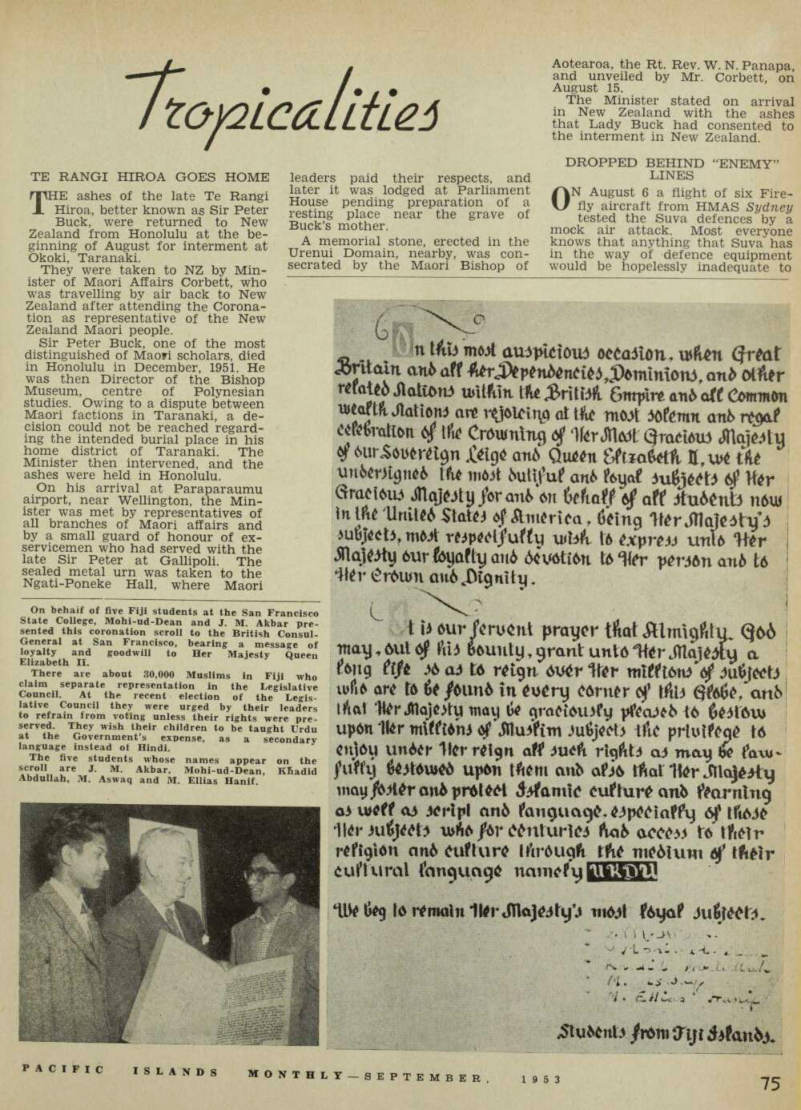
On behalf of five Fiji students at the San Francisco State College, Mohi-ud-Dean and J. M. Akbar pre sented this coronation scroll to the British Consul- General at San Francisco, bearing a message of loyalty and goodwill to Her Majesty Queen Elizabeth 11.
There are about 30,000 Muslims in Fiji who claim separate representation in the Legislative Council. At the recent election of the Legis lative Council they were urged by their leaders to refrain from voting unless their rights were pre served. They wish their children to be taught Urdu at the Government’s expense, as a secondary language instead of Hindi.
The five students whose names appear on the scroll are J. M. Akbar, Mohi-ud-Dean, Khadid Abdullah, M, Aswaq and M. Ellias Hanif.
meet the real thing—even from six Fireflies —but the “attack” was undoubtedly an interesting exercise for the local defence force, and an even more interesting way for Major Oliver Edwards of the Fiji Contingent to complete the home ward trip after attendance at the Coronation celebrations.
Sydney was bound from Honolulu to Auckland and made no call at Suva. Aircraft of the carrier landed at Canton Island to pick up details of the defence exercise, then, after the attack on Suva, six Fire flies landed at Nausori airfield. In one of the two-seater aircraft was Major Edwards as passenger.
Other members of the Fiji Coron ation contingent continued on to Auckland aboard HMAS Sydney.
Apia Starlet
IT was recently reported that Miss ’ Moira Macdonald, of Apia, who played an important part in the Return To Paradise film made in W. Samoa last year, was to study music in America.
In July, Miss Macdonald went to Suva at the invitation of J. Arthur Rank film representatives to discuss the possibility of her appearing in another film to be made in New Zealand, where she would play the part of a Maori girl.
If Miss Macdonald is accepted for the part her plans to visit America will be delayed.
Asininity Of P-Ng Law
“TT has come to my knowledge X that provocative action against natives is being used by Euro peans in Papua,” said the Port Moresby District Commissioner, Mr.
S. Elliott Smith, early in August.
He went on, sternly: “There is no circumstances, except in self-defence, where a European can strike a native. This kind of behaviour is dangerous.” He reminded employ ers that they are protected against disrespectful, insulting or abusive natives by the Native Labour Ord inance.
All of which makes about as much sense as the new Territories law which now allows an in dentured native to run away from his native labour contract, and suffer no punishment. The em ployer may have spent £lOO in in denturing and equipping the native, but he has no recourse whatever if the native clears out—except to proceed against him, in a proper and gentlemanly way, in a civil court. Also, if he is truculent and insolent while in his employment, he must not be touched; he must be taken to a civil court. Anyone who knows the Territories knows what this leads to.
It is impossible to handle natives in everyday activities in Papua-New Guinea unless the native knows that, if he is lacking in respect and
co-operation, he is liable to receive a sharp smack across the more sensitive end of his back. None knows this better than the experi enced official.
The law proverbially is an ass; but in Papua-New Guinea, since the introduction of the post-war anthropologic-sociology, it has taken unto itself a peculiar kind of asininity.—R.
Sandy Of Numa Numa Is The
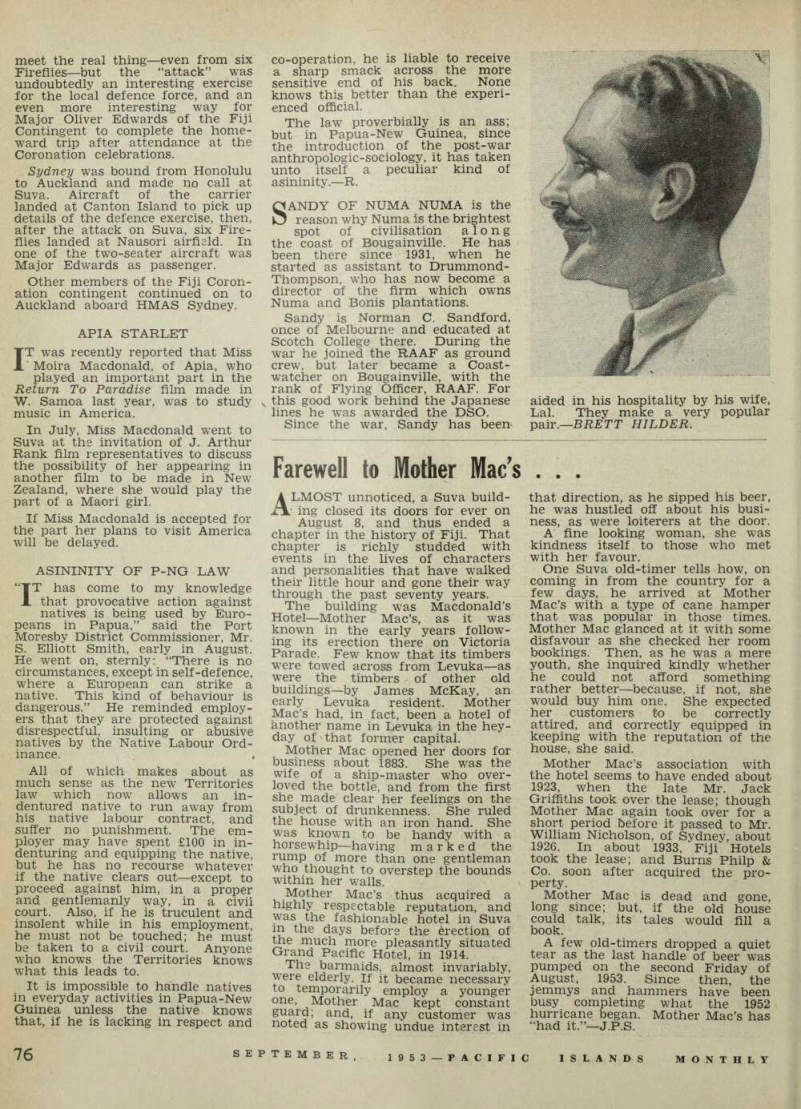
reason why Numa is the brightest spot of civilisation along the coast of Bougainville. He has been there since 1931, when he started as assistant to Drummond- Thompson, who has now become a director of the firm which owns Numa and Bonis plantations.
Sandy is Norman C. Sandford, once of Melbourne and educated at Scotch College there. During the war he joined the RAAF as ground crew, but later became a Coast watcher on Bougainville, with the rank of Flying Officer, RAAF. For this good work behind the Japanese lines he was awarded the DSO.
Since the war, Sandy has been
aided in his hospitality by his wife, Lai. They make a very popular
pair.