We Saw Wafer—But No Rice!
pp. 75-76 · Read in the full issue
Magazine Section
By R. W. Robson.
Forgetting, for the moment, her cares and worries as a man ager of Stewart’s new hotel at Lae (New Guinea), Miss Dorothy Stewart thumped the table and asserted: “Those lads trying to establish rice-growing out on the Markham should be helped. They believe in the country; they’ve got some land; they are sure they can make a do of rice. They work on the roads, or anywhere, to make money to keep their rice-farms- going. Why doesn’t the PIM give them some publicity?”
I said I’d gladly help the cause, and I was free Thursday afternoon.
Dorothy organised the expedition, and decided to come along, to give the rice-growers a Cheero call.
The area is 30 miles away up the swampy Markham valley; and the rain had been phenomenal. A transport manager said he would not hire a car—no chance of get ting through—it was a jeep job.
Our jeep, driven by a fretful and anxious little Papuan, probably is the honoured grandparent of a thousand New Guinea jeeps. It hurled rattles and squeaks at us, and menaced Miss Stewart’s comely face with a busted windscreen. But it bounded staunchly from rut to pothole, from boulder to puddle, and held together.
I’ve motored in greater comfort.
But I forgot my miseries while the tough expedition-leader told me stories of the track between Wau and Edie Creek in the early Morobe days, when jeep-travelling would have been regarded as luxury and decadence.
WE passed George Whittaker’s optimistic cocoa plantation, and Works and Housing’s pessimistic road down to Markham Point; and the old jeep maintained a really lively. 15 mph. Thick jungle came down to meet us on either side. I gazed at the tangled masses and
wondered how the Aussies ever got through there, to jump on the necks of the Japs at Lae. And then we reached a small river, rushing muddily across the road—either Munum or Yalu.
We learned later that an un marked track provided a slight de tour for jeeps and cars. But our driver followed the main motor truck route, straight into the river.
The jeep sank into a hole, lay wearily over, panted once or twice, and stopped. The driver carried Miss Stewart ashore and came back and gazed sadly at me. By this time the water was all over the jeep, and I was roosting on top, in an attempt to keep my clothes dry.
I had not had time even to remove my shoes.
The driver, half my weight, backed up. His Pidgin boggled at “pigaback," but I guessed what he meant.
I mounted, and the journey began.
The little man was walking among boulders, and stumbled horribly. I had a cruel vision.
Does anyone remember how Territories Minister “Eddie" Ward refused to be carried from a boat, and scrambled ashore all wet and bedraggled; and, publishing a photo graph of the official landing, I said the Minister arrived in New Guinea “like a sandboy catching worms"?
(Next Page)
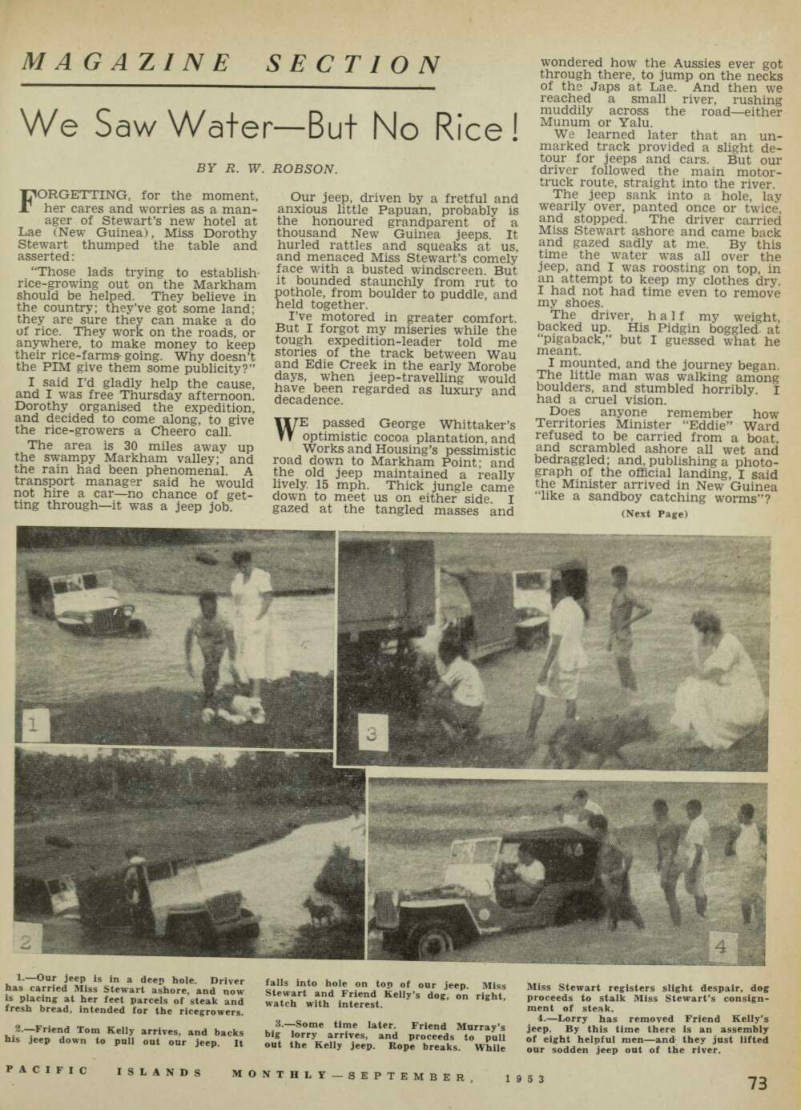
1.—O ur jeep is in a deep hole. Driver has carried Miss Stewart ashore, and now is placing at her feet parcels of steak and fresh bread, intended for the ricegrowers. 2 .— Fri end Tom Kelly arrives, and backs his jeep down to pull out our jeep. It
falls into hole on top of our jeep. Miss Stewart and Friend Kelly’s dog. on right, watch with interest. 3.—Some time later. Friend Murray’s big lorry arrives, and proceeds to pull out the Kelly jeep. Rope breaks. While
Miss Stewart registers slight despair, dog proceeds to stalk Miss Stewart’s consign ment of steak. 4.—Lorry has removed Friend Kelly’s jeep. By this time there is an assembly of eight helpful men—and they just lifted our sodden jeep out of the river.
As I awaited the apparently in evitable tumble into the mountain stream, I remembered “Eddie” and wished that I, too, had waded ashore.
But the muscular little man landed me, dryshod. Praise be, there was only one spectator; but the cynical Stewart mouth ex pressed what all of us were think ing.
Dorothy sent the harassed driver back to the jeep for a large food parcel—a gift she had prepared for her ricegrowers. “Well,” she said, as she regarded the now soaked provisions, “if we’ve got to spend a night in the jungle we shan’t starve. You smoke, don’t you?”
Wondering, I said I didn’t.
“Damn and blast you,” said Miss Stewart. “We’ve got no matches!”
The meat in the parcel was mostly raw steak!
NEITHER of us knew the terrain.
We asked the driver where the nearest habitation was. “Long way lik-lik,” said he; which meant that he had to travel a fair distance for help. He departed, running, and our prayers went with him.
Ten minutes later, another jeep came down the track, with our driver as grinning cargo. By the greatest luck, he had met Mr. Tom Kelly, Lae’s dairyman, returning home, with his young brother.
Tom turned his jeep around and backed down, intending to put a rope onto our jeep. Something went wrong. Tom’s jeep rolled right down into the river, and fell into the hole, partly on top of our jeep.
I asked Dorothy Stewart if she understood the words that Tom Kelly was using. Like a lady, she said she hadn’t heard. A Mel anesian came silently out of the bush, laid his jungle knife carefully on the bank, and waded in to help the party in the river.
The two jeeps seemed inextricably locked. Tom’s engine was almost clear of water, and functioning; but its wheels would not grip because its tail was atop our jeep’s bonnet.
Then Tom semi-dived, and miracul ously persuaded our jeep’s engine to mote, under water. I formed a new respect for jeeps. But all the rac ing of engines, and all the Kelly blasphemy, could produce only a vast shower of water.
The mid-river party was wet and weary, and the next move seemed obscure, when around the corner, coming up, appeared a huge red truck. It was driven by a lad from the Murray ranch, and it carried several labourers.
THOSE practical mid-New Guinea pioneers wasted no time. The truck hauled out Tom’s re calcitrant vehicle —and smashed up its one rope. They could not reach our jeep; so about eight men simply got around it, and lifted it out of the hole, and. it crawled ashore under its own water-logged engine.
The soaking Mr. Kelly worked patiently on our bedraggled jeep until it functioned, in a way; and then we turned around, and re luctantly left our ricegrowers to their fate, and headed for home.
Thenceforward, every half-mile, our jeep “conked”; whereupon Tom Kelly—tailing us like a guardian angel—would come forward, do sundry things calculated to make a jeep mote on a mixture of petrol and water, and get us going again.
Near Lae, we paused to do obeisance at the Kelly property.
There, he runs 80 fine Illawarras on a few hundred acres. It is a well managed, well-equipped place. Tom Kelly will succeed on his own merits. But, if there is any value in mental force, he will be helped by the good wishes of the travellers he rescued that day.
Stuttering and stumbling, the poor old jeep eventually reached home, and a tired little Papuan de livered us safely at the Stewart hotel.
That was how we failed to see the work of that young Australian ricegrow - 3. I hops they will take the will for the deed.