Mechanical Copra-Cutter
pp. 71-73 · Read in the full issue
Tahiti Resident Invents Mechanical Copra-Cutter
From Our Own Correspondent SUVA, August 10.
Monsieur henri d. rey, the French-Tahitian inventor of what is known as the Rey coconut splitting and extracting machine, spent several days in Suva in early August before continuing on to Burbank, California, by air, to set the production wheels in motion.
Planters in Tahiti who have seen the prototype machine at work are convinced of its effectiveness, and have placed firm orders for 100 machines for that island alone. M.
Rey will spend some months in California with the manufacturers, then will return to Fiji to make a tpur of demonstration, and later visit all major copra producing areas in the South Pacific on a similar project. Burns Philp will be South Pacific agents for the machine.
Its functions are to cleanly split coconuts longitudinally into two halves in the first operation, then to rapidly gouge the flesh from the shell in a second operation. The two operations can be performed simultaneously by two operators, or by one man doing the two jobs suc cessively.
An unskilled operator can put through 5,000 nuts per 8-hours day a o fast-working operator upwards of 8,000 nuts.
The machine occupies a floor space of about 4 ft by 2 ft and stands about 8 ft high overall. It is made almost entirely of simple angle-iron materials, bolted
together, and power is supplied by a one-horse-power motor of any type.
The experimental models use a standard American home-generator type of petrol motor. Fitted with this, the total weight is 290 lbs, and the cost, f.o.b. Burbank, will be $2BO for the complete machine.
The splitting is done by a simple type of guillotine which is hoisted to the upper extremity of its guide rails by a clutch-operated windlass and flexible steel cable. The nuts are simply pushed between the sprung sides of a v-shaped cradle, one after the other, a hand-lever pulled, and the guillotine flies up and falls, cleanly splitting the nut without causing any fragmentation of the shell.
With this machine, the water from the nuts, rich in food value, is not wasted. It runs into a bucket below the machine and the 70-80 gallons per ton of nuts, lost by normal axe-splitting methods, is saved for pig-rearing purposes.
The gouging device in the model illustrated is directly coupled to the shaft of the motor, but, as the splitting operation is about four times as fast as the gouging, an other model will be available with four gouging heads operated from counter-shafts.
The action of pressing the flesh of the nut against the gouging tool sets the tool in vibration like a pneumatic drill, and, with very little
practice, the flesh is cleanly re moved from the shell with a few twists of the half-nut.
M. Rey has spent two years of full-time work and about $lO,OOO in cash to develop the machine to its present efficient form. He holds patent rights, on it throughout the world.
M. J. MILLAUD, representative of Tahiti at the last South Pacific Research Council meeting at Noumea, showed photos of the machine to the delegates present.
M. Rey is convinced that as soon as the copra-growers in Fiji and New Guinea have seen the machine in operation they will be com pletely converted to this modern method of cleanly, quickly and efficiently preparing their copra for drying.
After the cutter and gouger is safely launched, its inventor thinks that he will turn his attention to modern and efficient methods of extracting the oil from the copra by simple means, right on the plantation, thus eliminating the present unecopomic system of ship ping cdpra from one end of the earth to the other.
M. Re^ i! said that for some essential experimental work at Burbank he was paying $1 each for Hawaiian coconuts —by the time they had been fumigated and landed at the works there, that was what they cost!
Coconut-Shell Buttons
While in Suva, Mr. Rey showed the PIM representative samples of buttons currently being manu factured from coconut shell by a factory in Honolulu. The factory is owned by Mr. John H. Wilson, Mayor of Honolulu.
Mr. Rey says that there is a con siderable market in the States for these cheaply-made buttons, which are cut to various diameters by machinery. They appear suitable for either men’s or women’s clothing.
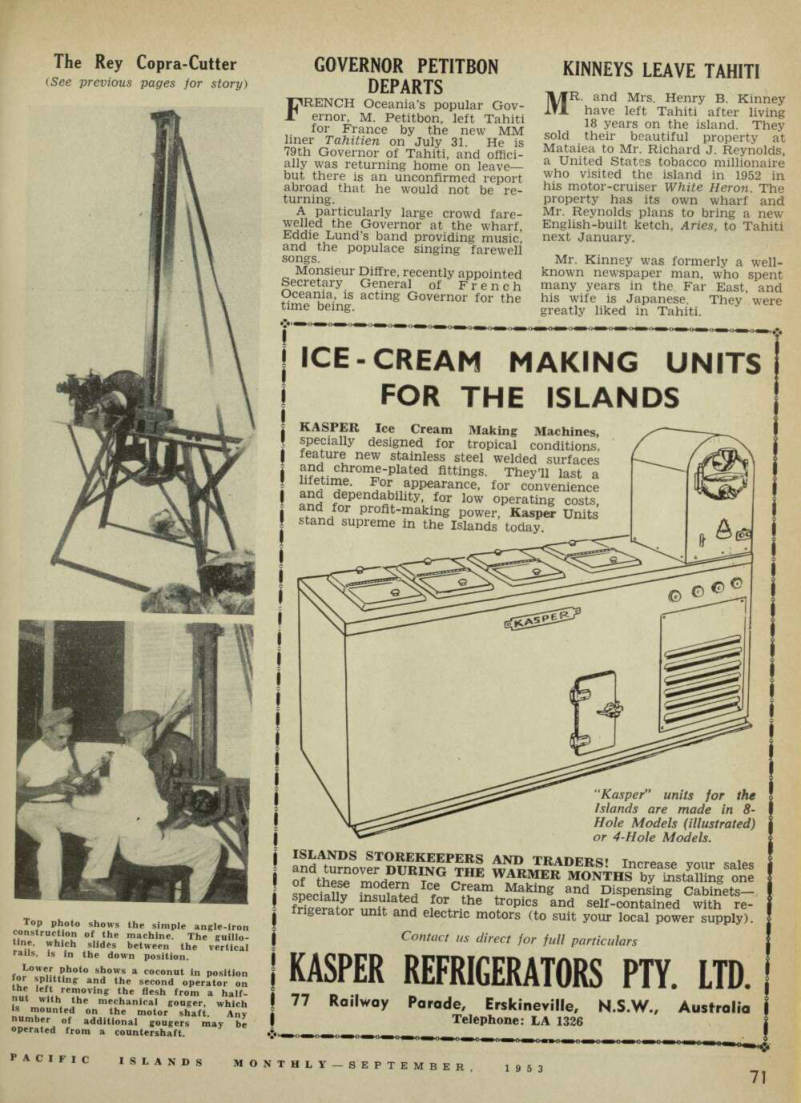
(.Photographs of copra-cutter opposite.)
Top photo shows the simple angle-iron construction of the machine. The guillo tine. which slides between the vertical rails, is in the down position.
Lower P hoto shows a co conut in position fo r and the second operator on the left removing the flesh from a half nut with the mechanical gouger, which is mounted on the motor shaft. Any Number of additional gougers may be operated from a countershaft.