Literacy
p. 56 · Read in the full issue
In Fiji
Angles of Racial Problem
From Our Own Correspondent SUVA, August 10.
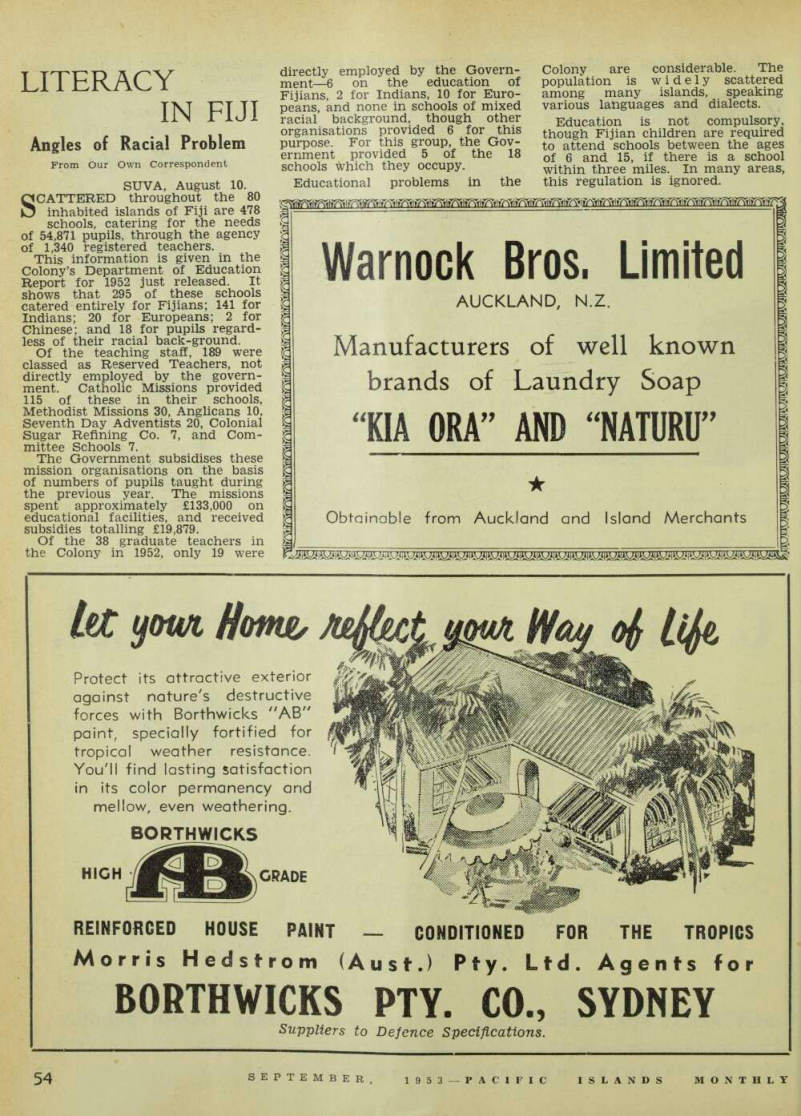
SCATTERED throughout the 80 inhabited islands of Fiji are 478 schools, catering for the needs of 54,871 pupils, through the agency of 1,340 registered teachers.
This information is given in the Colony’s Department of Education Report for 1952 just released. It shows that 295 of these schools catered entirely for Fijians; 141 for Indians: 20 for Europeans; 2 for Chinese; and 18 for pupils regard less of their racial back-ground.
Of the teaching staff, 189 were classed as Reserved Teachers, not directly employed by the govern ment. Catholic Missions provided 115 of these in their schools, Methodist Missions 30, Anglicans 10, Seventh Day Adventists 20, Colonial Sugar Refining Co. 7, and Com mittee Schools 7.
The Government subsidises these mission organisations on the basis of numbers of pupils taught during the previous year. The missions spent approximately £133,000 on educational facilities, and received subsidies totalling £19,879.
Of the 38 graduate teachers in the Colony in 1952, only 19 were
directly employed by the Government—6 on the education of Fijians, 2 for Indians, 10 for Europeans, and none in schools of mixed racial background, though other organisations provided 6 for this purpose. For this group, the Government provided 5 of the 18 schools which they occupy.
Educational problems in the
Colony are considerable. The population is widely scattered among many islands, speaking various languages and dialects.
Education is not compulsory, though Fijian children are required to attend schools between the ages of 6 and 15 if there is a school within three miles. In many areas, this regulation is ignored.