“New Australian” Cedar for the Islands
p. 38 · Read in the full issue
Extensive cultivation of the useful and beautiful Cedar tree, Cedrela Odorata, is now being introduced, or considered for Introduction, in all tropical and sub-tropical parts of the world, and it appears to be quite suitable for the South Pacific Territories.
The trees need rain and humid air, and grow best on naturally drained slopes, intermingled with other vegetation. They do not thrive in swampy or sour ground, nor do they like long spefls of drought or hot, dry winds. They are easy to handle in nurseries.
According to climate and soil, Cedrela Odorata, M.A.S. 13012, (known by the trade name of “Cedro”) is mature within 18 or 25 years, but can be used profitably for many purposes long before.
These Cedars are leafy, not coni ferous, and give excellent shade.
They are related to the Australian red Cedars (Cedrela Toona), but grow much faster. It has been proved in Ecuador that Cedrela Odorata, M.A.S. 13012, are not at tacked by the Cedar twig borer— they are pest and vermin proof.
The growing tree has a bitter sap that seems to be poison for vermin and borers. It exudes a gum simi lar to gum arabic, and has a typi cal Cedar smell.
One of the world’s quickest growing timber trees, it develops a strong root system whi«h makes it resistant against hurricanes.
Besides being used for furniture, boats, small sailing ships, veneer
and building boards, etc., this “New Australian” Cedar (which origin ated in Cuba) is good for paper pulp.
For centuries the wood has been used for cigar boxes, and for making pencils. The roots provide excellent furniture timber. Rather soft and light, the wood is easy to work, turn or bend; has a reddish tint; and takes a fine finish.
About 25 years ago, the late Frederico von Buchwald took some Cedrela Odorata seed from Cuba to Ecuador and planted them in the large experimental La Mina estate, owned by Dr. Pedro Holst, of Guayaquil (Ecuador). Among over 30 more or less different varieties of this species, the strain taken to Ecuador proved to be ex cellent. and it was admitted.to the international register of trees in Washington, U.S.A., under the number “M.A.S. 13012,” which is a safeguard for growers.
Dr. Pedro Holst, Danish by birth, is Royal Danish Consul, estate owner and manufacturer in a large way. Ecuador has bestowed many honours on him for his contribu tions towards afforestation in the Republic with Cedros M.A.S. 13012.
Under the style of Cedar Planta tion Co-operation, Dr. Holst is co operating with Mr. N. F. O. Stevns. of Stevns & Company, 40 Third Avenue, Epping, N.S.W., Australia, for the propogation of this useful tree. Free seed for experimental purposes is liberally distributed, and enquiries are solicited from all in terested parties. I ***
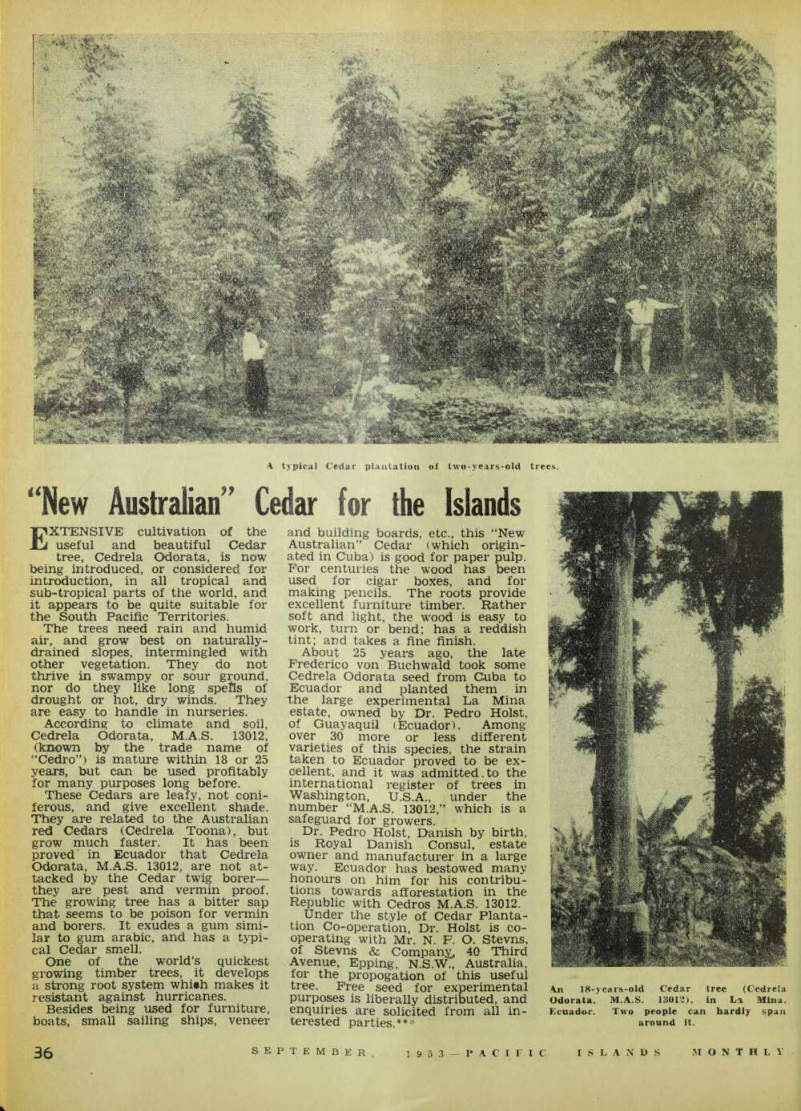
A typical Cedar plantation of two-years-old trees.
An 18-years-old Cedar tree (Cedrela Odorata, M.A.S. 13012), in La Mina.
Ecuador. Two people can hardly span around it.