Guinea
p. 23 · Read in the full issue
[?]roducing Tea in New Guinea Many Problems to be Solved Yet
N OVERSEAS tea expert who i visited Papua-New Guinea at the invitation of the Australian □vernment some months ago has [bmitted his report to the Min cer for Territories.
The expert reports—as most iople in New Guinea are already vare—that many parts af the srritory are suitable for tea culti ition.
Best quality tea could be grown Highland areas over 4,000 feet, ) says; but higher yields would be Gained from tea planted at lower titudes. . .
The expert said (and this is also 31l known in NG) that labour and mmunications are the two main •awbacks to the successful com ercial establishment of tea grow g in the Territory.
At present tea is being grown ccessfully in a comparatively small ly by a few individuals in upland eas of NG. The Department of jriculture has a tea experimental ation at Garaina, Eastern High nds, at about 3,000 feet, where, >art from the research side of the isiness, seed is produced for future
mmercial plantings—tea-seed is,
course, a prohibited export from esent tea-producing countries.
Tea plantations are by 0 means as easy to estab sh as coffee or cocoa. The ia grows easily enough, at the factory processes ad the blending that jme after are something lat has taken India and eylon and other tea roducing countries years > perfect.
Trained native labour >r tea picking will prob bly never be as good as milar labour in India and eylon where generations 1 these people have lived a the tea estates. But ;a-picking can now be ane by mechanical means -small contrivances which re slung around the neck m be worked by un billed labour.
It is understood that here mechanical pickers re used, the tea bushes re pruned severely into sort of hedge. When the aung shoots grow out ley are all about the ime length and it is com iratively easy to run the tachines, which work imething like hair-clip jrs, over them. Mech aical picking is much licker than hand picking
and this factor might do something to cancel out the scarcity of good labour in NG.
After picking, the tea leaves must be fermented, dried and rolled.
Europeans who have tried NG grown tea are divided in their opinion about it; some say they do not like the flavour (although this is probably only a matter of blend ing), while others are enthusiastic about it.
Transport, however will be as big a problem to overcome as labour.
As yet the only roads that exist in the areas suitable for growing tea are jeep tracks and there is no road between the sea-ports and the Highlands. Even under the happiest circumstances, it is un likely that roads capable of carry ing heavy freight between tea plantations and sea-port will exist for many years. Therefore, air transport will continue to be a factor in the cost of production.
There is no doubt that tea, and good tea, can be grown in parts of the PNG Territory. However, PNG with its inefficient native labour has not yet been able to com pete on a cost for cost basis with countries like Indian. Malaya, Ceylon or Indonesia in any product the latter produce. Therefore, the mere fact that tea will grow in the Territory is only the beginning of establishing it as a flourishing in
dupfry.
Australians consume 62 pounds of tea per head per annum which puts them amongst the top-rank ing tea drinkers of the world. The
price paid by Australians for their imported tea is about the lowest in the world, due to the heavy subsidy paid on it by the Commonwealth Government. But there is no doubt that New Guinea could supply Aus tralia with its tea —when all the problems of labour, production, transport, prejudice and price are overcome.
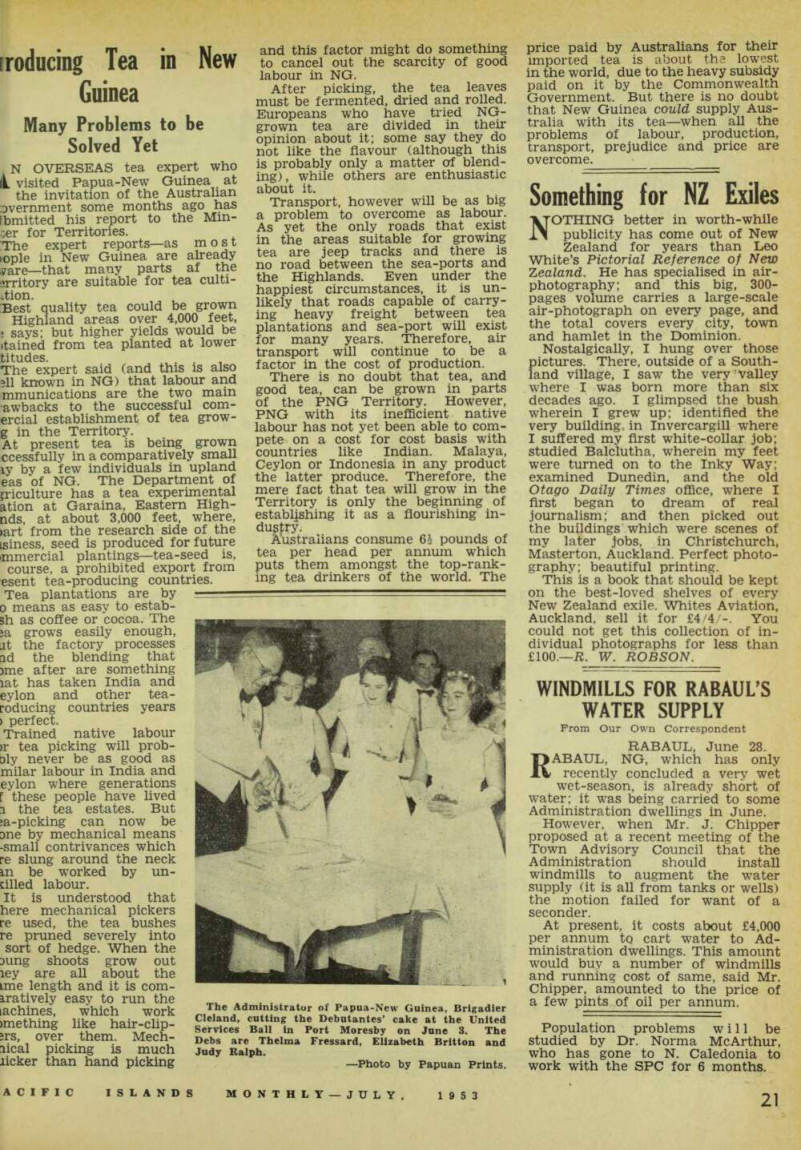
The Administrator of Papua-New Guinea, Brigadier Cleland, cutting the Debutantes’ cake at the United Services Ball in Port Moresby on June 3. The Debs are Thelma Fressard, Elizabeth Britton and Judy Ralph.
Photo by Papuan Prints.