Kenaf To-Day And, Perhaps,
pp. 108-113 · Read in the full issue


To-Aiorrow
Survey of the Industry in Papua and New Guinea
THREE viewpoints about kenaf as a commercial proposition in Papua-New Guinea: Rabaul— no darned good. Markham Valley cautious. Port Moresby.— enthusi astic.
Among individual Territorians the viewpoints do not stop at three, of course. But the above are interest ing, if only because they are sectional.
At Kerevat Experimental Station, about 30 miles from Rabaul, they will wave their arms vaguely at some forlorn looking scrub grow ing in a paddock and say that kenaf. has already served its purpose, any way, in that the price of jute has fallen by half since kenaf came into the picture, and bags and sacks to almost one-third.
Kerevat, of course, is devoted almost 100 per cent, to the cult of cocoa. Little else interests them — one reason being that cocoa is suit able to local soil conditions. The Gazelle Peninsula is basically pumice, with an unfortunate tend ency to float off in heavy rain.
Annual cropping, or any agriculture that requires t.he continual disturb ance of the soil, is therefore regarded as suspect as it is believed that this
will lead to widespread erosion.
Cocoa trees growing in quiet shade,
dropping their leaves to the fores! floor to make, eventually, a layer of leaf-mould provide the ideal crop for the locality.
AT Bubia Experiment Station]
about seven miles up the Mark ham Valley from Lae, a coni siderable amount of experimental work with kenaf has been under
jiken. With jute at £9O per ton, t 3 it was in April, it was believed nere that kenaf could probably ompete if the industry were fully Mechanised. If the kenaf was to « retted to extract the fibre (that soaked for long periods in ponds t troughs) then the cost would .robably be three times as much — :ut vetted fibre, Bubia is inclined o believe, was more durable than ne decorticated fibre, and possibly acre suitable for a few commercial urposes.
It is believed there, too, that for maximum fibre strength with maxi mum fibre content, the ideal grow ig period in the Markham Valley about 135 days—this in com arison with the original conten :on around Port Moresby that the •op was ready for cutting in from to 90 days. However, as the :sidue of gums in the decorticated lore is greater with older kenaf, •me modification of Bubia’s ideas . this direction may be necssary.
Manila Hemp
Agricultural officers at Bubia are enthusiastic about the possibilities 0 f ma nila hemp, of which they have a t present about 8,000 young plants grown from seed.
Manila hemp is a species of banana; it bears hard, woody fruit which, unlike the commercial banana, still contains seeds. At maturity, the steam of the plant is about 12 feet high and it is from this that the fibre comes. The stem is cut i n t Q three segments and the fibre stripped from this—the best fibre coming from the inside of the segment, and falling in quality to wards the outside.
Experiments in manila hemp were undertaken by the New Guinea De partment of Agriculture before the war, with stock grown from im ported suckers. However, the disease, bunchy top, had been imported with the suckers although it did not show itself in active form and after the war, manila hemp plants which
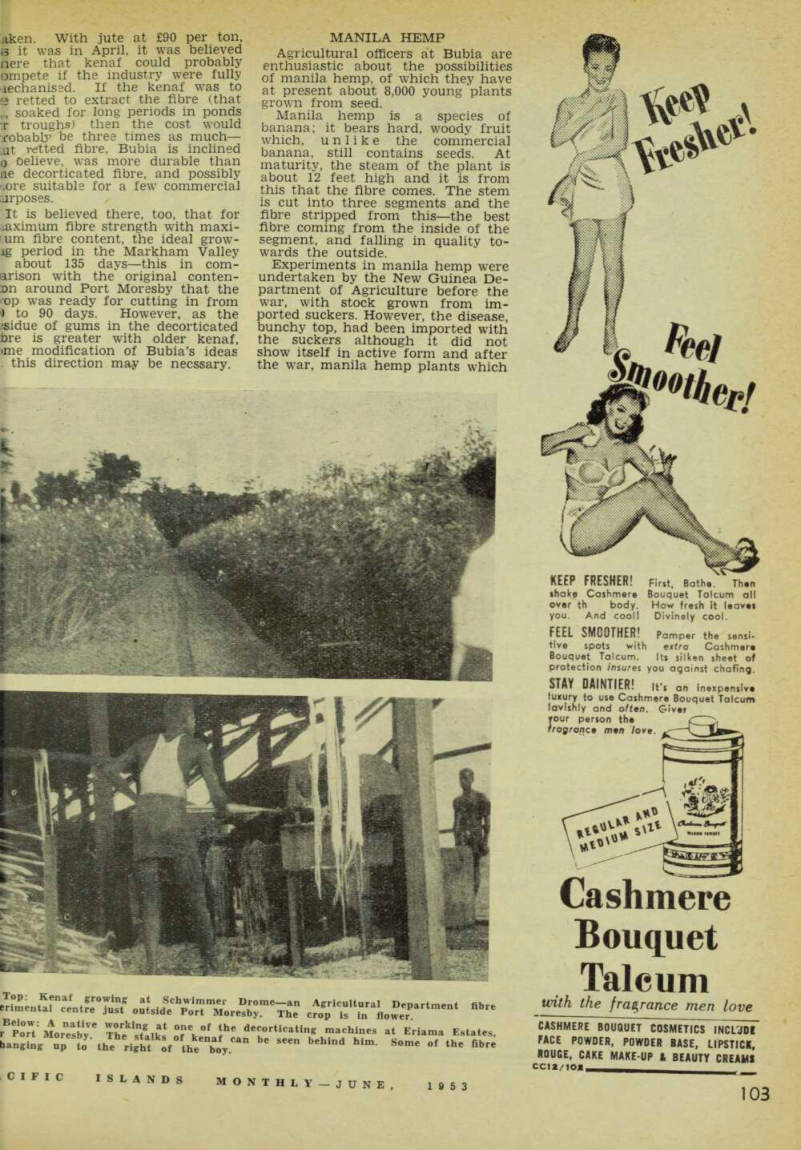
Top: Kenaf growing at Schwimmer Drome-an Agricultural Department fibre [?]erimental centre just outside Port Moresby. The crop is in flower.
Below: A native working at one of the decortixating machines at Eraima Estates, hanging up t othe right of the boy.
)d survived the blitz showed mptoms of it, although they were rmant or suppressed. Rather than >k native food bananas, the whole were cut out and destroyed. (New :iinea is one of the few countries the world free of bunchy-top— 'nee the notable lack <jf en " nsiasm for importing improved •rieties of bananas from over *s).
Some of the seeds of manila hemp ?re saved and as these do not msmit the disease, present young :ck was grown from these. As :ck grown from seed does not »;ed true, it will take some years breeding and selection before a »d type can be stabilised.
Vhen and if this does happen, w Guinea will probably have the ;y disease-free manila hemp in * world.
The growing and processing of nila-hemp is believed to be much ire suitable for village industry -n is kenaf.
Kenaf In Papua
JT it is just outside Port Moresby that one sees kenaf growing in large stands; it is round here, Eriama Estates (previously a ai owned by Mrs. Ruth Sefton). jre it is being worked on a small t testing scale, the fibre extracted I packed into bales and shipped Australia; and it is in this area t you find, in spite of the in try’s teething troubles and active ipetition from jute, faith in the ire of the product, rowing, kenaf is an unspec ilar crop. It is sown closely and stalks grow up straight to a ;ht of nine to 11 feet. It a white nondescript flower with ;d centre—more like a hollyhock r er than a hibiscus, to which ily it belongs. leally, it is harvested mechanic by a machine similar to that vn on page 107, which throws a bundle of stalks about a foot k. neatly tied with string, lally the area to be harvested prayed a few days beforehand i a defoliator—this makes the r ester’s work easier and does not lage the stalk or fibre), le kenaf is then ready for the
decorticator. At Eriama Estates there is a battery of six or eight of these small double machines
shown in the illustration. Two natives work at each, feeding in the stalks of kenaf, three or four at a
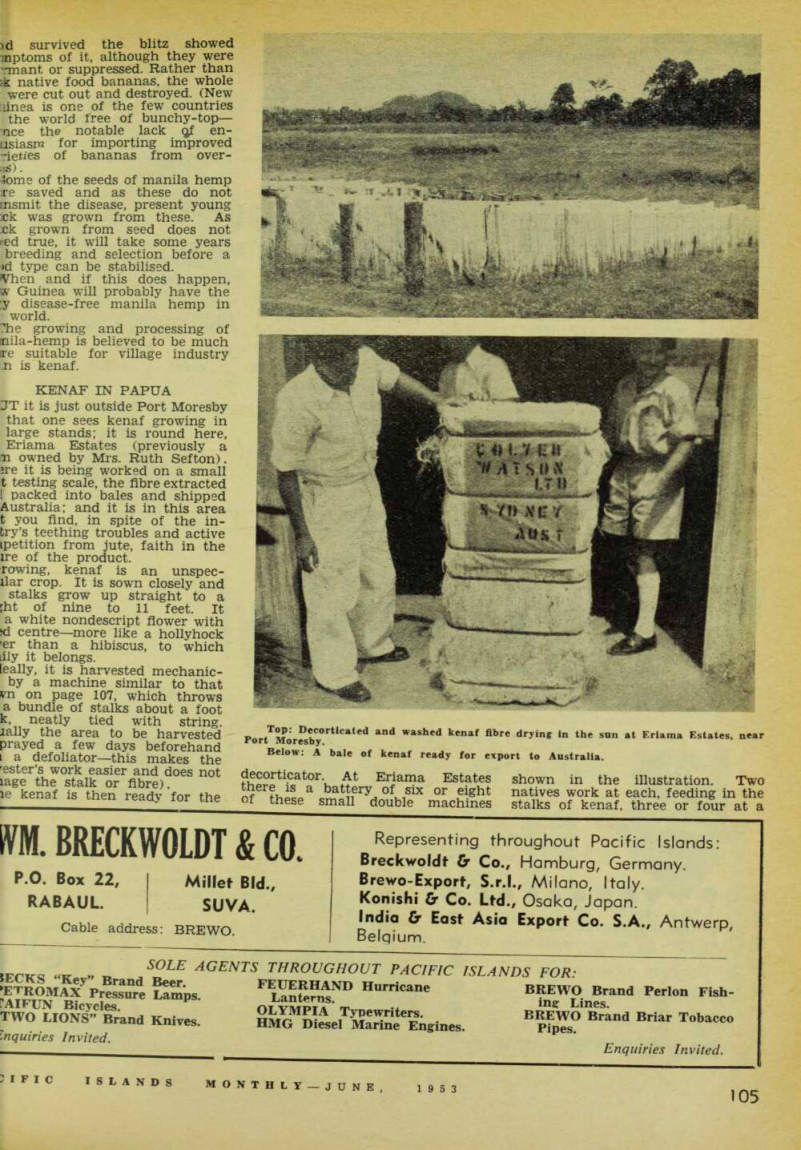
Top: Decortixated and washed kenaf fibre in the sun at Eriama Estates, near Port Moresby.
Below: A bale of kenaf ready for export to Australia.
time, between the corrugated steel rollers They do not let the stalks go right through the machine but pull it back and forth against tne pressure of the rollers until all the ■outside matter is removed and there remains a handful of long fibres— several strands of the freshly de corticated fibre can be seen hang ing up near the operator in one of the pictures herewith.
The fibre is then washed, hung out on wires in the sun to dry (see photo) and then pressed into bales for shipment. Some bundles of the dried fibre are harsher to the touch than others, due to the presence of gum, etc., which has not been adequately washed out. This may be one aspect in which the jute of Pakistan is superior to Papuan kenaf—due to the more thorough washing methods of the Pakistani women in comparison with those of the Papuan workers. Before manufacture into sacking, etc., the kenaf fibres are softened with oil.
A very large decorticating machine is now on order from overseas for Eriama Estates; as well as extract ing the fibre, it will give it its preliminary washing.
Behind the drying kenaf in one of these photos, can be seen stands of kenaf—this will not be harvested as the present battery of de corticators cannot cope with all the kenaf that has been grown this year on Eriama.
IN recent months, a lease of 15,000 acres has been granted to Eriama Estates in the Oro Bay area of Papua and it was announced about the same time, by the Common wealth Government, that some hundreds of thousands of Govern ment money would be spent in opening up the area by providing
access road, bridges, and port facill ities at Oro Bay.
Government help also includes provision of technical aid to growl ers, agricultural research, making land available and providing plant! ing material.
At the end of May, Eriama (Holdiiags) Ltd. was registered in
'dney as a public company, its ijects being to grow, decorticate id process kenaf in New Guinea id elsewhere. The nominal capital the company is £1,000,000 in £1 ares but initial issue is £200,000, e shares being restricted to cer in individuals and interests. Offers om the public are not being scepted.
Mr. R. A. Colyer, of Colyer Wat n (NG) Ltd., has been interested the kenaf experiment since its ception. The new company, has, well, the backing of a strong oup of leading Australian indus al and pastoral companies.
Kenaf, in short, is receiving more eking from Government and from I money interests than any other :w Guinea industry, new or old. >on this, therefore, is based the rrent Port Moresby man-in-the ■eet’s opinion that kenaf is a 3od thing.” With these interests idly behind it, he says, then Piously the industry must suc ed. ft has been proved that kenaf re is just as suitable as jute for i production of wool packs, wheat gs, sugar bags, copra sacks and lilar containers. Twine and ing can also be made from it. can be woven on machines eady existing in Australia for jute )ducts. Little if any adjustment these machines is necessary.
Phe strength of the decorticated re from the 1952-53 crop is well >ve that of high-grade retted jute. ( NLY cloud on the kenaf horizon is the obvious one—competition from jute. To date, production Papua and New Guinea has been le more than small-scale experi ntation from which it has been luced that, on present prices, jute
has the edge on kenaf. When, how ever, large-scale completely mech anised commercial production is in full swing in the Territory the cost of production of kenaf could equal or be less than jute.
But competition from jute should not be underestimated. Jute is the economic life-blood of Pakistan and to only a lesser degree, of India.
These countries will fight savagely to preserve their valuable markets in Australia, which is also the legitimate outlet for P-NG kenaf products. Nor, in this present-day world of involved trade pacts, over seas markets and economic dealings as between country and country, will the fact that P-NG is Aus tralian territory entirely temper the wind in home-produced kenaf’s favour.
P-NG kenaf is a valuable insur
ance against the type of bush ranging that took place in the jute industry in recent years and, as such, is worthy of Government encouragement and protection. Be yond this point of insurance, how ever, Australia’s valuable trade with India and Pakistan becomes a factor and from thereon kenaf must stand on its own economic feet. It is obvious that Eriama Estates feels that this it can do.
It was generally understood that Paul Gauguin, famous French painter, who died in Tahiti exactly 50 years ago, left no part-Tahitian children. Recently, however, a 60years-old man of Paea said that he was Gauguin’s son, and he has made formal claim to some portion of the fortune realised by Gauguin’s paint ings.
This is one of 25 kenaf harvesters made the United States during the war by [?]e combined efforts of International harvester and John Deere. Drawn by a attractor it cuts the kenaf, and ejects it atiy tied into bundles about a foot ick.