Two Governors
pp. 77-78 · Read in the full issue
The O’Keefe Story:
Mapia-Another Page
From John Riedel , of Washing ton, DC, whose inquiry set off the voluminous story of Mapia Island a year ago, comes, very briefly, the war-time story of the island as he knows it.
A large number of Japanese Marines from Palau had taken the islands, and were well entrenched on Bras and Pegun islets (see map September, 1952, p. 69). I arrived several days after an American in fantry unit had landed, taken the islands, and left.
We were told that 25 to 30 Americans had been killed. We found that the Brown house had been demolished by Air Force bomb ing and Navy gunfire. About the only identifiable object was the re mains of a piano. But there were 20 to 30 natives still there, some from New Guinea. One old gentle man who seemed to be a leader spoke English well and said he came from Yap and that he had been a cabin-boy on an American vessel.
We camped on the north tip of Pegun islet and established a Loran station —a weather reporting station of which I was in charge—and a communications station. In all, about 25 men were stationed there after the initial occupation. There was no airfield at Mapia. (The Loran station —Loran stands for “long range navigation”—was one of a Pacific network employed in a system of radio navigation estab lished during the war. All except a chain across the North Pacific have since been dismantled.)
Tragic State Of O’Keefe
Ladies
WITH Hollywood probably on the verge of a rich financial
harvest from the about-to-be released “His Majesty O’Keefe,” it is of interest, if sad, to hear that two of “His Majesty’s” nearest sur viving descendants are to-day liv ing in very poor circumstances, almost on the charity of the Dutch authorities, in a quonset hut on Biak Island, Dutch New Guinea.
They are Mrs. Eugenia Scott, closest living descendant of the O’Keefe Yap family (heard of most in the film) and Mrs. Janie S.
Brown, head of the Mapia branch —both grand-daughters of O’Keefe.
With the O’Keefe Yap interests disbanded long since, Mrs. Scott had been living with Mrs. Brown on the Mapia Island property when World War II came—destroying all.
After the war, the O’Keefe descendants endeavoured to obtain financial indemnity from the Ameri can Army authorities, as all damage had been caused by American forces in reclaiming the island from the Japanese. They were given a sympa thetic hearing, but as the territory was Dutch, no financial recompense.
The matter was then taken up with the Dutch authorities but they, too, are not prepared to pay war damage.
So to-day Mrs. Brown and Mrs.
Scott, now ageing, their former home gone, and with insufficient financial backing to re-establish the plantation, live in very poor circum stances on Biak.
Mrs. Brown recently stated that though she had heard that a film was to be made on the life of O’Keefe she knew nothing of the book by the American authors, Klingman and Green, and—most surprisingly—she had never been approached by the authors for any information on the life of O’Keefe, The book, in fact, as mentioned in PIM (Sept., 1952) makes only the barest mention of Mapia, which in
(Continued on Next Page)
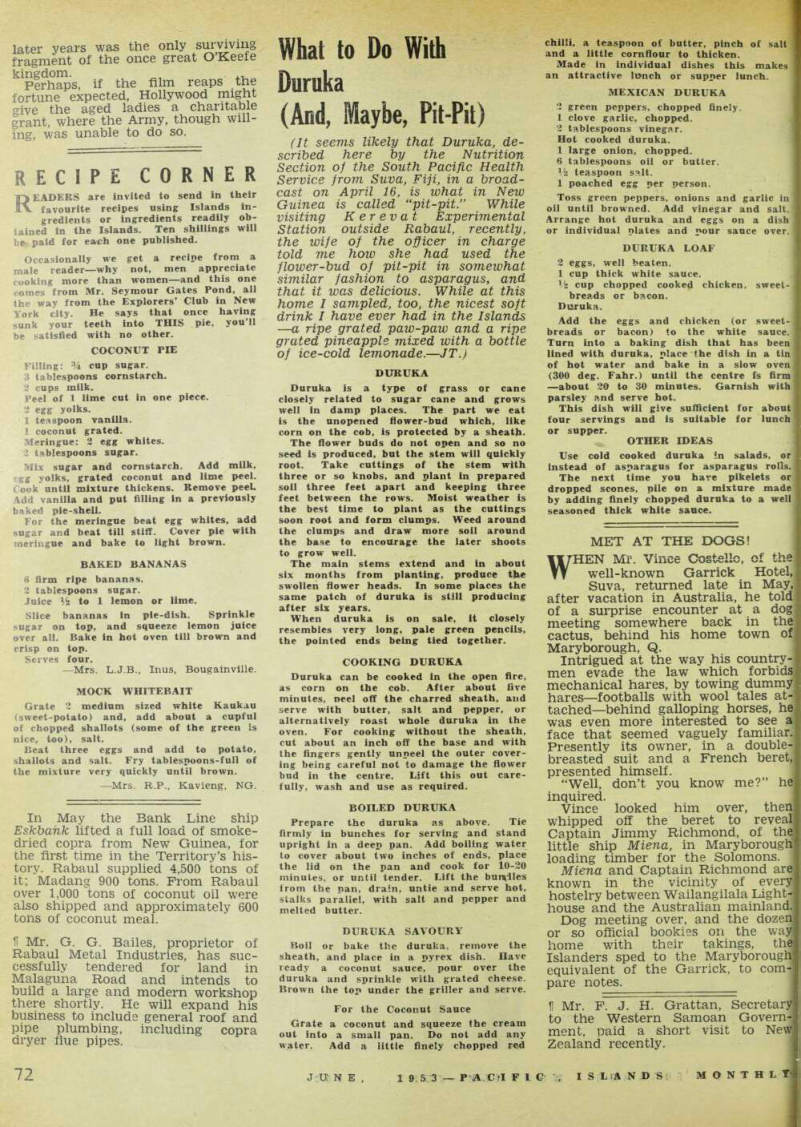
Two Governors
(At right) The new Governor of Dutch New uinea, Dr. J. van Baal, entering s official residence shortly after s arrival in Hollandia. —Photo by van Leuven.
The new Governor of Eastern [?]moa, Mr. Lawrence Judd, in Pago [?]go, accepting the oath of office as ministered by Mr. Justice Morrow. [?]. Judd was formerly Governor Hawaii. —Photo by A. Vercoe.
later years was the only surviving fragment of the once great O Keefe kingdom. „ Perhaps, if the film reaps the fortune expected, Hollywood might srive the aged ladies a charitable grant, where the Army, though will ing, was unable to do so.