Lake Wisdom Eruption
pp. 59-61 · Read in the full issue

k LTHOUGH the rest of the world 1. knew that there had been an eruption on Long Island Cbeveen the New Guinea mainland >ast, at Saidor, and the western tip : New Britain), the 370 natives who yed there did not know of it until xe evacuation ships arrived to take lem away a few days later.
The eruption occurred (and the
cone continues to erupt) in Lake wisdom, a crater lake maybe seven miles by seven miles in the centre of the 12-by-19 miles island. The lake is surrounded by hills, one of which is 1,000 feet high, and none of which is less than 500. The two main villages, and a small break away group, were situated on the foreshores of the island and well out of sight of the lake—which
accounts for the fact that they did not know of the eruption.
The history of Long Island fol lows a familiar pattern—the story of a marine volcano that eventually formed an island, then resumed volcanic activity towards the end of last century, culminating in a
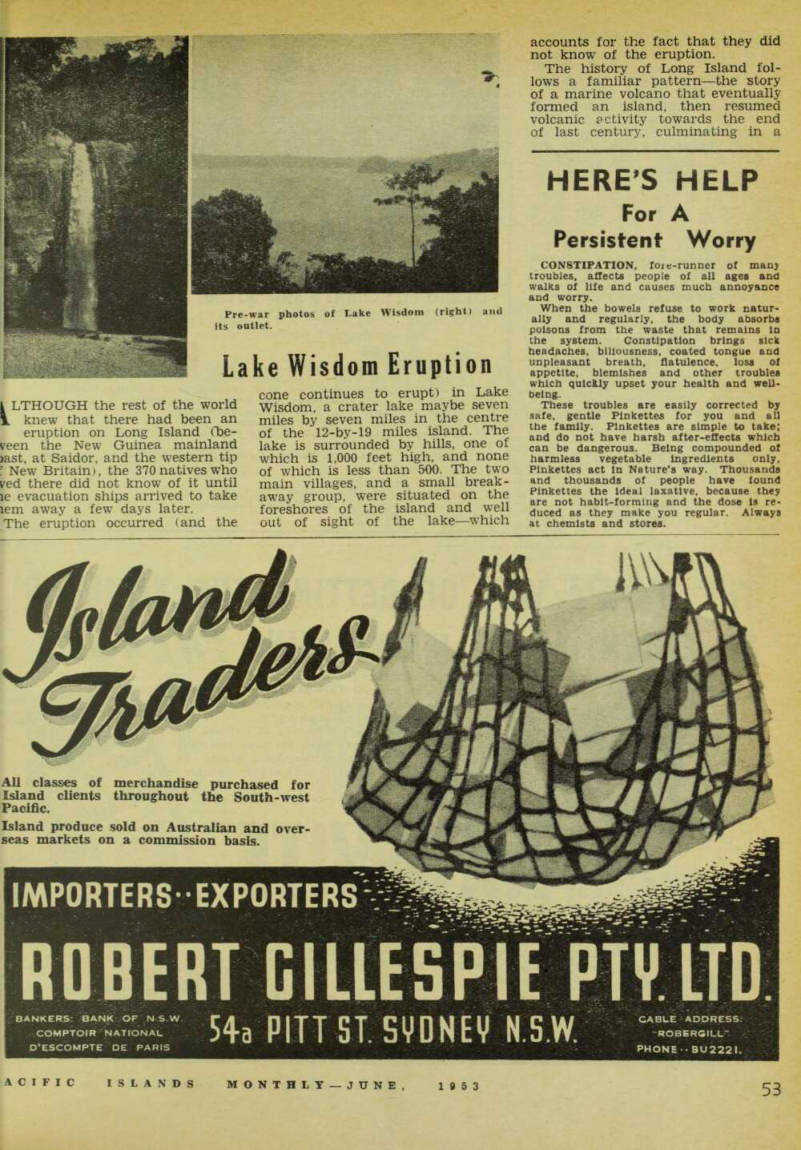
Pre-war photos of Lake Wisdom (right) and its outlet.
tremendous eruption which blew out the centre of the island and formed the crater lake, subsequently called Lake Wisdom (after a former NG Administrator of that name?) Native legend is to the effect that there were warnings of an impend ing disturbance then and most of the inhabitants who lived there got away to the mainland before it blew up. The island remained un inhabited for many years, but be tween 1920 and 1928 a few returned and it was these people and their descendants who were evacuated in May.
The present volcano, when in spected on May 11, was of no great size—a horseshoe shape, with the lake waters lapping into the open side, and about 100 feet high. Steam clouds rose to normal cloud level and eruptions of pumice and rock fragments were being thrown two or three hundred feet. This is not the first cone that has erupted in the lake —a small one was sighted and photographed during the Pacific War, but it was not visible when inspected by a vulcanologist last year.
On May 10, the day after the eruption was reported by a pilot of Qantas Empire Airways, the Madang District Commissioner. Mr.
C. D. Bates, flew over the volcano and that night had coastal ships moving to the island to evacuate the natives.
A government party consisting of the Administration’s senior geolo gist and the Acting Director Dis trict Services, flew from Moresby on May 11 and, with Mr. Bates, that day made another inspection. The party, with Mr. J. Best, Rabaul vulcanologist, made a final inspec tion on May 12.
THE natives apparently did not mind leaving the area and it has been suggested that the Administration acquire land for them near Saidor, on the mainland coast, where they can settle per manently. Although they have lived on Long Island for many years they are apparently not a seafaring
neople—and they seem to have, in ► ddition, a healthy respect for mlcanoes.
Vulcanologists have for many tionths been keeping a close check in Umboi Island, which is in the ame area as Long Island. Thermal ;prings on Umboi have been show ig signs of great activity and it vas thought that these could cul :iinate in a volcanic disturbance Ibout March 1953.
Long is a very big island, and Mr. iKarkar” Schmidt (now living in atirement at Gosford, NSW), says here is good cocoa land there. He ved for years on neighbouring larkar Island, and knows Long sland well.