The Indian Claim To A
pp. 48-101 · Read in the full issue

Home In Fiji
Suva Merchant Argues that Inter-Racial Harmony is Possible
Written for Pacific Islands Monthly by SHANKAR PRATAP
rr\HE article entitled, “Some Brutal 1 Facts about the Indian situa tion in Fiji and Elsewhere,” in the December issue of Pacific Islands Monthly casts an unmerited slur, not only upon Indians who have made their permanent homes in Fiji, but upon the continent of India. There is much that is ex aggerated and misleading. Mr.
Robson makes many statements with which I cannot agree.
I would like to take readers back to 1918, when Rev. C. F. Andrews paid a visit to this Colony and, in his report condemning the indenture system, opposed recruited immigra tion in any form from India. The then Governor, expressing his opinion, said:— “7 refuse to believe that it is im possible to devise some scheme of immigration from India, which shall assist the industrial development of this colony, and at the same time provide for immigrants, in the first instance, congenial employment under favourable conditions , and, ultimately, a prospect of settlement
and advancement far more attrac tive than any prospect which their own Country offers them.
“7 have not been here long, but I have already seen something of the industrial and agricultural pos sibilities of the Islands, and I do not hesitate to say that the man who makes the errors of the past a pretext for closing the door against immigration from India in the future, will be doing a lasting disservice to our fellow-subjects of that Empire.”
I am glad to note that Mr, Robson also reflects the same thoughts when he says: “Such a remedy (to deport Indians) is politically impracticable, and would bring about the economic collapse of one of the most prosperous of Britain’s smaller colonies.”
“The Indian is a ceaseless toiler” (in the words of Mr. Robson) and as such he has already become an integral part of the Colony. What more does the writer want? Would he expect Europeans, for example, to start wearing a Sulu instead of
The Editor of PIM, in an article in December, surveyed the Indian settlements in British territories in and around the Indian Ocean, and in Fiji and commented upon their pro digious growth.
He could not see a future for any race, except the Indians, in those lands; and he expressed grave concern for the well being of the Fiji natives, whose land rights were guaranteed by Great Britain in the Deed of Cession. There are now 150,000 Indians and 130,000 Fijians in Fiji, and the Indians are in creasing more rapidly.
A large and increasing pro portion of the Indians in Fiji are Fiji-born and educated, and perhaps the future of the Colony is in their hands. Mr.
Shankar Pratap, thoughtful and cultured, speaking perfect Eng lish, is typical of this new class.
At our invitation, he wrote this forceful reply to our article.
trousers; to sing mekes and play the ukelele in place of orchestral music; to discard beer, rum and whisky in favour of Yangona; to live in bures instead of in concrete buildings; to adopt Fijian manners and customs and ways of living? If he does not ask that of Europeans,
why does he ask it of a community which, in the words of the writer, nad “a civilisation and a culture antedating that of Europe?” [XIHE Indian is a good mixer. In 11. the schools, at weddings, in social functions, Fijians and Indians entertain each other. Euro oeans are invited also. But very neldom are invitations to European unctions issued to non-Europeans.
The European is the greatest isolationist. He does not like send ing his children to an inter-racial ichool; he refuses common bathing facilities with people of other nationalities; he does not, except in ■are cases, invite other races to his ;ocial functions; he seldom goes to live in a Koro with Fijians, except vhen it suits him; he inter-marries, aut only when he has to, and the urogeny are not properly cared for —when such offspring seek ad nission to schools reserved for
European children they are not avourably considered.
Any visitor, on the other hand, an see for himself how hundreds f Fijian and Indian children attend lixed schools and are growing up n. an atmosphere of fraternity, aleration and co-operation.
The policy pursued by statesmen i the British Empire—which is still emg advocated—is to preserve the ultures and traditions of the vari us peoples that comprise the ritish Empire. Cultural differences o not make a person anti-British, cientific men are sent out at con derable expense to all the Colonies ) preserve and revive their culture, 'et you argue that the Indians in iji should forget that which is so tuch prized by all—their old culture nd traditions.
Even if wholesale deportation took [ace, and Fijians were left to them- Jlves in this Colony, with their ‘sources undeveloped, a day would
come when the Colony would not be able to support its increasing population. Would our Australian friends then throw open their vast unoccupied territories for our loyal and fine race of Fijian people?
Australia has welcomed Italian settlers to her shores for settle ment? What about the loyal and peace-loving members of the Empire, whose only disqualification, perhaps, is the colour of their skin?
OUR experienced writer should use a little caution when mak ing suggestions and using slogans, as they can have remark able psychological results. Irrespon sible phrases such as “There is racial antagonism between Indians (Continued on Page 93)
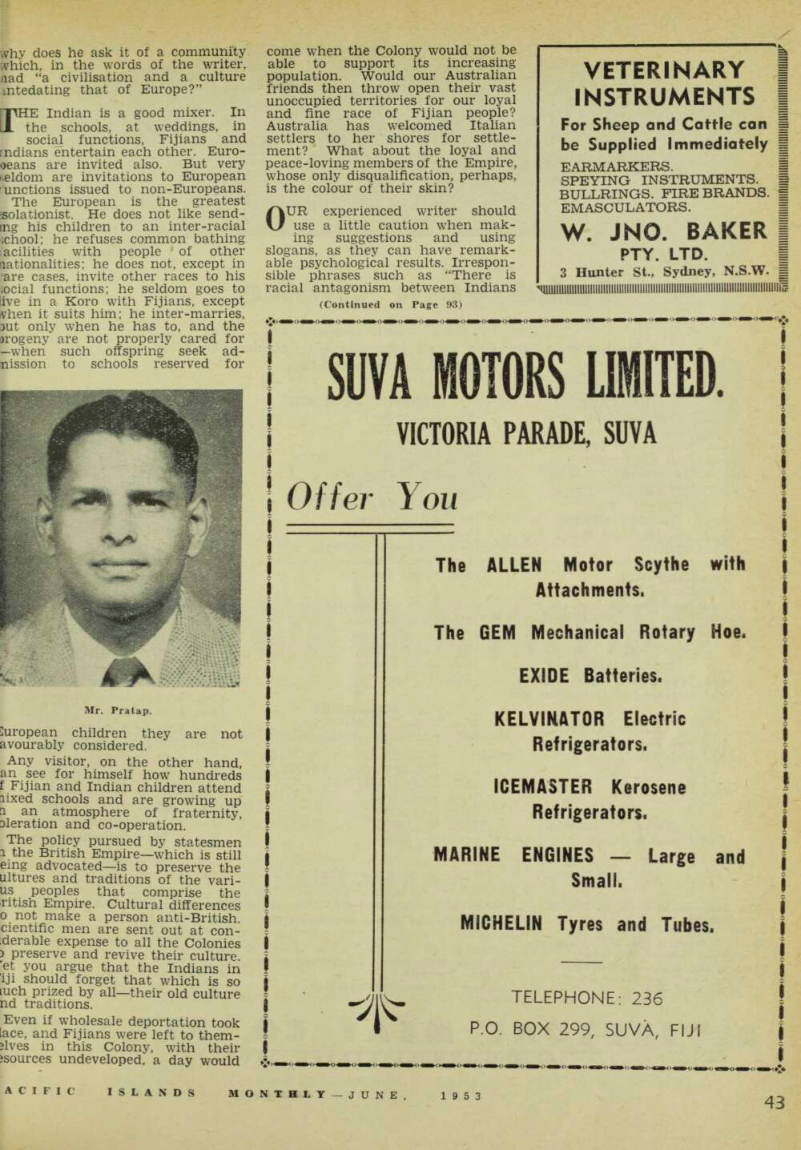
Mr. Pratap.
)d Fijians,” and “Each race holds E 0 other in contempt,” are mis presentations of facts, and calcu • ;ed to sow seeds of undesirable iti-racial feeling. India is a part the British Commonwealth, and ir influence can never be other Ean friendly. irhere are problems here, as in ner places; but what is required, the moment, is a sane and inperate appreciation of facts, a .ink recognition of existing difli- Ities, and a definite policy for the ;ture which will provide for all the tnmunlties in this Colony, and irmonious relations between them.
I am in full agreement with Mr.
'bson when he says that “with a :.rit of co-operation, goodwill and ntual trust, a way could be found making Fiji a permanent and ippy home for both Fijians and lians, under British guardian p.” Schemes, planned and jcuted, to develop the Colony’s Itural resources, would go much *ther in solving our present )blems than suggestions that are t only impracticable, but would ruinous for the Colony. ! should like to give the follow t extract from My African trney, written by the Right Ren table the Prime Minister, Sir nston Churchill, regarding iians in Africa. He says:— How stands the claim of the
British Indian? His rights as a human being, his rights as a British subject, are equally engaged.
“It was the Sikh soldier who bore the honourable part in the conquest and pacification of these East African countries. It is the Indian trader who, penetrating and main
taining himself in all sorts of places to which no white man would go or in which no white man could earn a living, has more than anyone else developed the early beginnings of trade and opened up the first slender means of communication.
“It was by Indian labour that the one vital railway on which every thing else depends was constructed.
It is the Indian banker who supplies
*perhaps the larger part of the cap ital yet available for business and enterprise, and to whom the white settlers have not hesitated to turn for financial aid.
“The Indian was here long before the British official. He may point to as many generations of useful industry on the coast and inland as the white settlers, especially the most recently-arrived contingents from S. Africa (the loudest against him of all) can count years of residence.
“Is it possible for any Govern ment, with a scrap of respect for honest dealing between man and man, to embark upon a policy of deliberately squeezing out the native of India from regions in which he has established himself under every security of public faith? Most of all must we ask, is such a policy pos sible to the Government which bears sicay over three hundred millions of our Indian Empire?”
Does the above quotation not fit in with the present set-up in this Colony? Should we not take a lesson from it and plan for the future with the same understanding?
The PIM writer has suggested many things which the Indian leaders had not even dreamt of. I would like to sound a note of warn ing to him against the use of such phrases as: “There is racial an tagonism between Indians and Fijians”; “Each race holds the
other in contempt”; “The influence of India is anti-British.”
IF that writer could stay in the Colony for a longer period, he would see with his own eyes how Indians and Fijians mix freely and invite each other to their social functions. It is a pleasant sight to watch Fijian and Indian guests sit ting together, enjoying meals and conversing amongst themselves.
Such occurrences are rare with Europeans. They also attend such functions; but very rarely do they
reciprocate by inviting non-Eurol peans to their functions.
Europeans freely express view| against Governments, as Mr. Robson has done against the Attlee regime! but it is a sin for a non-Europea| to express himself with similar free! dom, and he has to be on his guana for fear of being designated anti* British, as soon as he opens his lips to utter even a polite and harmless word to express his disagreemerl with the views of the Government.
Articles such as that in the Pacific Islands Monthly do more harm than
:d in trying to solve the problem. ;t is simply a creation of this iter’s imagination to say that nans now dream of the day when iia will dominate the Indian ;ian—for the simple reason that IFiji-Indian leader has ever given session to such views, either tlicly or privately, to any irnalist. ; may be remembered that when Indian Parliamentary delega ji to Australia visited Fiji, and lied to the welcome given them the Grand Pacific Hotel, the Her of the delegation, Seth findas, told the Fifi-Indians that was their home, and India ited them to do all in their power make this Colony prosperous, . to assist in improving their udard of living.
Ihe Government of India, time again has advised the Fiji flans not to look to India for kind of moral or material sup t, but to regard Fiji as their dierland, and to work for its sperity and happiness.
IE future of this country rests with the three communities of Europeans, Fijians and Indians, opeans brought the wealth and ie: Fijians provided the land; the Indians gave of their sweat develop this Colony to what it 3-day. !y people came here from India dll the soil of these islands and j have brought the agricultural Is to their present state of de pment with attendant benefits, as born in Fiji and this is my ie, as it is also the home of the tiger generation, ur policy always has been, and be, to live in harmony with ?r races, and to strive for the i of this Colony as a whole, t we may go forward together in mony is the sincere wish of all people who have made Fiji their nanent home. i conclusion, may I be permitted luote the last sentences of the ;ch delivered in the Legislative ncil in July, 1946, by the Honour i Indian member for the North stern Division, when speaking the motion relating to the Deed Cession concerning the safe rding of the Fijian Race: \ly Honourable colleague, the opean member of the Eastern ision, wanted some sort of de ation from us that could allay fears and suspicions of the Fiji imunity.
Veil, the assurance I am pre id to give on behalf of my people our Fijian neighbours in this my is that we have all these ’s lived in this country, as sugar milk, and we shall always live the same as we have done in past. It has never been our re to dominate over anybody; let it be remembered that we
will not tolerate any domination from others as well.
“As our previous Governor men tioned in this Council, Tn God’s eyes all men are equal.’ We sincerely believe in it: we shall live up to that maxim and we shall make every endeavour to make others live up to it, too.
“It is the only assurance that I can give, and I hope that you will accept it with the same sincerity with which it is being given this evening