Rabaul Auction
p. 41 · Read in the full issue
Naruta Passed in at Rabaul Auction
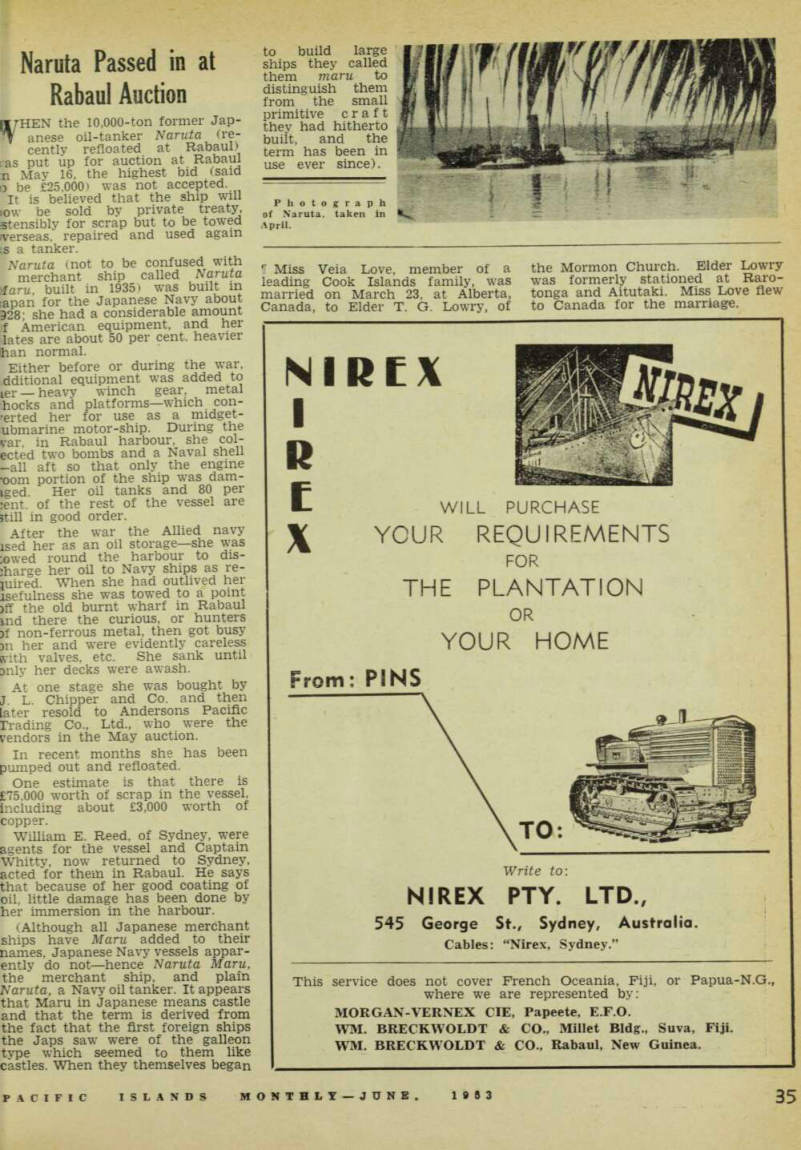
it/HEN the 10,000-ton former Jap anese oil-tanker Naruta (re cently refloated at Rabaul) ■as put up for auction at Rabaul n May 16, the highest bid (said □ be £25,000) was not accepted.
It is believed that the ship will iow be sold by private treaty, Btensibly for scrap but to be towed verseas, repaired and used again is a tanker.
Naruta (not to be confused with merchant ship called Naruta tiaru, built in 1935) was built in ;apan for the Japanese Navy about 928- she had a considerable amount f American equipment, and her •lates are about 50 per cent, heavier han normal.
Either before or during the war, .dditional equipment was added to ler heavy winch gear, metal ;hocks and platforms—which con certed her for use as a midget ubmarine motor-ship. During the *rar, in Rabaul harbour, she col ected two bombs and a Naval shell -all aft so that only the engine ’oom portion of the ship was dam iged. Her oil tanks and 80 per ;ent. of the rest of the vessel are still in good order.
After the war the Allied navy ised her as an oil storage —she was ;owed round the harbour to dis charge her oil to Navy ships as re juired. When she had outlived her isefulness she was towed to a point iff the old burnt wharf in Rabaul md there the curious, or hunters >f non-ferrous metal, then got busy in her and were evidently careless pith valves, etc. She sank until jnly her decks were awash.
At one stage she was bought by J L. Chipper and Co. and then later resold to Andersons Pacific Irading Co., Ltd., who were the vendors in the May auction.
In recent months she has been pumped out and refloated.
One estimate is that there is £75,000 worth of scrap in the vessel, including about £3,000 worth of copper.
William E. Reed, of Sydney, were agents for the vessel and Captain Whitty, now returned to Sydney, acted for them in Rabaul. He says that because of her good coating of oil, little damage has been done by her immersion in the harbour. (Although all Japanese merchant ships have Maru added to their names, Japanese Navy vessels appar ently do not —hence Naruta Maru, the merchant ship, and plain Naruta, a Navy oil tanker. It appears that Maru in Japanese means castle and that the term is derived from the fact that the first foreign ships the Japs saw were of the galleon type which seemed to them like castles. When they themselves began
to build large ships they called them maru to distinguish them from the small primitive craft they had hitherto built, and the term has been in use ever since).
(I Miss Veia Love, member of a leading Cook Islands family, was married on March 23, at Alberta, Canada, to Elder T. G. Lowry, of
the Mormon Church. Elder Lowry was formerly stationed at Raro tonga and Aitutaki. Miss Love flew to Canada for the marriage.
Photograph of Naruta, taken in April.