The Editors' Mailbag
pp. 27-33 · Read in the full issue
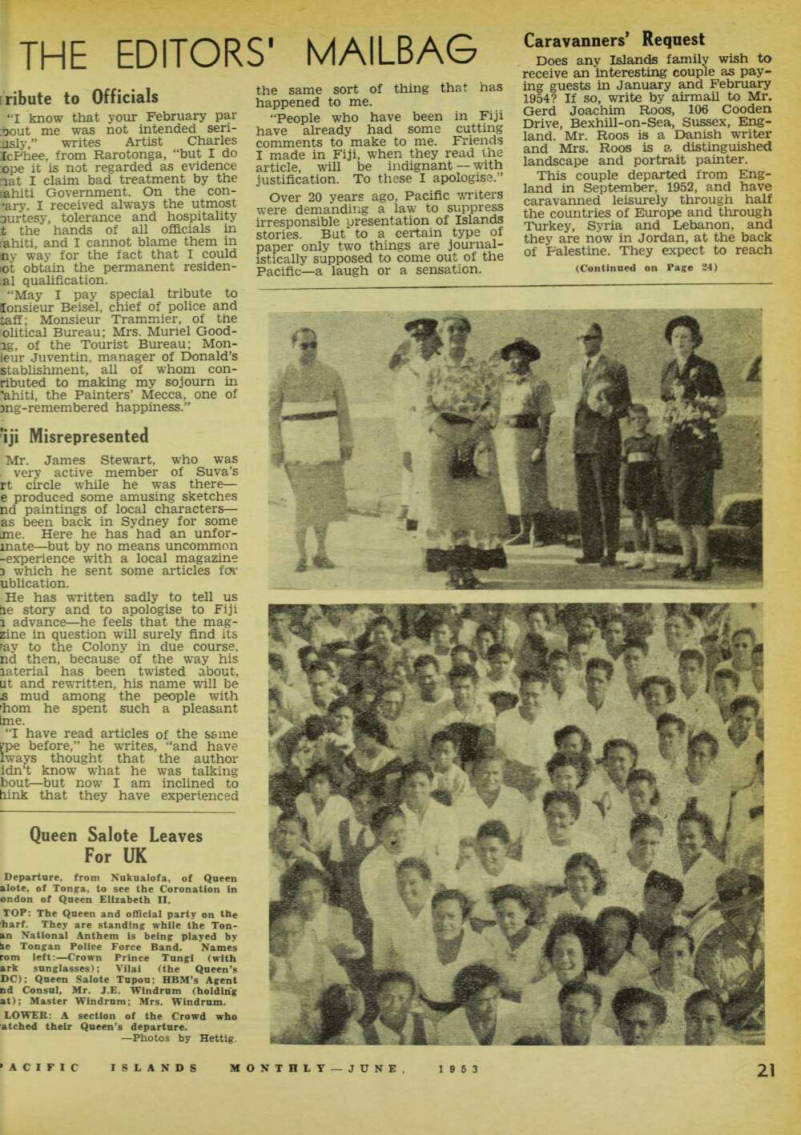
tribute to Officials
“I know that your February par bout me was not intended seri iisly,” writes Artist Charles IcFhee, from Rarotonga, “but I do x>pe it is not regarded as evidence ’lat I claim bad treatment by the ahiti Government. On the con -ary. I received always the utnupst Durtesy, tolerance and hospitality t the hands of all officials in ■ahiti, and I cannot blame them in ny way for the fact that I could ict obtain the permanent residen .al qualification.
“May I pay special tribute to lonsieur Beisel, chief of police and taff; Monsieur Trammler, of the olitical Bureau; Mrs. Muriel Good ng, of the Tourist Bureau; Mon ieur Juventin, manager of Donald’s stablishment, all of whom con ributed to making my sojourn in "ahiti, the Painters’ Mecca, one of mg-remembered happiness.”
r iji Misrepresented
Mr. James Stewart, who was . very active member of Suva’s rt circle while he was there— e produced some amusing sketches nd paintings of local characters — as been back in Sydney for some me. Here he has had an unfor inate—but by no means uncommon -experience with a local magazine d which he sent some articles for üblication.
He has written sadly to tell us tie story and to apologise to Fiji i advance —he feels that the mag zine in question will surely find its ray to the Colony in due course, nd then, because of the way his laterial has been twisted about, ut and rewritten, his name will be £ mud among the people with r hom he spent such a pleasant ime.
“I have read articles of the same me before,” he writes, “and have Iways thought that the author idn’t know what he was talking bout—but now I am inclined to blnk that they have experienced
happened tot"' **“* haS h h h a a d Ve some M 2 article, will be indignant with Justification. To these I apologise.”
Over 20 years ago, Pacific writers were demanding a law to suppress
irresponsible presentation of Islands
stories. But to a certain type of paper only two things are jouiiniistically supposed to come oiu of the Pacific — a laugh or a sensation.
Caravanners* Request
Does any Islands family wish to receive an interesting couple as pay ing guests in January and February 1954? If so, write by airmail to Mr.
Gerd Joachim Roos, 106 Gooden Drive, Bexhill-on-Sea, Sussex, Eng land. Mr. Roos is a Danish writer and Mrs. Roos is a distinguished landscape and portrait painter.
This couple departed from Eng land in September, 1952, and have caravanned leisurely through half the countries of Europe and through Turkey, Syria and Lebanon, and they are now in Jordan, at the back of Palestine. They expect to reach
(Continued on Page 24)
Ceylon late this year; bring their caravan by ship to Perth; and to reach Sydney in December. All they want after that are “some friendly people and a typical South Seas Island.”
P-NG and Political Prophecy
A CORRESPONDENT who signs himself “Your Political Spy”, writes from the North: You may take it as certain that Papua-New Guinea has not heard the last of Colonel J. K. Murray.
He is residing in Queensland, and he takes a keen interest in political affairs generally, and Territories in particular.
I am assured that the Labour Party has a safe seat earmarked for him; and that, if and when it re turns to power in Canberra, the portfolio of Minister of Territories will go to JKM.
So far, I think we are on safe ground. But some prophets go further. They say that, as soon as this new Minister takes control , he would expect soon to have a vacancy in the Administratorship; and that he probably would offer the position to Mr. E. J. Ward.
Me, I don’t support it—l pass it on for what it is worth.
It is not worth much. “Eddie”
Ward has a seat (East Sydney) that is safe for him as long as his name is Ward. Why should he give up that comfortable life, with its pos sibility of a portfolio (he has even raised his eyes to the Prime Min istership), and its assurance of a liberal pension, for that exceedingly uncomfortable job in P-NG? Un less, of course, he has a yearning
to reside in the timbered highland and sniff the never-to-be-forgottei aroma of Bulolo pines.
Matter of Psychology
That paragraph in February PIM jeering at the expensive am elaborate arrangement under whicl the American Administration of th
[ 'rust Territory of Micronesia had esnt a functionary from Honolulu official cheerer-up to the de iressed and melancholy natives of :he Korror Islands, has left the territories’ high officials “startled md taken aback,” according to a Tiendly letter from the Territory’s Headquarters.
The data on which the para was vritten was a newspaper extract; vhereas the full official details ihow that Mr. Powlison was sent ;o Korror not only as a director of lecreational activities, but also as :n organiser of social projects, in vhich he has had world-wide ex •erience.
Although only a few months have •assed, rather remarkable success las been achieved. The native »eople, formerly aimless and evinc ing little public spirit, now are .ctively supporting young people’s .gricultural clubs and leadership raining classes, and have demon trated their interest by themselves recting a large building as a centre or their communal activities.
In the view of the American ad ninistrators, the psychological care >f trusteeship peoples is just as mportant as their physical welfare.
Exasperated
“If Mr. K. R. Bain represents the ittitude of Fiji officialdom towards he population problem in Fiji, then t’s God help the Fijians,” writes , London resident who heard an address given by Mr. Bain to a ection of the Royal Empire Society.
Our correspondent says that the ecture itself was non-contentious; lut afterwards the lecturer skilfully ide-stepped questions about the ndian over-population threat to he Colony’s food supply, and whether the Indians were co iperating in seeking a solution of he problem. London observers were ager for information.
“His attitude appeared to be, sufficient unto the day’; in the [leantime, drift along as easily as ►ossible; things will come out all ight in the end,” says our friend.
He had nothing to say about the **iji Council’s recent request to the Jritish Government to set up a ommission to consider the Colony’s uture, in relation to population . . Such people are an exaspera ion.”
Censor, Ahoy!
Mr. Sydney Chance (formerly >apua), briefly in Sydney town in iday, writes in a way which indi ates he was peeved because the LBC has not yet broadcast the fol owing story sent in by him; A young Patrol Officer from New Juinea, lonely and very fed-up, itting in a Sydney lounge, caught - smile in the eye of a lass not ar away. He sent a polite message »y a waiter and the lady joined
him. They spent a pleasant after noon together out in the country and then, as the returning car neared the city, the New Guinea man said: “Well, don’t let us part so soon. What about a little kai kai?”
“Oh, all right,” replied the lady.
“I don’t mind. But don’t you think
we might have something to eat first?”
Report Exaggerated
“I still don’t believe it,” says Hugh Hickling, writing from Rarotonga, and enclosing a cutting from PIM. which reads: “Mr. Lewis Hirshon, a
well known resident of Tahiti, died on September 1, after a short ill ness.”
That infernal paragraph has been following us around in this fashion for 11 years—it was pub lished in 1942, in a moment of aberration. Lew Hirshon must be very well known, for many people have written, not only to protest against a premature report, but also to insist that Hirshon is the live liest man they know.
Hickling, in a PS, says that he was turning over some old copies when he came upon the announce ment, and felt he must do some thing about it. The only person deeply concerned in the matter, who has not protested, is Mr. Hirshon himself.
Water into Aluminium
The Sydney manager of Aluminium Union Ltd., Mr. A. W. Bell, writes to say that the Canadian Company, Aluminium Limited, is in no way connected with the British Alu minium Co. of London which at pre sent is associated with the Aus tralian Government in prospecting for water power in the western area of Papua.
With Mr. Bell’s letter comes a beautifully illustrated booklet which tells what Aluminium Ltd. has done in Canada and plans to do in the immediate future. This group already produces 500,000 metric tons of aluminium a year in Quebec and by the middle of next year, an additional 83,000 tons will be com ing from a new project in British Columbia.
Further expansion of the British Colombia plant at Kitimat will eventually produce 500,000 metric tons annually—making an even million metric tons per annum for the company. Aluminium Ltd. is the largest single producer of aluminium in the world; 85 per cent, of it is ex ported and Australia is the fourth biggest customer.
The booklet tells us that for large scale production of aluminium an “over-riding consideration is an abundant supply of low-cost electric power which is relatively free from other consumer demands.” This, in Canada, has meant the establish ment of aluminium production in areas remote from ordinary com merce and the performance of ex traordinary engineering feats of the size and dimensions of Australia's; Snowy Mountains project.
Aluminium production is big busi ness, whichever way you look at) it.
The raw material for Kitimat) will come from Jamaica.
The activities of the New Guinea* Resources Prospecting Co. (which is the Commonwealth Government in partnership with the British Alu minium Co.) are much easier to: understand when it is realised that)
Tore there can be an aluminium fiustry in Papua there must be rge quantities of cheap power. ae company, as yet, has done jtHng but prospect for hydrorctricity potentials. There has jver been any suggestion, as many :ople have naturally inferred, that « raw material, bauxite, exists in » Territory We understand that Ts is to come from an island off =e coast of North Australia.
1 Mr. W. Simpson, a well known resident of Papua, was taken by air to hospital in Brisbane early in May, to receive treatment for a serious illness. There was anxiety among his friends; but a report from Brisbane early in June says he is doing very well. “Bill” Simp son has the distinction of holding the number PXI in World War II —he was the first man from Pappa to enlist in the AIF.