Rhinoceros Beetles at Work in New Guinea
p. 20 · Read in the full issue
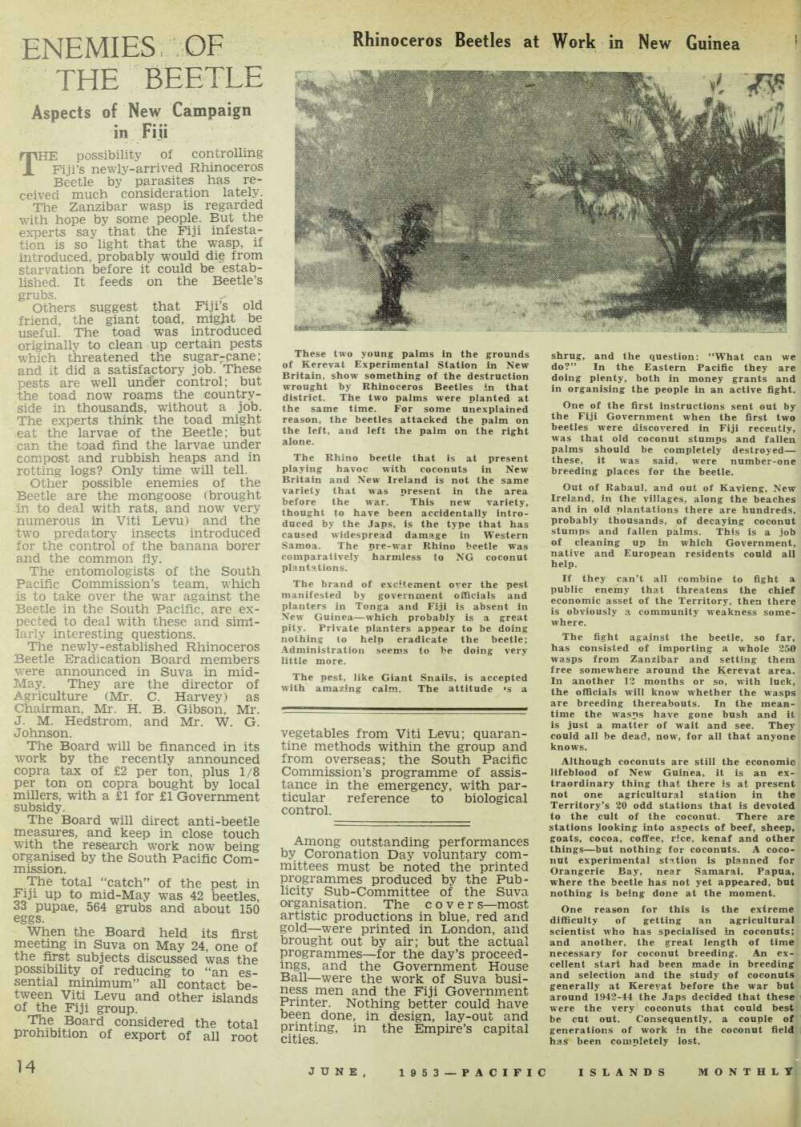
These two young palms in the grounds of Kerevat Experimental Station in New Britain, show something of the destruction wrought by Rhinoceros Beetles in that district. The two palms were planted at the same time. For some unexplained reason, the beetles attacked the palm on the left, and left the palm on the right alone.
The Rhino beetle that is at present playing havoc with coconuts in New Britain and New Ireland is not the same variety that was present in the area before the war. This new variety, thought to have been accidentally intro duced by the Japs, is the type that has caused widespread damage in Western Samoa. The pre-war Rhino beetle was comparatively harmless to NG coconut plantations.
The brand of excitement over the pest manifested by government officials and planters in Tonga and Fiji is absent in New Guinea—which probably is a great pity. Private planters appear to be doing nothing to help eradicate the beetle; Administration seems to be doing very little more.
The pest, like Giant Snails, is accepted with amazing calm. The attitude 's a
shrug, and the question: “What can we do?” In the Eastern Pacific they are doing plenty, both in money grants and in organising the people in an active fight.
One of the first instructions sent out by the Fiji Government when the first two beetles were discovered in Fiji recently, was that old coconut stumps and fallen palms should be completely destroyed— these, it was said, were number-one breeding places for the beetle.
Out of Rabaul, and out of Kavieng, New Ireland, in the villages, along the beaches and in old plantations there are hundreds, probably thousands, of decaying coconut stumps and fallen palms. This is a job of cleaning up in which Government, native and European residents could all help.
If they can’t all combine to fight a public enemy that threatens the chief economic asset of the Territory, then there is obviously a community weakness some where.
The fight against the beetle, so far. has consisted of importing a whole 250 wasps from Zanzibar and setting them free somewhere around the Kerevat area.
In another 12 months or so, with luck, the officials will know whether the wasps are breeding thereabouts. In the mean time the wasps have gone bush and it is just a matter of wait and see. They could all be dead, now, for all that anyone knows.
Although coconuts are still the economic lifeblood of New Guinea, it is an ex traordinary thing that there is at present not one agricultural station in the Territory’s 20 odd stations that is devoted to the cult of the coconut. There are stations looking into aspects of beef, sheep, goats, cocoa, coffee, rice, kenaf and other things—but nothing for coconuts. A coco nut experimental station is planned for Orangerie Bay, near Samarai, Papua, where the beetle has not yet appeared, but nothing is being done at the moment.
One reason for this is the extreme difficulty of getting an agricultural scientist who has specialised in coconuts; and another, the great length of time necessary for coconut breeding. An ex cellent start had been made in breeding and selection and the study of coconuts generally at Kerevat before the war but around 1942-44 the Japs decided that these were the very coconuts that could best be cut out. Consequently, a couple of generations of work in the coconut field has been completely lost.