Two More Years Of
pp. 96-97 · Read in the full issue
Malaya!
The British, the Fijians and The Fecund Indians!
Prom a Special Correspondent SUVA, April 24.
NO outburst of criticism has fol lowed the announcement that the Fijian Battalion in Malaya Is to serve there until January, 1956—tw0 years longer than the original two-years term. But it is impossible to find a single re sponsible European who approves.
There is thoughtful, soundly based opposition arising from the belief that the despatch of hun dreds of the best of young Fijian manhood to south-east Asia places an unjust burden on a people who, numbering only 135,000, are being increasingly outnumbered in their homeland by aliens.
When he made the announcement* the Governor (Sir Ronald Garvey) said that the Fijian Affairs Board —the body which tops the Fijian Administration as more or less distinct from the Central Govern ment —had stated that “the Fijian people are proud to agree to their sons serving the Empire for yet another period.” But the average European, with all respect to the Governor and the FAB, comments that this is what the Board might be expected to say.
The Governor said the request for the extension had come from the Secretary of State for the Colonies with the active support of the War Office and the High Com missioner for Malaya, General Sir Gerald Templer. They recognised the outstanding service rendered by the First Battalion in jungle opera tions.
He said the extension would not affect the promise to the men now
serving that they would be over-j seas for two years only. The men in Malaya would be gradu ally replaced by a high proportion of new recruits. Officers, senior non-Coms. and specialists who could not be replaced would get leave in Fiji. Periodical visits to the Battalion would be made by repre sentatives of the Fijian people and by Public Relations staff. The War Office had agreed to provide married
arters, so that families might n men who could not be replaced.
Sir Ronald said he knew there »uld be criticism in some quarters the decision to extend the period service in Malaya. “I know it asserted that we are depriving ji of the flower of its manhood a time when these men should rearing families in their home id,” he continued. “But the erage age of the Fijian soldiers wing overseas is 22, which is, I derstand, below the average age which a Fijian man marries.”
HE Fijians and their friends are naturally very pleased with the compliment that has been paid their loyalty and their prowess jungle fighters. But they are ling pointedly whether the British thorities really understand the lies that are involved in this ng—whether the Fijians are not ng sacrificed to official selflsh >s and expediency.
'’or many years, the British itary forces made a truly lament e showing against the Red rorists in Malaya. Their record lained black until General npler took charge. This able amander has made effective use the special qualities of the ians. But neither General npler nor the British Govern nt nor any other interest seems think that the welfare of the ian race is as important as the d to keep good jungle fighters Malaya. ■he position, quite brutally ted, is that while a thousand ng Fijians are held in Malaya, Indian community of Fiji 'eady numbering 150,000 as inst the Fijian total of 135,000) steadily extending its hungry ) upon the Colony, at the ex se of the indigenous race. If re were no Indians in Fiji, or n if the Fiji-Indians had the s and the political nous to also vide a battalion for Malaya, no icism of the British and of leral Templer in relation to intion of the Fijians in Malaya ild be possible. he Governor, with characteristic ness and frankness, has put the ; possible face on the situation, the point we stress against him iot so much the potentialities of absent battalion in the matter fatherhood, as the psychological 3t on the race of having so many ng men away from the Colony so long, just at a time when r race is under so much social commercial and political >sure by the extremely fecund ians. The verdict of history be against the British. t. Dan Costello, of Tavua, has intly returned to Fiji after a day in Australia and New Zea l. His mother, Mrs. Dan Costello, is still away on holiday.
Tribute to Sir Alport Barker
Sir Thomas Alport Barker,
of Suva, who is retiring from public life in Fiji, and who probably will in future reside in New Zealand, is to be allowed to retain the title of “Honourable,” in recognition of his long service to the Colony. Sir Alport has been for many years a member of the Legislative Council, and Executive Council, and of many public bodies, and he has been Mayor of Suva on several occasions. At the last meeting of the Legislative Council the Governor (Sir Ronald Garvey) warmly praised the services given in a public capacity, and as editor proprietor of The Fiji Times, by Sir Alport Barker.
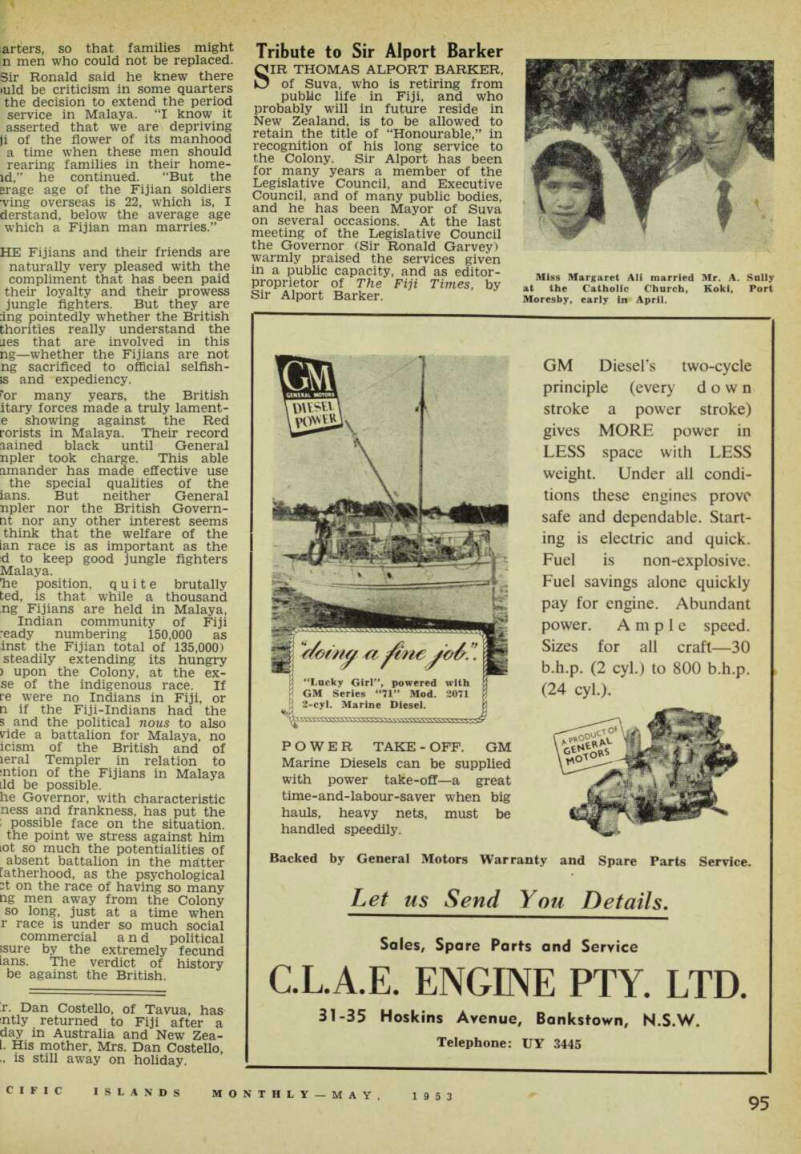
Miss Margaret Ali married Mr. A. Sully at the Catholic Church, Koki, Port Moresby, early in April.