Mallships Of The Pacific
pp. 87-95 · Read in the full issue
Artemise Inquiry
Inquiry into the loss of the 80-ft. ffiooner Artemise, of Papeete, died to disclose the cause of the re, which started in the engine )om.
Captain Marcel Amaru reported lat it had not been possible to ;ach the vessel, which sank at her ichorage in Raroia lagoon.
Oiseau Des Iles
Captain Bernard Pirault, who has en in command of the CFPO 350n, 3-masted schooner Oileau des is on the Papeete-Makatea run ice 1948, has resigned and will on return to France with his wife d children. The family may later ttle in New Zealand, where adame Pirault, an Englishwoman, s relations at Napier.
Command of the schooner has m taken over by populat Captain »bert Argod, who brought the all vessel Fleur d’Ocean to Tahiti m France in 1950, and sold her ;re for two million francs. Later brought the schooner Vega down >m Honolulu to Papeete for mpagnie Generale des Voyages lynesiens. He has lately com inded Orohena.
Oiseau des lies made a labour :hange run from Makatea phos ate island to the Cooks early ril.
Ngan Shipping Facilities
i badly-needed lighthouse few kualofa’s western approaches •uld be in operation by the end the year, Captain Carl Johnson, rbour-master at Tonga, reported April. Delay on the construc i of the light (which will be on iau Mamao reef on the south ; of the main entrance to the igan capital) has been occasioned insufficient funds, aptain Johnson said it is not mded to re-establish the Eua
Iki light in the eastern approaches at the present time, as there are now no regular trading vessels arriving from or clearing for the eastward. Eua Iki light collapsed a couple of years ago. Occasional overseas vessels arriving from the east could use the western pass.
Captain Johnson reported that good progress is being made on the new slipway for local inter-island cutters, and with alterations to the wharf there. Heavy silting had occurred alongside the stone wharf and this was being overcome by extending a piled section beyond the stonework. This work is in charge of American civil engineer Pleben Kauffman, who, dressed in a lava lava and luxuriant beard, causes some local interest. Mr. Kauffman arrived in his yacht L’Hirondelle a year or so ago.
Holm Burn For Sale
Built in Germany in 1906 as the Favorita Dona Catalina, and re spectively known since then under various owners as Newston, Marie Kothe, Mars, Marion Sleigh, Port Whangarei and finally as Holmhurn, this 512 g.t. motor vessel is for sale.
The Holm Shipping Co., of Well
ington, had a contract with Holm horn to supply the outlying meteoro logical stations on Campbell Id. and Raoul Id. She has also been the only vessel maintaining contact between NZ and Norfolk—a call in
eluded in the Raoul Id. (Kerma decs) trip. . r , Iftn With the arrival of a new 1,100 ton motor vessel from Holland, April 18, to be used on this service, the old Holmburn is no longer re quired. Being 46 years old, with a checkered history, Holmburn now seems to possess the usual qualifica tions for entering the Pacific Islands Port Whangarei, this vessel was once owned by retired Auck land master mariner Captain Watchlin, who called at Tahiti and Fiji some months ago in his mag nificent yacht, Fitheach Ban.
The new vessel, named Holmwood, takes the name of the 550-tonner which was sunk in the late war. A few hours out of the Chatham Islands, bound for Lyttelton, NZ, with a cargo of sheep and some passengers (including a radio man and his family returning after ser vice in the Chathams), the Holm wood was intercepted by the raider Komet. Obeying the Hornet’s signals to maintain radio silence, the Holmwood was sunk by gunfire only after all persons and several hundred sheep had been taken off.
Two days later the Komet and two other raiders — Orion and Kulmer land —intercepted and sank the 16,000-ton Rangitane, which had left Auckland for Panama after the sinking of the Holmwood. The
Holmwood’s failure to transmit a distress message later became the subject of a naval investigation, it being maintained that, as there was a warship in Lyttelton at the time, the raiders might have been brought to action, and also that the Rangi tan e would not have been allowed
to sail with raiders known to be in the vicinity. In defence it was said that the Holmwood’s radio was in poor condition. Certainly, had the Holmwood used her radio, there would have been loss of life aboard when she was shelled.
Survivors from the Holmwood
d other ships were later landed Emirau, North of New Ireland.
Hifofua On Survey
Jnder Capt. Carl Johnson, with orge Walder as Mate and David umoepeau as Chief Engineer, the ngan Government’s auxiliary f ofua arrived in Auckland, April after a rough 8-days’ passage m Suva, for survey. Five leper ients had been taken from kualofa and Haapai to Makogai, ’his was her first visit to Auck d since she was built in the ley yard there in 1926 —surveys ally are made in Suva.
Ufofua is a wooden, copper athed vessel of pleasant lines, by 18’, with a loaded draft of 6”. She is of 108 tons gross, ;ons nett, and has a cargo-carry capacity of about 50 tons, with in accommodation for ten and a nse to carry 80 deck passengers the Tongan islands trade, auled up on Lowe’s slip, an ex nation showed that the iron -bolts, which had not been re ;ed since the vessel was built, e almost completely corroded, h these, and parts of the steel heads fore and aft of the engine n to be replaced, it is unlikely ~>fua will return to Tonga be- July.
Philante Ii
essrs. Rusden and Baker’s Fair i Philante II called at Suva ;bound from Tahiti late March. vessel was reported for sale e at £13,000.
The Orohena
.V. Orohena, flagship of the ich Oceania inter-island fleet, been purchased from the Gov tient by M. O. Andre Blouin & of Papeete, for 7,010,000 francs ut £39,000 Stg.). idre Blouin purchased the well m schooner Tagua from Cook ids Trading Co. in January, In that same month Orohena, based from the US, arrived in ;ete from the Pacific Coast. In
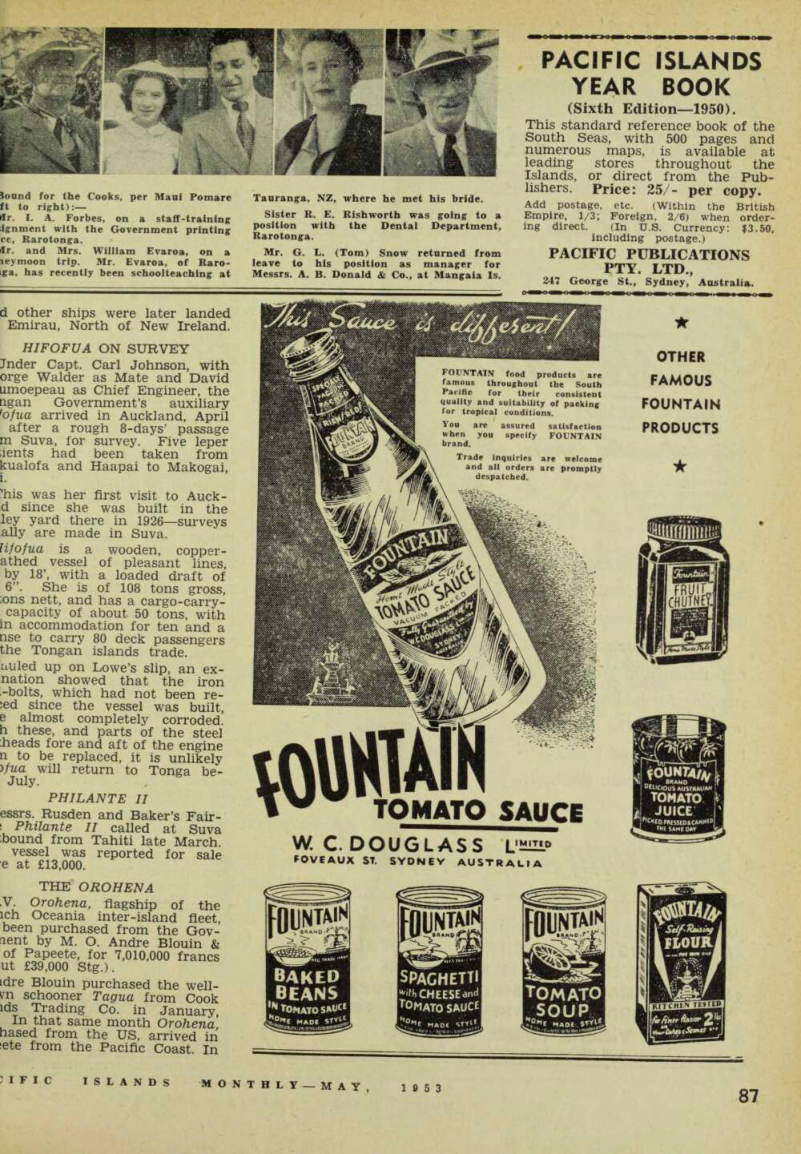
Bound for the Cooks, per Maui Pomare ft to right):— Mr. I, A. Forbes, on a staff-training [?]ignment with the Government printing [?]ce, Rarotonga.
Mr. and Mrs. William Evaroa, on a [?]eymoon trip. Mr. Evaroa, of Raro [?]ga, has recently been schoolteaching at
Tauranga, NZ, where he met his bride.
Sister R. E. Rishworth was going to a position with the Dental Department, Rarotonga.
Mr. G. L. (Tom) Snow returned from leave to his position as manager for Messrs. A. B. Donald & Co., at Mangaia Is.
May, 1948, Orohena visited Welling ton and drydocked in Auckland.
Orohena is a standard type of composite, war-time-built, supply vessel, with a solid wooden hull and intended for use in the far North Pacific. She is an attractive vessel of 532 GT. (278 nett). 148’ overall, 33’ beam, and with a draft of 17’ loaded.
Her late master, Captain Robert Argod, has joined the Oiseau des lies, and his place is taken by Cap tain Alfred Voirin.
Te Matapula Launched
Too late for April PIM came news of the launching of Te Matapula, for the Colony Wholesale Society of the Gilbert & Ellice Islands, from the yard of Charles Whippy & Co., of Suva.
Sixth of her type—the others were HP’s Taveuni, Macuata, Moala and Koro (sold and later lost in N.
Cal. waters) and the Tongan Copra Board’s A’oniu —she will be the last vessel launched from the Walu Bay location.
Te Matapula was quietly launched on March 26. The type are wooden vessels 86’ 0.a., 71’ wJ., with a beam of 22’ and a midship depth of 9’— nett tonnage 80. This one, owing to delays in material, took a year to build, the others five months each.
Te Matapula is framed with Aus tralian and Fijian hardwoods, planked with Fijian kauri, and decked with Oregon. Much of the local timber came from Mr. G.
Barratt’s Deloi Estate.
The vessel had only a 3” side clearance through the Walu Bay bridge piles, and had to be loaded! with drums of water to clear the< bridge decking at low tide. Brought out to the harbour, she will now be ketch-rigged. She is powered by a 200 b.h.p. Ruston-Hornsby which,: with two-to-one reduction gear, should drive the vessel at 10 knots.
A 30 hp Southern Cross takes care of the electrical supply to lighting, winch and windlass.
Captain A. R. Peckham, lately master of R.C.S. Tuvalu, will have the command.
Suva Docking Facilities I
Mr. W. Whippy, of Charles Whippy! & Co., Suva shipbuilders, gave de tails recently of new building facil-l ities planned by the firm for that* port. Modern machinery is on order from England, and a new slipway has been designed to build wooden vessels up to 120 feet long. With the launching of Te Matapula in March, no further vessels will be built at the former location.
Awahou Inquiry
Over seven months after her loss somewhere in the north-west Tas man Sea on September 10 last, a Marine Court of Inquiry in Sydney —presumably at the request of the authorities in Suva, where the ship
is registered—looked into the sappearance with all hands of the tie 438-ton tramp Awahou.
The court found that she had en surveyed and issued a rtificate of seaworthiness on Sep nber 8; that the cargo at time of Qing from Sydney for Lord Howe .. was properly stowed (though e widow of the Mate, Mrs. tyllis Maxwell, told the Court that r husband had been worried re rding the stowage); and there is no cause it could find for the raster which cost the lives of all card —ten Fijian or part-Fijian imen and eight Europeans, in iding Captain Robert Darroch, of va, who had joined in a reliev j capacity for that voyage, rhe distress message heard from oahou, picked up at Hobart and lelaide marine radio, was weak, d both stations gave different :sions. Hobart, at 7 p.m., on Sep nber 10, reported hearing the in national distress signal on radio one—the word MAYDAY —equivmt to the SOS in morse—followed ninutes later by “. . . . sixty miles st of . . . .” That was all. Ade le, however, reported hearing the itress word MAYDAY repeated, m . , . seeking shelter sixty les off Sugarloaf Point.” £any seamen consider that the jar Loaf referred to in this ssage was Sugar Loaf Point, •th of Port Stevens, on the NSW ist, and a little south of the lati
tude of Lord Howe Id. Why, they say, would a vessel, approaching Lord Howe from the south-west, give a position in relation to a point on the opposite side of the island.
The air search may thus have been directed to the wrong area.
Ada For Islands Trade
Another little tramp-ship will
soon be seen in the South-central Pacific. She is the Tasman Steam Ship Co’s Ada (first “a” as in “ardour”) which was due in Auck land from Italy at the end of April, via Suez and Australia.
Ada is a wooden vessel, 132 ft. long, of 299 gross tons (156 nett), built in Viareggio. She is to be registered in Suva, and on Fiji
Articles, with a Fijian crew. She was to sail for Suva in May, after dry-docking in Auckland, and would pick up her first Islands cargo in Apia for Auckland.
It was reported in Auckland in April that the same company’s Viti (formerly of Fiji and currently on the trans-Tasman fish and fruit trade) is for sale. No comment was available from the ex-servicemen owners who acquired her after World War 11.
News of Cruising Yachts
• The American yacht Calypso, is lying at Tahiti while her owner, John W. Litton, and his English brother-in-law, Kim Powell, a resi dent of Tahiti, have gone to Panama canal. Calypso, 12-tons, arrived in Papeete last July 20 from Panama, after two months in the Galapagos, a week at Taiohae (Marquesas), a fortnight at Takaroa, and a month in the Leeward Isles.
Owner Litton was accompanied by his wife Gene, small daughter Kathleen, and crew-member Choppy White. Ultimate destination is given as Honolulu. Calypso is at present moored off Mr. Powell's property at Pirae.
Kim Powell, his wife Peg, and Kim Robin, 5, arrived at Tahiti in December, 1950, from Panama in their schooner Wind’s Will. They, too, spent two months in the Gala pagos and a fortnight each at
Marquesas and Tuamotus. Since then they have cruised through the Leeward Isles to the Lower Cooks, and via Penrhyn back to Tahiti, where they plan to remain. Mr.
Powell, an experienced bulldozer operator, has done considerable roadmaking work on the property of Mi*. Van den Broek d’Obrennan, and elsewhere, since his arrival from Panama, where he was formerly employed on the Panama canal. He now leases a small property from Mr. Van den Broek d’Obrennan.
• From Honolulu comes further details of Gemini (reported recently at Takaroa, Tuamotus, and bound for Papeete). • Vic. Schoenberg, who maintains Ham radio contact with Jack Wheeler aboard the yacht, advises that Gemini is a steel 38 ft double ender ketch. She was scheduled to clear Takaroa for Papeete in mid-April. Owners Jack and Leah Wheeler plan to be back in Hono lulu, homeward bound for Portland, Ore., late in the year. • Eric and Susan Hiscock, in their
xm jib-headed sloop Wanderer arrived at Papeete, March 25, »m England, via Atlantic ports, nama and the Marquesas. » Departure reported from Pacific ast is two-masted schooner mona, commanded by Captain in Ozanne, (one-time skipper of » big American luxury yacht, ca, which has cruised the cific). Ramona is owned by Mr. d Mrs. William A. Pomeroy, of usalito, Cal. Aboard also are }ir three children and a crew 10. The owners plan calls at hiti, Samoa, Fiji, Rapa and rotonga. » The British yacht Arthur gers, owned by Mr. and Mrs. Tom pworth, of England, cleared peete April 12 for Bora Bora, rotonga and Auckland, after a gthy stay in the Tahiti capital. ► The 8-ton Swedish yawl Viking, sviously unreported in these ;es, arrived in Papeete from the irquesas, April 11. Owned by ;ve and Brita Holmdahl, of thenburg, the voyage was made way of Falmouth, Madeira, nary Is., Las Palmas and the nama canal. Present plans are a month in Papeete before mov on westward. Mr. Holmdahl is jarpenter by trade, and his wife professional dressmaker. ► Trans-Pacific Yacht Club of ; Angeles reported in March that r 40 yachts are this year ex ted to cross the starting line for 2,228-miles Trans-Pacific yacht ssic from Los Angeles to Hono i, due to start on July 4. Yachts n will follow with interest the v system of handicapping worked by Dr. Clark B. Milliken and dents at the California Institute Technology. Tabulating the per mance of all yachts in the 1947- 51 races the experts drew three formances curves, from which y produced an average curve v named the Caltech Curve. All idicapping will this year be in ordance with the Caltech Curve. lS the Honolulu-Tahiti race is eduled to commence July 24, it evident that few vessels could er for both races, as an average ed of over 4.6 knots would be uired on the Trans-Pacific race make the deadline, with little e for a rest in Honolulu for the r boats that could make the ;ance in time. It is not clear V this early date was fixed for Tahiti race.
UHirondelle, in which Ameri- Pleben Kauffman cruised down ough the eastern Pacific to illy settle in Tonga, seems to r e ended her wanderings for the sent. Mr, Kauffman, now em ped as a civil engineer by the igan Government, has made a of the yacht to young 7-year- Prince Taufa’ahau, son of
Prince Tungi. On completion of his present contract Kauffman has obtained permission to become a lone settler on the island of Hunga Tonga • Remember Alfred F. Loomis and his 33-foot Colin Archer-type yacht Stornoway, which circum navigated the world in 1951-52? In January, Loomis was awarded the coveted Cruising Club of America s Blue Water Medal for the year s outstanding deep-water cruise.
Others considered were Carnbhee, Sopramno, and Dr. Tom Davis (Rarotonga) and family with their yacht Miru. • With the popular press giving great publicity in recent months to
the round-the-world voyage com pleted last year by M. Toumelin in his yacht Kurun, of France, it should be mentioned that this was not a single-handed circumnaviga tion. From France to Tahiti, Toumelin was accompanied by M.
Paul Farge.
Great Auckland Exodus
• As forecast in March, Auckland is this autumn witnessing the great Polynesian migration in reverse.
Never in the history of New Zea land yachting have so many vessels ventured forth for the Islands in a single season. • Ghost, first away on March 9, reached Rarotonga April 2, and left on 15th for Papeete. A pro
;ted call at Mangaia was pre nted by reef conditions. Ghost rived at Papeete on April 25. • White Squall, 33-ft., second in e 1951 Tasman Race, with owner iss Norgrove, his wife Doreen and r sister and brother-in-law, Mr. d Mrs. J. Duncan, cleared April for Tahiti direct. She is now tch rig. • A Seabird-type yawl, formerly y but lately renamed Sundance, ived down harbour in late April, ading probably first for Tonga, lis 34-footer was purchased in w Zealand by her present Ameri i owner, Clayton C. Knago, two irs ago. With him is Mrs. Knago, d Allen Draflin, of Whangarei. ey are bound for the Pacific ast of USA—the route: “Pretty 11 whatever way the wind blows 99 ► On April 25, Taurangi, with ner P. Edmonds and mate K.
Idon, nosed out, Tahiti bound, h a possible call for water at pa. Mr. Edmonds’ father was le years ago a schoolteacher at le. Launched this season, this -ft. cutter has been well tested coastal racing.
Blue Water (sister ship to White tall) and Leda made a spec ular twin departure on April 28. lunch-hour crowd watched their ;-minute preparation at the Ad alty steps, in the centre of Auck d. Blue Water, 31-ft., for Tahiti h a possible call at Rapa, carried ' —owners L. Vitali and K. Kirk d, and crewmen N. Wright, D.
Duane and H. Gordon. Leda, 54footer flying Tauranga Yacht Club pennant, was headed for America via Tonga, Fiji, the Cooks, French Oceania and Hawaii. She was manned by her owners (brothers C. G. and W. A. Wilson), their wives, Mr. D. Woolf, and the two little daughters and a tiny 2months-old son of Mrs. C. G. Wilson.
The women and children will re turn from Suva. • Wakaya, in Tonga and Fiji waters last year, and a newly launched craft, Flamingo, were ex pected out in early May from Auck land; with Aloha, 38-ft., and the Wellington craft Leonora, 28-ft, soon to follow. Leonora, bound for Auckland, went aground down the coast, but was undamaged. Others known to be preparing are the Syd ney yacht Corsair and George Dibbern’s Te Rapunga, at Hobart, to clear for the Islands from Auck land.
Yet other owners are known to have the fever and may join the north-bound throng this winter— even if it costs a fur coat or two!