Tropocalities
pp. 70-71 · Read in the full issue
Wau—Goldminers’ Ghosts
And Peanuts And Cabbage
LIKE most other towns in the Territory of New Guinea, Wau is blessed (or cursed, whichever way you look at it) with a Town Plan. But unlike the others, Wau has linked history with the future by remembering its pioneers. Pyrke, Money, Dover, Stower, Darby, Glasson, Booth, Darling, Arnold, Mustar, Royal, Joubert, Chisholm, and Levien, all these names and more appear upon the Plan—as streets, and roads and avenues and crescents.
Some of these men whose names are perpetuated in the new Wau have passed on; some have quit the Territory; a few still pioneer on.
The present generation of Terri torians has scarcely heard these names—and they were once the Territory’s Big Names—but then, Wau to-day bears small resemblance to the wild frontier town of the 20’s and 30’s. A quiet, small town ship now, its inhabitants are not concerned with gold nuggets so much as with the size of the cab bages it grows, or the succulence of its peas and beans and carrots and tomatoes that are shipped out in ton lots by air and road to Lae and Moresby and as far as the Naval establishment at Manus.
But the battle of the leases still goes on—land leases, this time, for coffee estates and peanut farms, etc., and which the Administration for various (and not always plain)
time-absorbing reasons is reluctanl
to grant. * * Down at the BGD township at Bulolo, another method has been adopted for naming the streets-] they have been given the names of BGD men who died in active ser vice during World War 11.
On The Bonnie Banks
Of The Butibum
ALTHOUGH it is an affront to my long line of Macdonald and Wallace ancestors, I’m reluct antly driven to the conclusion that there is an affinity between the wild Highlanders of Scotland and the maybe not-so-wild-natives of Papual New Guinea: Both appear to be emotionally stirred by the sound of bagpipes.
I guess some anthropologist, or some other specialist adviser to the Administration of PNG, discovered this—how else would they have had the temerity to use a recorded pipe band, playing (I’m told) Cock of the North, to introduce the 5.30 p.m. native session from 9PA Port Moresby? The skirl of the pipes at this time of the evening brings the houseboys runing to surreptitH ously hang round the masta’s radios receiver for the betterment of his mind. The evening I listened it was a discourse, in Pidgin, on how to best set about the business of rice-growing.
In New Guinea the sound of bagl pipes is apparently now so asso-i dated with natives —and not neces-| sarily Highland ones either—that Mr. Harry Starr, proprietor of Lae theatre, uses the same Cock of the North recording to introduce boys’i night at the local picture show, j And some courageous soul, with
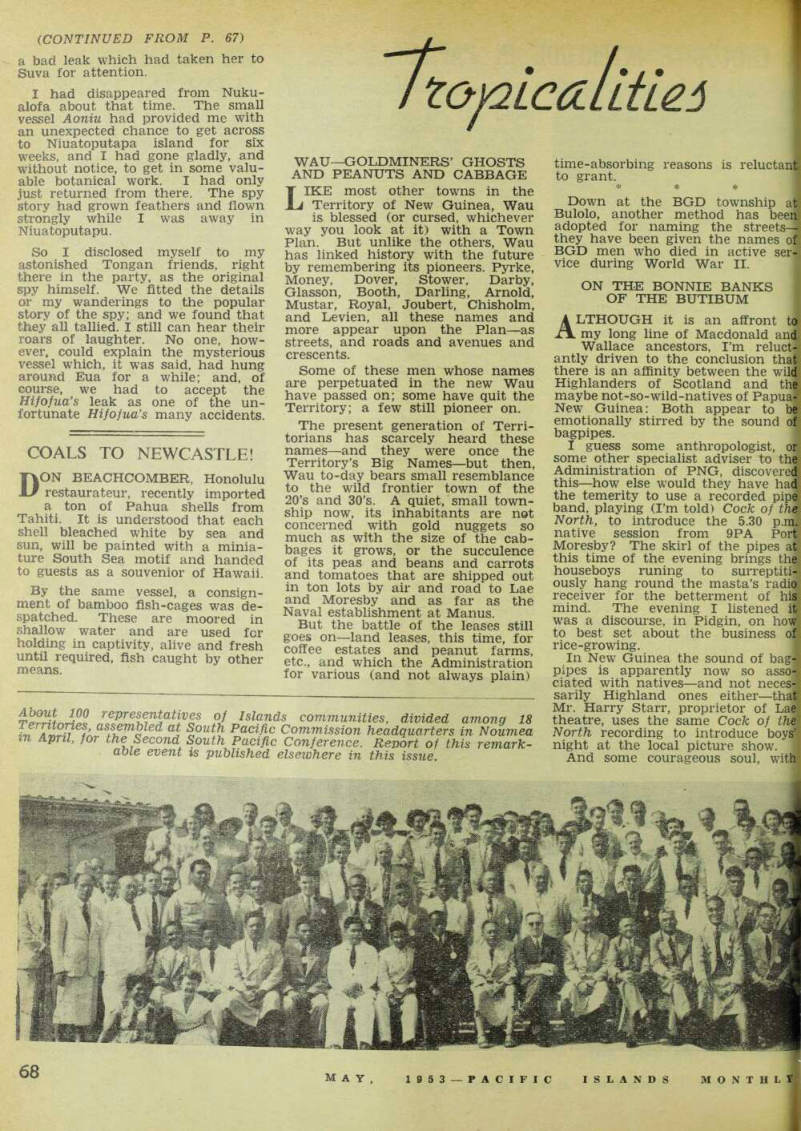
About 100 representatives of Islands communities,divided among 18 Territories, assembled at South Pacific commission headquarters in Noumea in April, for the Second South Pacific Conference. Report of this remark able event is published elsewhere in this issue.
a good Scots name, has actually formed a pipe band among the native members of the Pacific Islands Regiment in Port Moresby.
It was not my fortune to hear or see this phenomenon but according to those who had, it is capable of performing in orthodox fashion. It is this band that is going to Lae to help them with their Coronation celebrations —much to the chagrin af Rabaul, who also coveted the autfit.
I’ve spent a few idle minutes iere and there, wondering whether Robert the Bruce would be pleased it this missionary zeal that has jarried the music of Scotland to ;he Brown Brethren of the South Seas, or whether poor old Bob is, ■ight now, turning handsprings in lis grave at the very idea of it.— JT.
An Ill Wind ...
A T least one man profited by the :x Fiji hurricane of January, 1952. Mr. A. V. Cole, of the iterary staff of the NZ Herald, was ately awarded the Cowan Memorial >rize for good journalism in 1952.
Subject: a series of articles on the r iji Hurricane and its after-effects.
Those Irish Beetles!
JOHN GUNDRY, in his Auckland P Star weekly column, Listen Here, complained bitterly in ipril about the mispronunciations lade by New Zealand school-broad ast speakers. Cited for special con emnation was an educational talk n the depredations of the yanosseris beetle (in other words, le Rhinoceros beetle, which is >ose in Fiji).
Gundry’s comment: “Apologies re surely due to all the Ryans in le world for suggesting that they ave some family resemblance to, r that they may have stemmed om either the largish horned ■eature, or the beetle.”
Papuan Tadpoles For
London
BRITISH scientists want to know > why tadpoles in Papua reach maturity so quickly; and, at leir request, a collection of speci
ally-preserved specimens is being sent to the British Museum. The collectors were asked to get the tadpoles straight from their swamp and pond hideouts into a special preservative fluid to enable the stomach contents to be studied.
The collaborators in this bit of research discovered tadpoles in wheel-ruts in the Mekeo district which had contained water for a very short time; and they heard of other tadpoles being found in the accumulated rainfall between the stem and leaves of banana plants.
Mavis Rivers For Us
Attractive and popular 23year-old Samoan “torch”-singer Mavis Rivers is to study music at the Brigham Young Mormon University of Provo, Utah, USA.
Miss Rivers went to NZ in 1947, and her plaintively appealing voice —not unlike that of the English singer Vera Lynn—made an im mediate hit in radio broadcasts there. Up to the time that Miss Rivers returned to Samoa late last year, as the first Samoan passenger on the Coral Route Service to Samoa, she had recorded over 50 songs.
Entente Cordiale
BUSINESS houses and consulates in Papeete, chief town of French Oceania, hoisted their flags at half-mast on the announcement of the death of Queen Mary in March, and they were flown thus until
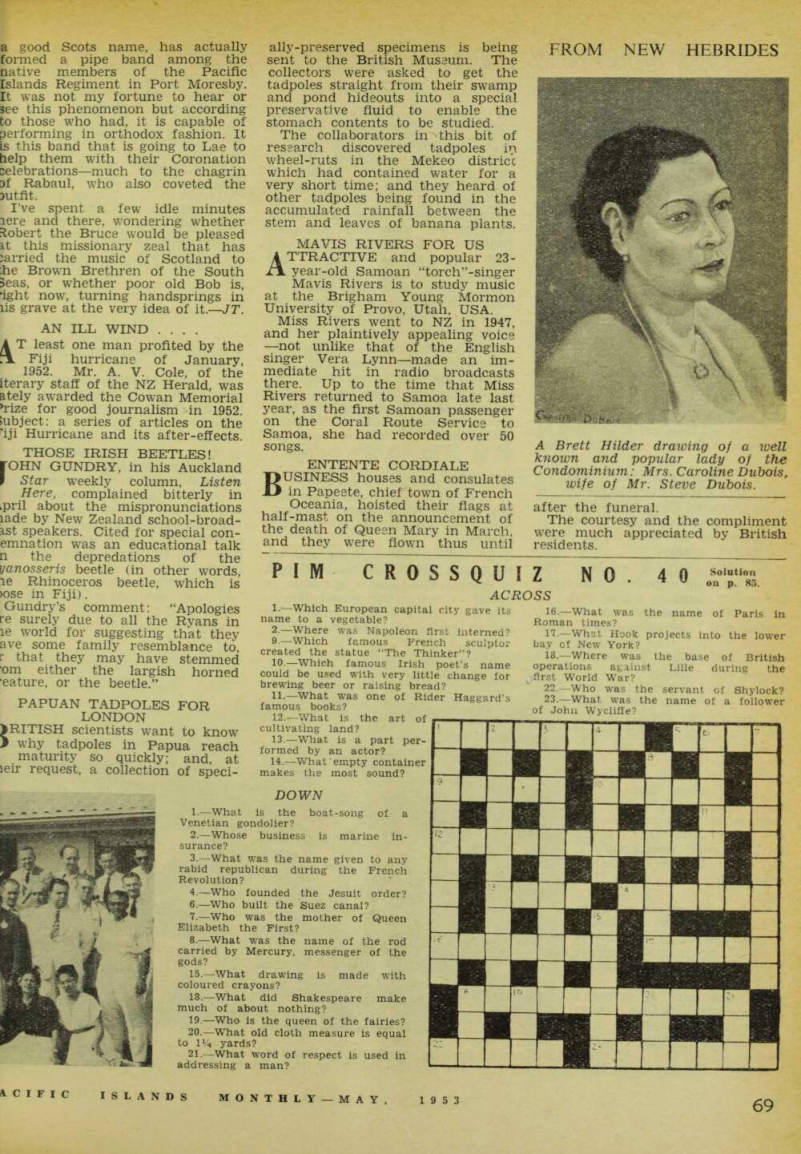
after the funeral.
The courtesy and the compliment were much appreciated by British residents.