Solomons
pp. 121-124 · Read in the full issue
The Taralala In The
Some Notes in Passing
By Judy Tudor
i MONG the many importations L from Fiji int® Honiara (a large portion of the European popula m seems to have served in Fiji some time, and there are 30 to Fijian artisans, clerks, etc., and sprinkling of Indians) the Taralala is an honoured place.
This loose-limbed slouching to usic, said to have begun in a ethodist Mission kindergarten in ji, is a favourite pastime of the jal native gentry and it will be teresting to see if it gradually 3ps up through the Group and ;o New Guinea by way of •ugainville. \t the welcome home to Dr. Tom ivi, given by the Fijian com mity of Honiara on March 19, ropean ladies in long evening 'wns, their formally-dressed itlemen, Fijians in suius, bushy ired local “blondes”—who surely ist be the ugliest females in the ole South Seas—local male Solo n Islanders, a few Indians, all d a sprightly Taralala until the all hours, to the music supplied two local bands of guitar ndolin players.
Somewhere about midnight heavy n poured through the temporary f roof without dampening the husiasm of the dancers. ’he Taralala followed a Fijian come and presentation of a ua to Dr. Dovi, who that day 1 returned in Malaita after six nths refresher course in New land and two weeks’ holiday in . A brother of Ratu Sir Lala
Sukuna, he chooses, for the time being, to minister medically to the fractious natives of Malaita, He is one of the most popular men in the Group—and that is saying some thing in a community where the usual form of South Pacific back biting is more than usually prev alent.
Between the Tabua presentation and the Taralala was a Fijian feast spread on banana leaves on the matted floor. Chickens, pigs, turtle, manioc, sweet puddings, all cooked in native ovens, were spread out for the guests, who hitched up their evening gowns, suius or pants, as the case may be, and pitched m, to tear chickens limb from limb and eat with their fingers.
The prize went to a somewhat
paunchy Solomon Islander who started near the top of the spread and ate his way stolidly down the whole length of the banana-leaf tablecloth, in about one hour flat.
Reflections On Pidgin
HOW nice to get back to civilisa tion again—to where the natives actually understand you when you give forth in Pidgin, and answer you right back in the same pattern.
The natives around Honiara, BSI, are the dourest, surliest, un smilingest, most cast-down creatures I’ve seen in the whole of the South Pacific. If they know how to laugh, then they do it in the strict privacy of their own leaf huts. They submit to the extraction of information
ti about the same enthusiasm as y would submit to a major ration; and to get it you need be armed with a pair of meta rical surgical forceps. have a theory that, as part of trouble, they have only a slight imering of what the average opean is saying—for the simple >on that the European, evidently er the impression that he (or i is speaking Pidgin, makes up e gibberish as he goes along, sn Brown Brother looks dumb, lumber than usual, they try to their ideas across by yelling. i NG, there has always been e pride taken —by Europeans— peaking good Pidgin. Nothing :he same feeling is abroad in . Pidgin-according-to-the-Rules purned by post-war residents, )pean and native —perhaps be ;e both feel that its use spells of dignity. may be that Pidgin, officially, out, in BSIP. But, if so, lority has neglected to provide hstitute. i a contribution to better re ns between European and vn Brother (and the Chinese nunity, too) I suggest the quick compulsory introduction of a ta franca (even if it is Esper and everyone has to return to schoolroom), else before long entire population of the owful Solomons will be reduced
ign language.
Ipeaking Sartorially
E would have to be more mthusiastic about the British Solomons than I to make a t of holding them up as an ex [e to the rest of the Pacific— the gold cup goes to the Euro gentlemen of the place for sensible not-so-formal even iress. has been usual in most parts lese South Seas for the ladies ear long skirts at night, while nen wear nothing more elabor han a fresh white suit —which ps seems to me to be a sartorial ism. The men of Honiara have
improved considerably on this, with black dress trousers, black cum
merbund, long-sleeved, soft white shirt and collar, and black bow tie.
A black felt hat and a red cape would turn them into Spanish toreadors —but the rig looks at tractive and is probably as cool as pnvthing can be in this pressure cooker climate.
Returning To Fiji
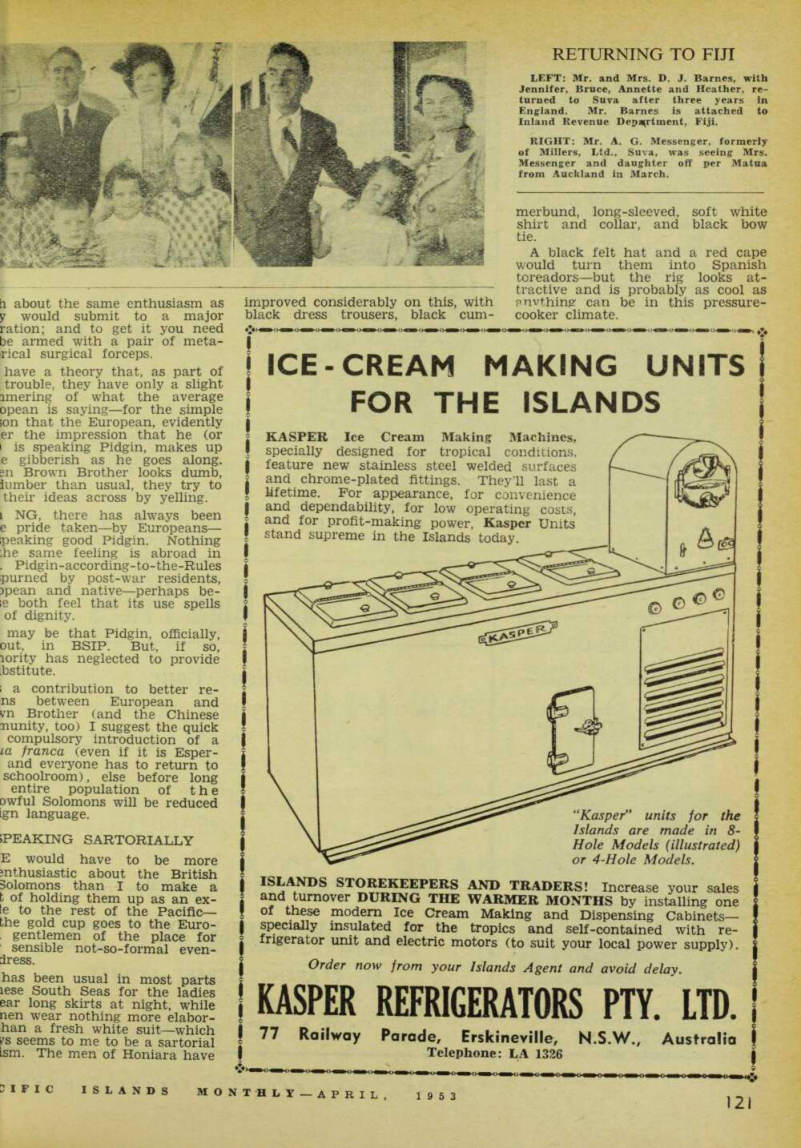
LEFT: Mr. and Mrs. D. J. Barnes, with Jennifer, Bruce, Annette and Heather, re turned to Suva after three years in England. Mr. Barnes is attached to Inland Revenue Department, Fiji.
RIGHT; Mr. A. G. Messenger, formerly of Millers, Ltd., Suva, was seeing Mrs.
Messenger and daughter off per Matua from Auckland in March.
The Racial Problem Again
A grievance of some British re sidents of the New Hebrides is the failure of the British administra tion to “recognise” children of British fathers and native mothers — that is, to afford them British citizenship rights. As a conse quence, many of these part-Euro peans are taking French nation ality, which apparently can be had virtually for the asking.
The “recognition” is not merely a matter of academic interest or social pride—it is vital to these people when or if they wish to travel outside the New Hebrides.
As French citizens with French passports the world is open to them.
The alternative seems to be to remain “unrecognised” British, and to stay at home.
Source Of Irritation
/ A post-war regulation of the New Hebrides (which was designed to protect the then scarce supplies of sugar, soap, etc. being carted off to Europe by crews of visiting ships) has recently been brought into force again in Vila and Santo. The re introduction of the prohibition seems to be directed mainly against Australian ships and designed to produce irritation rather than revenue. Seamen buying a stick of shaving soap or a tube of tooth paste have had the goods con fiscated or impounded by Customs officers. The alternative seems to be to pay an export tax; or get the permission in writing of the French and British Resident Commissioners to take the goods out of the country.