tropicalities
p. 72 · Read in the full issue
Awkward For All
SINCE the advent of Colonel J. K.
Murray, Administrator of Papua- New Guinea from 1945 to 1952, the people of Port Moresby have got accustomed to the appearance of selected natives at official functions, and do not now react strongly. But, in old-fashioned Rabaul, they still have to learn that the Territories are being sociologic ally rearranged.
While the new Administrator, Mr. D. M. Cleland, was making his first official visit to Rabaul, there was the usual 5.30 p.m. cocktail party at the residence of the Dis trict Commissioner; and Mr.
McCarthy, in accordance with official policy, invited the members of the native Village Council to the function. European officials came along, with their ladies; but a good many non-officials were ostentatiously absent.
“Our brown brothers stood around awkwardly, and no one could quite get going,” says a private letter writer. “It was rather odd to in vite the poor blokes to come and watch the masters drink cocktails, while they are restricted to lolly water. Or were they?”
Rabaul will get used to it in time, no doubt.
The Evil He’S Done
FRENCH taxation expert, Louis Mercier, returning from Tahiti to France after spending six months organising a new taxation system in French Oceania, said in Auckland that his mission had been successful —but that everyone was glad to see him leave, though the evil that he’s done will live after him.
Fishing Is Good
THERE may be stormy seas around Norfolk Island—it is one of the places detested by mariners— but there is nothing wrong with the fishing grounds. The snapper which may be caught in certain places there have been responsible for some fishermen getting a life long reputation as liars.
A few days after the new Admin istrator, Brigadier Norman, arrived in NI, he went fishing, and he hooked and captured one of the biggest groper seen in those waters.
He thinks he is going to like Norfolk Island!
History Of An Island
IT is nearly 150 years since Cap tain Matthew Flinders, in the very unseaworthy ship, HMS Investigator, set out from Sydney
to circumnavigate Australia and chart the coasts.
Near Thursday Island, Flinders discovered a small island, about miles long by about I-mile wide,
partly wooded, and fringed with a coral reef. Flinders recorded that “as it had no other name I called it Good’s Island, after Peter Good, the botanical gardener.”
I note that Pacific Islands Year Book spells it “Goode,” so that is evidently the official way.
This is from an article in NZ Gardener, by A. W. Anderson, a noted authority on botany: “Peter Good attended to the manual work of collecting seeds and plants on Flinders’ ship. There was also a botanist named Robert Brown, and a botanical draughts-; man named Ferdinand Bauer. The botanical party had been specially chosen by Sir Joseph Banks. Peter Good entered Kew Gardens in 1796 and was highly thought after by the Curator.
“When HMS Investigator came back to Sydney, on June 9, with many sick men, Peter Good was too ill to be taken ashore. He died on board.
“Such was Peter- Good, the first Kew-trained plant collector to reach Australia. His name survives in a wildflower, Goodia Lotifolia, found in NSW by Peter Good, and seeds of which were transmitted by him to Kew Gardens.”—AJS.
No Hero To His Valet
FRED ARCHER, recently visiting Rabaul, says that one of his houseboys used to “do” for Cap tain Brett Hilder; so the other day Fred showed him Brett’s photo graph in The Woman.
Yes, he savvied. “Master, him he all the time he paint him boat long Bee Pees.” He went on to explain that Bee Pees often looked ask ance at the cost of keeping their boats painted; then, as his eye fell on some reproductions of Hilder’s work, he asked: “Wonem?”
Fred explained that Hilder hadj forsaken boat-painting for art; and as the idea of “piksa” penetrated dusky’s skull, he clucked disapprov ingly. “No bloody good,” he de clared. “Sumsing nothing, tasol.j Na sopos he paint im boat, he some fella sumsing.” * * An applicant for clerical work informed Fred that he had been kuskus for Master Cummings na limlimhu (on leave). He stated modestly that he had practically run the taxi business, and could “figure.” Fred worked this out as an indication that he could do simple arithmetic, so he asked him what “four fours” amounted to.
A long silence, followed by a dis gusted cluck, then: “Me lusim! Be fore me savvy! Me tink twelve!”
He didn’t e:et the job.
This Progress!
There is an increasing number of native cemeteries in a certain section of the New Guinea High lands, reports an SDA missionary!
Pastor H. White.
In this area, until the recent advent of the white man, the primi tive natives always ate their dead,, irrespective of the cause of death.
Ageing folk accepted the system as a matter of course.
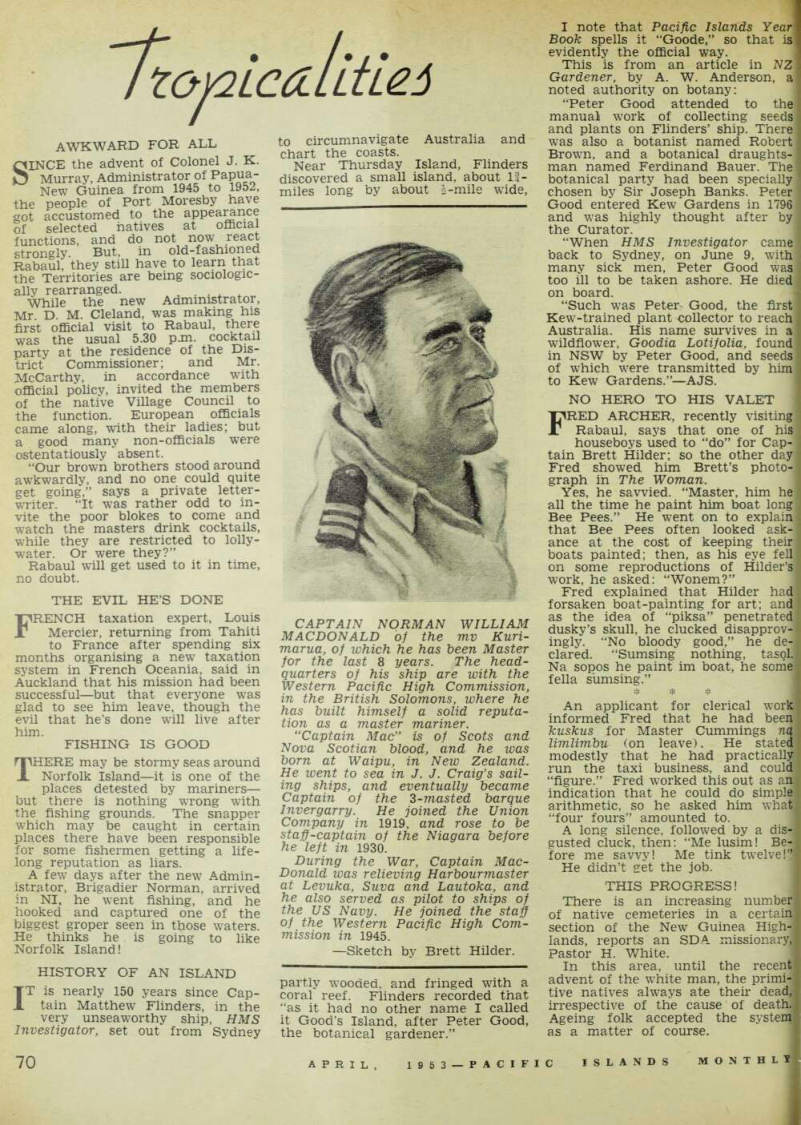
Captain Norman William
MACDONALD of the mv Kuri marua, of which he has been Master for the last 8 years. The head quarters of his ship are with the Western Pacific High Commission, in the British Solomons, where he has built himself a solid reputa tion as a master mariner.
“Captain Mac ” is of Scots and Nova Scotian blood, and he was born at Waipu, in New Zealand.
He went to sea in J. J. Craig’s sail ing ships, and eventually became Captain of the 3-masted barque Invergarry. He joined the Union Company in 1919, and rose to be staff-captain of the Niagara before he left in 1930.
During the War, Captain Mac- Donald was relieving Harbourmaster at Levuka, Suva and Lautoka, and he also served as pilot to ships of the US Navy. He joined the staff of the Western Pacific High Com mission in 1945.
Sketch by Brett Hilder.