Whence Came New Guinea’S
p. 67 · Read in the full issue
Magazine Section
‘Native’ Tobacco?
Mr. A. P. Lyons, former Departmental head in Papua, discusses a botanical puzzle.
lOON after white men began to ) settle in Papua, it became known at some natives smoked locally own tobacco. Sb far as I am yare, nobody has proved that this bacco was indigenous.
Before 1888, very little was known out the Territory. Sir William acgregor began his intensive ex oration of the country and its tentialities in 1889. That year he iited Mount Victoria.
En route, he met some friendly mntaineers and offered them some rade” tobacco, which, he records, ley do not greatly prize as they jw very good tobacco themselves” . 5 obtained some seeds of this jacco, and sent them to the Queens id Agricultural Department.
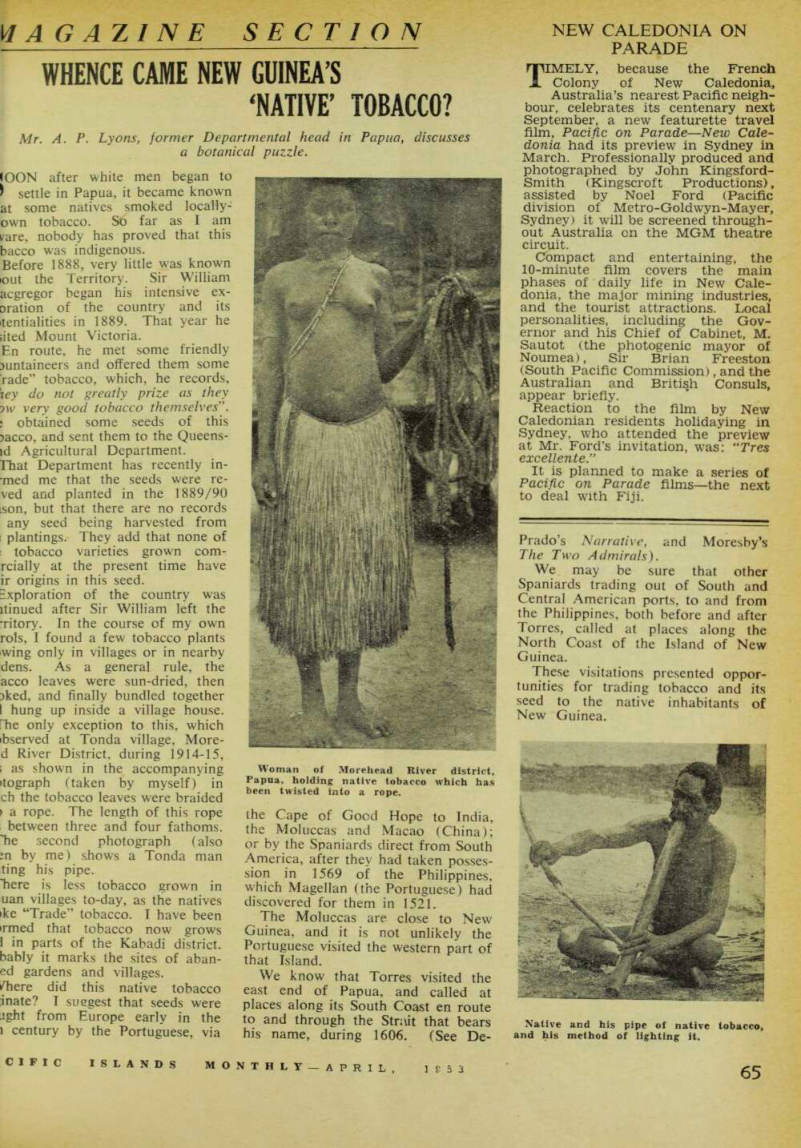
That Department has recently in med me that the seeds were re ved and planted in the 1889/90 ison, but that there are no records any seed being harvested from : plantings. They add that none of tobacco varieties grown com rcially at the present time have ir origins in this seed, exploration of the country was itinued after Sir William left the •ritory. In the course of my own rols, I found a few tobacco plants wing only in villages or in nearby dens. As a general rule, the acco leaves were sun-dried, then )ked, and finally bundled together I hung up inside a village house, fhe only exception to this, which tbserved at Tonda village, More d River District, during 1914-15, ; as shown in the accompanying •tograph (taken by myself) in ch the tobacco leaves were braided > a rope. The length of this rope between three and four fathoms.
Tie second photograph (also Jn by me) shows a Tonda man ting his pipe.
'here is less tobacco grown in uan villages to-day, as the natives ike “Trade” tobacco. I have been •rmed that tobacco now grows 1 in parts of the Kabadi district, bably it marks the sites of aban ed gardens and villages. /here did this native tobacco mate? I suegest that seeds were jght from Europe early in the i century by the Portuguese, via
the Cape of Good Hope to India, the Moluccas and Macao (China); or by the Spaniards direct from South America, after they had taken posses sion in 1569 of the Philippines, which Magellan (the Portuguese) had discovered for them in 1521.
The Moluccas are close to New Guinea, and it is not unlikely the Portuguese visited the western part of that Island.
We know that Torres visited the east end of Papua, and called at places along its South Coast en route to and through the Stnvit that bears his name, during 1606. (See De-
Prado’s Narrative, and Moresby’s The Two Admirals) .
We may be sure that other Spaniards trading out of South and Central American ports, to and from the Philippines, both before and after Torres, called at places along the North Coast of the Island of New Guinea.
These visitations presented oppor tunities for trading tobacco and its seed to the native inhabitants of New Guinea.
Woman of Morehead River district, Papua, holding native tobacco which has been twisted into a rope.
Native and his pipe of native tobacco, and his method of lighting it.