Affling Character Of Fiji-Indian Problem
pp. 127-129 · Read in the full issue
Mr. A. A. Ragg Appeals to British Parliament
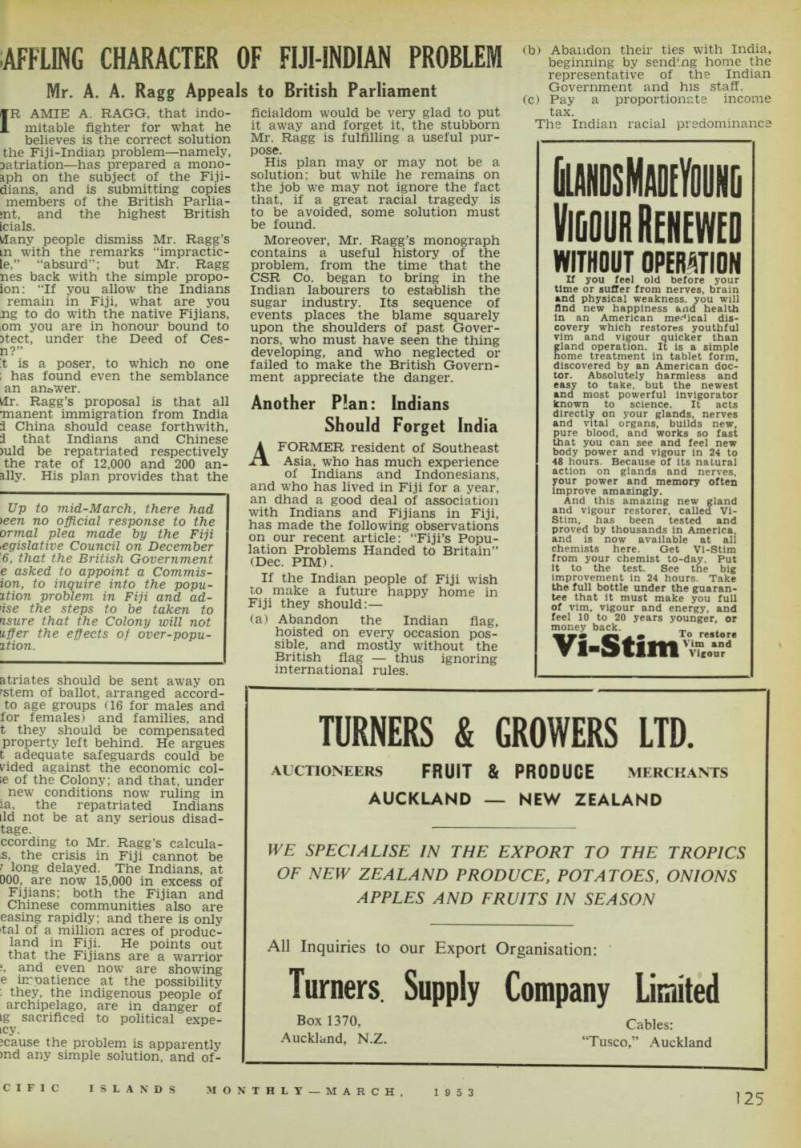
IR AMIE A. RAGG, that indo mitable fighter for what he believes is the correct solution the Fiji-Indian problem—namely, aatriation —has prepared a mono aph on the subject of the Fiji dians, and is submitting copies members of the British Parlia ;nt, and the highest British icials.
Many people dismiss Mr. Ragg’s in with the remarks “impractic le,” “absurd”; but Mr. Ragg nes back with the simple propo ion: “If you allow the Indians remain in Fiji, what are you ng to do with the native Fijians, om you are in honour bound to atect, under the Deed of Ces n?” t is a poser, to which no one ; has found even the semblance an answer. tfr. Ragg’s proposal is that all manent immigration from India 3 China should cease forthwith, 3 that Indians and Chinese mid be repatriated respectively the rate of 12,000 and 200 an ally. His plan provides that the
Up to mid-March, there had teen no official response to the ormal plea made by the Fiji legislative Council on December 6, that the British Government e asked to appoint a Commis ion, to inquire into the popu ition problem in Fiji and ad vise the steps to be taken to nsure that the Colony will not nffer the effects of over-popu ition.
atriates should be sent away on astern of ballot, arranged accord to age groups (16 for males and for females) and families, and t they should be compensated property left behind. He argues t adequate safeguards could be yided against the economic col ie of the Colony; and that, under new conditions now ruling in ia, the repatriated Indians ild not be at any serious disad tage. ccording to Mr. Ragg’s calcula s, the crisis in Fiji cannot be r long delayed. The Indians, at 000, are now 15,000 in excess of Fijians; both the Fijian and Chinese communities also are easing rapidly; and there is only tal of a million acres of produc land in Fiji. He points out that the Fijians are a warrior ?, and even now are showing e impatience at the possibility ; they, the indigenous people of archipelago, are in danger of ig sacrificed to political expe icy. jcause the problem is apparently »nd any simple solution, and of
ficialdom would be very glad to put it away and forget it, the stubborn Mr. Ragg is fulfilling a useful pur pose.
His plan may or may not be a solution; but while he remains on the job we may not ignore the fact that, if a great racial tragedy is to be avoided, some solution must be found.
Moreover, Mr. Ragg’s monograph contains a useful history of the problem, from the time that the CSR Co. began to bring in the Indian labourers to establish the sugar industry. Its sequence of events places the blame squarely upon the shoulders of past Gover nors, who must have seen the thing developing, and who neglected or failed to make the British Govern ment appreciate the danger.
Another Plan: Indians
Should Forget India
A FORMER resident of Southeast Asia, who has much experience of Indians and Indonesians, and who has lived in Fiji for a year, an dhad a good deal of association with Indians and Fijians in Fiji, has made the following observations on our recent article: “Fiji’s Popu lation Problems Handed to Britain” (Dec. PIM).
If the Indian people of Fiji wish do make a future happy home in Fiji they should:— (a) Abandon the Indian flag, hoisted on every occasion pos sible, and mostly without the British flag thus ignoring international rules.
(b) Abandon their ties with India, beginning by sending home the representative of the Indian Government and his staff. (c) Pay a proportionate income tax.
The Indian racial predominance
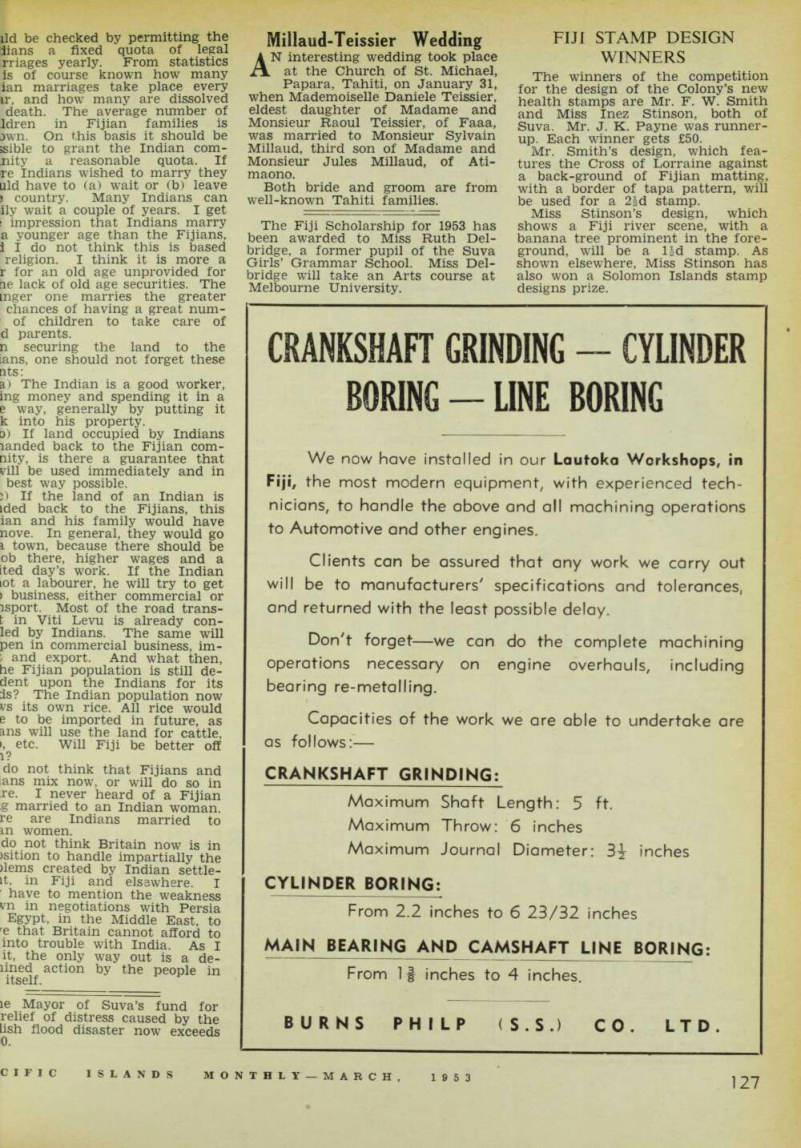
ild be checked by permitting the lians a fixed quota of legal Triages yearly. From statistics is of course known how many ian marriages take place every ir, and how many are dissolved death. The average number of Idren in Fijian families is jwn. On this basis it should be jsible to grant the Indian com nity a reasonable quota. If re Indians wished to marry they uld have to (a) wait or (b) leave 5 country. Many Indians can ily wait a couple of years. I get ! impression that Indians marry a younger age than the Fijians, 1 I do not think this is based religion. I think it is more a r for an old age unprovided for tie lack of old age securities. The mger one marries the greater chances of having a great num of children to take care of d parents. n securing the land to the tans, one should not forget these nts: a) The Indian is a good worker, ing money and spending it in a e way, generally by putting it k into his property. b) If land occupied by Indians landed back to the Fijian com nity, is there a guarantee that vill be used immediately and in best way possible, j) If the land of an Indian is ided back to the Fijians, this ian and his family would have nove. In general, they would go i town, because there should be ob there, higher wages and a ited day’s work. If the Indian lot a labourer, he will try to get ) business, either commercial or isport. Most of the road trans t in Viti Levu is already con led by Indians. The same will pen in commercial business, im * and export. And what then, he Fijian population is still de dent upon the Indians for its is? The Indian population now vs its own rice. All rice would e to be imported in future, as ans will use the land for cattle, », etc. Will Fiji be better off i? do not think that Fijians and ans mix now, or will do so in re. I never heard of a Fijian g married to an Indian woman, re are Indians married to m women. do not think Britain now is in )sition to handle impartially the )lems created by Indian settle it, in Fiji and elsewhere. I have to mention the weakness vn in negotiations with Persia Egypt, in the Middle East, to r e that Britain cannot afford to into trouble with India. As I it, the only way out is a de hned action by the people in itself. le Mayor of Suva’s fund for relief of distress caused by the lish flood disaster now exceeds 0.