Fiji-Owned
pp. 116-117 · Read in the full issue
Land
And Its Uses
From Our Own Correspondent
Suva, Feb. 23.
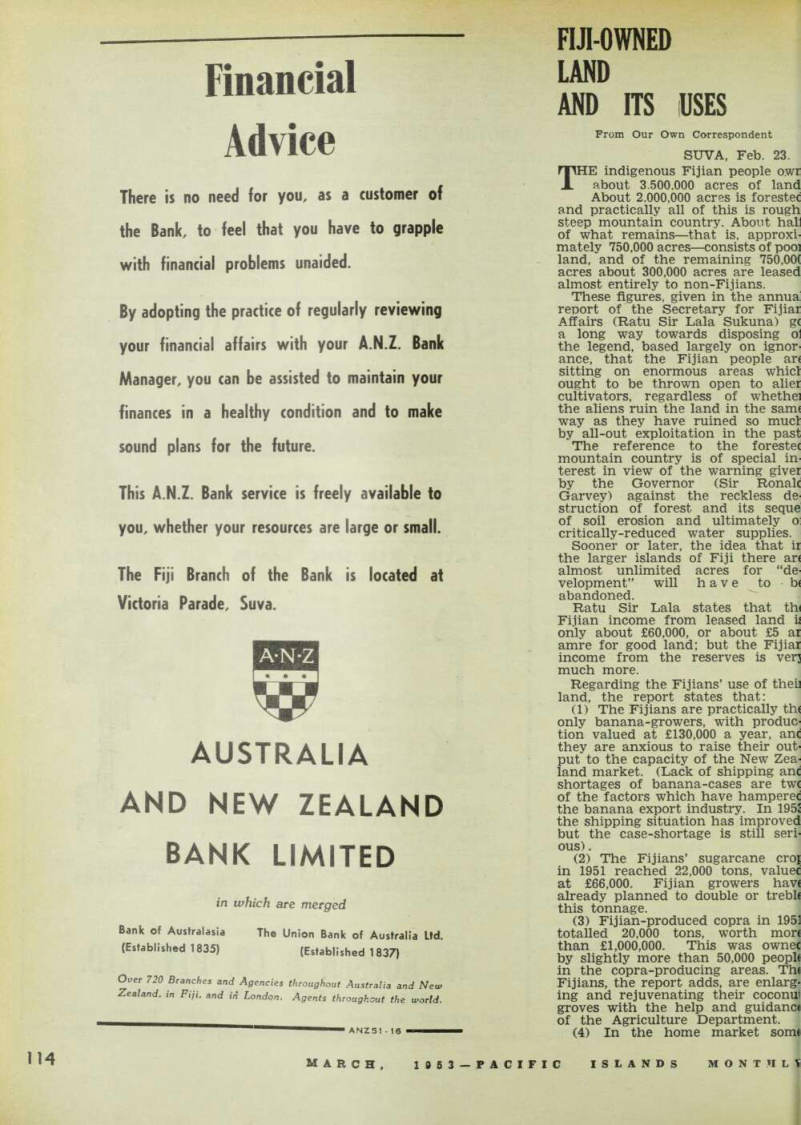
THE indigenous Fijian people own about 3.500.000 acres of land About 2.000,000 acres is forested and practically all of this is rough steep mountain country. About hali of what remains—that is, approxi mately 750,000 acres—consists of pool land, and of the remaining 750,00 C acres about 300,000 acres are leased almost entirely to non-Fijians.
These figures, given in the annua! report of the Secretary for Fijiar Affairs (Ratu Sir Lala Sukuna) gc a long way towards disposing oi the legend, based largely on ignor ance, that the Fijian people are sitting on enormous areas whicl ought to be thrown open to alier cultivators, regardless of whethei the aliens ruin the land in the same way as they have ruined so muct by all-out exploitation in the past The reference to the forested mountain country is of special in terest in view of the warning giver by the Governor (Sir Ronald Garvey) against the reckless de struction of forest and its seque! of soil erosion and ultimately o] critically-reduced water supplies.
Sooner or later, the idea that ir the larger islands of Fiji there are almost unlimited acres for “de velopment” will have to be abandoned.
Ratu Sir Lala states that the Fijian income from leased land is only about £60,000, or about £5 ar amre for good land; but the Fijiar income from the reserves is verj much more.
Regarding the Fijians’ use of theii land, the report states that: (1) The Fijians are practically the only banana-growers, with produc tion valued at £130,000 a year, and they are anxious to raise their out put to the capacity of the New Zea land market. (Lack of shipping and shortages of banana-cases are two of the factors which have hampered the banana export industry. In 195 S the shipping situation has improved but the case-shortage is still seri ous) . (2) The Fijians’ sugarcane cro* in 1951 reached 22,000 tons, valued at £66,000. Fijian growers have already planned to double or treble this tonnage. (3) Fijian-produced copra in 1951 totalled 20,000 tons, worth more than £1,000,000. This was owned by slightly more than 50,000 people in the copra-producing areas. The Fijians, the report adds, are enlarg ing and rejuvenating their coconui groves with the help and guidance of the Agriculture Department. (4) In the home market som(
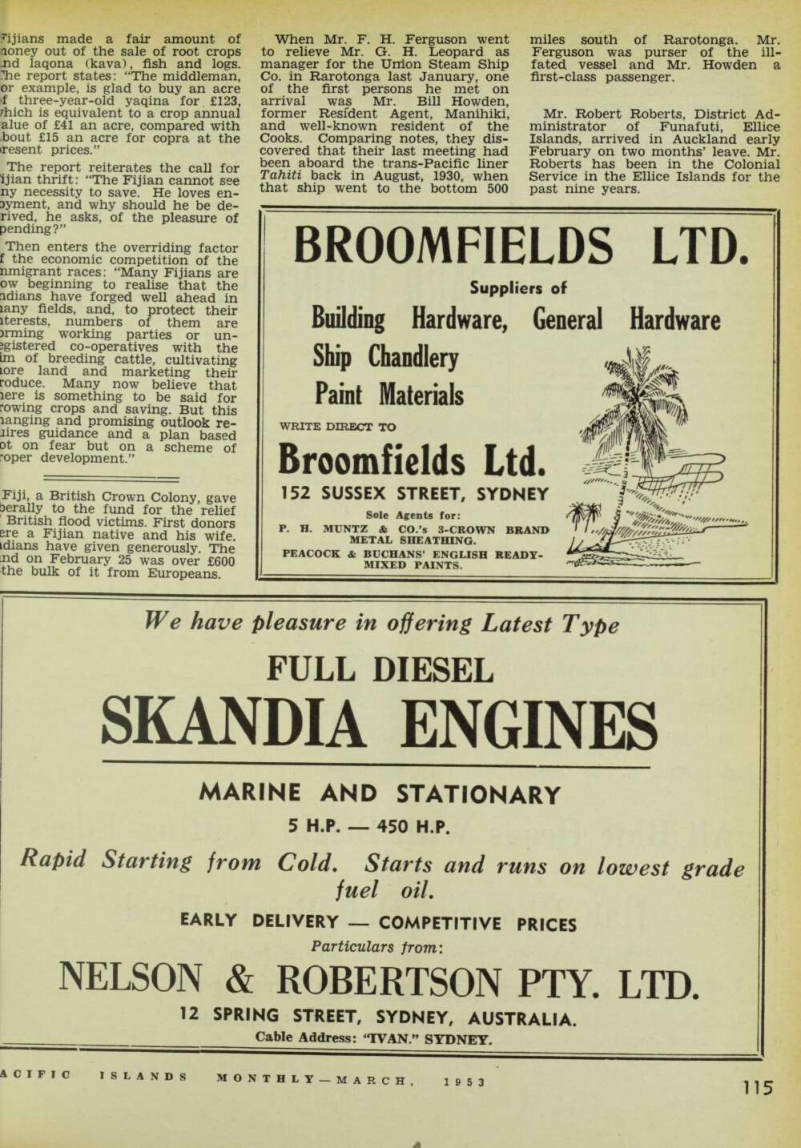
Fijians made a fair amount of tioney out of the sale of root crops -nd laqona (kava), fish and logs.
The report states; “The middleman, or example, is glad to buy an acre if three-year-old yaqlna for £123, rtiich is equivalent to a crop annual alue of £4l an acre, compared with -bout £l5 an acre for copra at the •resent prices.”
The report reiterates the call for ijian thrift: “The Fijian cannot see ny necessity to save. He loves en ayment, and why should he be de rived, he asks, of the pleasure of pending?”
Then enters the overriding factor f the economic competition of the nmigrant races: “Many Fijians are ow beginning to realise that the idians have forged well ahead in lany fields, and, to protect their iterests, numbers of them are liming working parties or un jgistered co-operatives with the im of breeding cattle, cultivating tore land and marketing their reduce. Many now believe that lere is something to be said for rowing crops and saving. But this langing and promising outlook re tires guidance and a plan based ot on fear but on a scheme of roper development.”
Fiji, a British Crown Colony, gave berally to the fund for the relief British flood victims. First donors ere a Fijian native and his wife, idians have given generously. The ;nd on February 25 was over £6OO the bulk of it from Europeans.
When Mr. F. H. Ferguson went to relieve Mr. G. H. Leopard as manager for the Union Steam Ship Co. in Rarotonga last January, one of the first persons he met on arrival was Mr. Bill Howden, former Resident Agent, Manihiki, and well-known resident of the Cooks. Comparing notes, they dis covered that their last meeting had been aboard the trans-Pacific liner Tahiti back in August, 1930, when that ship went to the bottom 500
miles south of Rarotonga. Mr.
Ferguson was purser of the ill fated vessel and Mr. Howden a first-class passenger.
Mr. Robert Roberts, District Ad ministrator of Funafuti, Ellice Islands, arrived in Auckland early February on two months’ leave. Mr.
Roberts has been in the Colonial Service in the Ellice Islands for the past nine years.