Future Of The Solomon Islands
pp. 21-122 · Read in the full issue
New High Commissioner’s Comprehensive Review
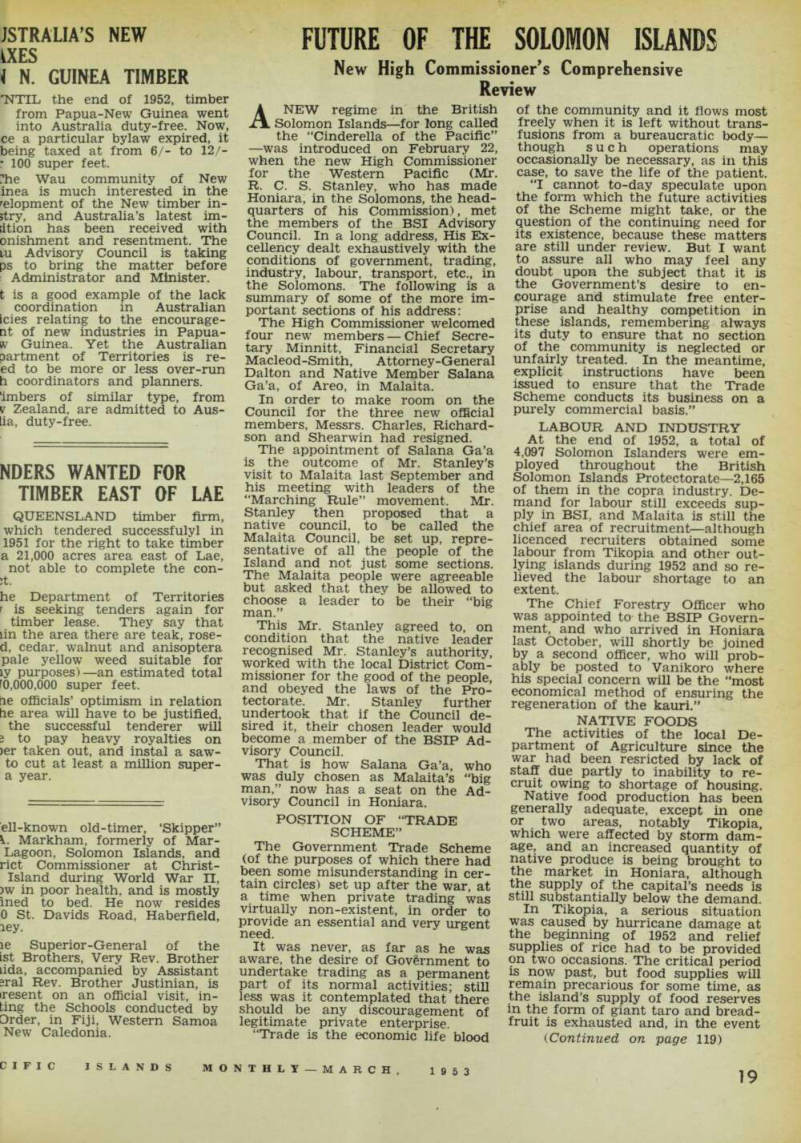
ANEW regime in the British Solomon Islands—for long called the "Cinderella of the Pacific” —was introduced on February 22, when the new High Commissioner for the Western Pacific (Mr.
R. C. S. Stanley, who has made Honiara, in the Solomons, the head quarters of his Commission), met the members of the BSI Advisory Council. In a long address, His Ex cellency dealt exhaustively with the conditions of government, trading, industry, labour, transport, etc., in the Solomons. The following is a summary of some of the more im portant sections of his address: The High Commissioner welcomed four new members Chief Secre tary Minnitt, Financial Secretary Macleod-Smith, Attorney-General Dalton and Native Member Salana Ga’a, of Areo, in Malaita.
In order to make room on the Council for the three new official members, Messrs. Charles, Richard son and Shearwin had resigned.
The appointment of Salana Ga’a is the outcome of Mr. Stanley’s visit to Malaita last September and his meeting with leaders of the "Marching Rule” movement. Mr.
Stanley then proposed that a native council, to be called the Malaita Council, be set up, repre sentative of all the people of the Island and not just some sections.
The Malaita people were agreeable but asked that they be allowed to choose a leader to be their "big man.”
This Mr. Stanley agreed to, on condition that the native leader recognised Mr. Stanley’s authority, worked with the local District Com missioner for the good of the people, and obeyed the laws of the Pro tectorate. Mr. Stanley further undertook that if the Council de sired it, their chosen leader would become a member of the BSIP Ad visory Council.
That is how Salana Ga’a, who was duly chosen as Malaita’s "big man,” now has a seat on the Ad visory Council in Honiara.
Position Of “Trade
Scheme”
The Government Trade Scheme (of the purposes of which there had been some misunderstanding in cer tain circles) set up after the war, at a time when private trading was virtually non-existent, in order to provide an essential and very urgent need.
It was never, as far as he was aware, the desire of Government to undertake trading as a permanent part of its normal activities; still less was it contemplated that there should be any discouragement of legitimate private enterprise.
“Trade is the economic life blood
of the community and it flows most freely when it is left without trans fusions from a bureaucratic body— though such operations may occasionally be necessary, as in this case, to save the life of the patient.
“I cannot to-day speculate upon the form which the future activities of the Scheme might take, or the question of the continuing need for its existence, because these matters are still under review. But I want to assure all who may feel any doubt upon the subject that it is the Government’s desire to en courage and stimulate free enter prise and healthy competition in these islands, remembering always its duty to ensure that no section of the community is neglected or unfairly treated. In the meantime, explicit instructions have been issued to ensure that the Trade Scheme conducts its business on a purely commercial basis.”
Labour And Industry
At the end of 1952, a total of 4,097 Solomon Islanders were em ployed throughout the British Solomon Islands Protectorate —2,165 of them in the copra industry. De mand for labour still exceeds sup ply in BSI, and Malaita is still the chief area of recruitment—although licenced recruiters obtained some labour from Tikopia and other out lying islands during 1952 and so re lieved the labour shortage to an extent.
The Chief Forestry Officer who was appointed to the BSIP Govern ment, and who arrived in Honiara last October, will shortly be joined by a second officer, who will prob ably be posted to Vanikoro where his special concern will be the "most economical method of ensuring the regeneration of the kauri.”
Native Foods
The activities of the local De partment of Agriculture since the war had been resricted by lack of staff due partly to inability to re cruit owing to shortage of housing.
Native food production has been generally adequate, except in one or two areas, notably Tikopia, which were affected by storm dam age, and an increased quantity of native produce is being brought to the market in Honiara, although the supply of the capital’s needs is still substantially below the demand.
In Tikopia, a serious situation was caused by hurricane damage at the beginning of 1952 and relief supplies of rice had to be provided on two occasions. The critical period is now past, but food supplies will remain precarious for some time, as the island’s supply of food reserves in the form of giant taro and bread fruit is exhausted and, in the event
(Continued on page 119)
»f another “blow,” the situation vould become very serious.
The island was barely adequate n area to support the existing »opulation under normal conditions, ind plans for the resettlement of a lumber of families are under con ideration.
Quality Of Copra
The quality of much of the copra troduced in the Protectorate was ar from high by world standards, nd the problem of its improve ment should seriously concern all arsons associated with the in ustry, although some large pro ucers had already commenced the itroduction of hot-air driers.
There had been no new outbreaks f pests or diseases of coconuts, "ields in the formerly heavily bl asted Amblypelta nut-fall areas of Guadalcanal had remained good.
Provision from Colonial Develop lent and Welfare funds for the ppointment and working expenses f an Emtomologist for three years ave been approved. This is aug lented by a proposed contribution ■om the Copra Board’s funds. Dr.
S. Phillips had accepted the ppointment of Entomologist and immenced duty in the Protectorate LSt July.
Buildings Needed
The Commissioner referred to the Honiara Hospital as a “serious re proach and a dismal reminder of the ineffectiveness of past effort.”
He said that a heavy building programme lay ahead of the Pro tectorate government in the next couple of years. In addition to re constructing the hospital (cost £A106,000) 39 houses for Govern ment staff and nursing sisters quarters were desperately needed and were, in fact, delaying the re cruitment of staff needed for de velopment schemes.
Buildings were required also for the air-radio installation at Hender son Field. In all, the building pro gramme of the next two years was expected to cost some £A265,000, a large proportion of which would be met from the Colonial Development and Welfare Fund.
Honiara V. Tulagi
He was well aware of the feeling among the mercantile community that it had been a mistake to abandon Tulagi in favour of Honiara. The natural superiority of Tulagi over Honiara as a harbour was obvious; but he believed that in the long-term view Honiara had the advantage. However, whatever
the demerits and merits of Honiara, the capital had been established there, money had been spent there, and there the capital must remain.
He thought that all that could be
said on the TulagLHoniara con troversy had been said.
A considerable amount of cargo destined for Honiara is at present landed at Tulagi and ferried across to Honiara. Steps should be taken to alter this and money that should soon have had to be spent on Tulagi wharf —which is in an advanced state of disrepair—would be better spent in providing an efficient lighter service at Point Cruz so that all cargo for Honiara could be landed directly there.
At present, for financial reasons, there seemed no prospect of build ing a wharf at Honiara capable of accommodating large ocean-going vessels; but this was the goal to be aimed at ultimately.
Mineral Prospects
Some goldmining interests have investigated possibilities in BSIP in recent years but nothing has come of it. It was understood that the reluctance of these companies to commit themselves to enterprises in the Protectorate was not because of lack of promise in mineral area but rather because of the regula tions and restrictions imposed by the mining laws of the country. All that, apparently, is now to be changed.
Mr. Stanley said that the Senior Geologist who has been engaged for the last three years in making an Interim geological survey of the Protectorate for the Colonial De velopment and Welfare Fund had produced a comprehensive report.
“It is important that prospecting, both by individual prospectors and the larger mining concerns, should beencouraged and the fullest avail able information will be furnished by the Mining Board to inquirers.
Aerial photographs are now avail able covering all islands of the Pro tectorate other than the Santa Cruz Group.”
Other Matters
He recommended a Standing Committee of the Advisory Council which he could consult from time to time, as problems of adminis tration arose.
It was hoped that the introduc tion of over 40 Hereford heifers and one Zebu bull from Fiji, and two Hereford bulls from New Zealand, 'would form the basis of a beef-rais ing project at Hu.
Co-operative Officer J. D. Davies who returned from a study of co operatives in the G and E Com pany, hoped to encourage coccoa production on a co-operative basis by the natives of Malaita.
Departmental Heads
Important statements on BSI matters of general interest were by J he Financial Secretary, (Mr. A. M. MacLeod Smith), Attor ney-General (Mr. P. N. Dalton) Senior Medical Officer, (Dr. W H
McDonaid) and Chief Secretary
(Mr. R. j. Mmmtt). have been summarised and will be published in an early issue of the PIM. y