Magazine Section
pp. 71-72 · Read in the full issue
War’S Aftermath—Noumea
By R. W.
Robson
Noumea, Oct., 1952.
IT Is 10* years since the first division of American troops poured ashore in this port, to establish the first corner of the line that eventually stopped the Japanese invasion of the South Pacific. It is six years since the Americans left this place.
It is not like Rabaul, which was simply obliterated. Nevertheless, the traces of war still are all over and around Noumea.
Before the end of 1942, the low hills for miles around this port had been covered with endless lines of pre-fabricated buildings, housing hundreds of thousands of service men. Most of the buildings nov; are gone, but the hills still carry the levelled terraces where they were sited —thus resembling, in a truly remarkable way, the terraced hillsides of some forgotten race of agriculturalists, which I photo graphed between Noumea and La Foa, and published in the PIM nearly 20 years ago.
Along the business streets, one notes some new buildings of modern design. They were paid for with >he dollars of half a million service men, who enriched scores of Noumea traders in 1942-45.
In the same streets there are nany cars and, among the cars,
countless jeeps—relics of the war, and a godsend to this, as to so many other Pacific territories.
Most of them obviously are near the end of their useful lives, but their grim-faced drivers keep them spluttering and moving.
And in the extraordinary mixture of races in these streets I am shown youngsters who may also be described as part of the flotsam of wa r—offspring of servicemen and local women. They are of all shades of colour but—thanks to the kindly ca f® of French administration they all a PPear well-fed and ha PPV- T • • , , h L i. vmg T m one street near the 1 S t w Tonkinese New p al^ doniar kanakas. Loyalty Isl anders ’, Indonesians, Polynesians f ro m Wallis, and various crosses showing Chinese and Japanese and American negro characteristics. It was a happy and contented community. Under to-day’s laws, all have equal rights as citizens of the French Union.
ag b ™^r a zz
palms and gardens, is a French Institute devoted to scientific
research. Had there been no war, there might have been no Institute, no Pentagon, and no South Pacific Commission in New Caledonia, T N a pleasant circular valley, A between Noumea and Anse Vata, is Noumea’s newest suburb. (See photographs). Scores, perhaps hundreds of decent families live in these Quonset huts, enjoying the shelter, electric light and power, water-supply and drainage provided 10 years ago for USA servicemen, , ... .. , 01 , , . , r Uri 6? amid
inhSfoH a
row, labelled respectively “Miss Montana”. “Miss Washington” and “Miss North Carolina”. No one could tell me why they thus were named: so your guess is as good as mine After I had photographed “Miss North Carolina” (see picture here with) I listed the contents of the comfortable little home which I could see from the sidewalk— and flowers.
I do not know the name of the neat little suburb. It should be
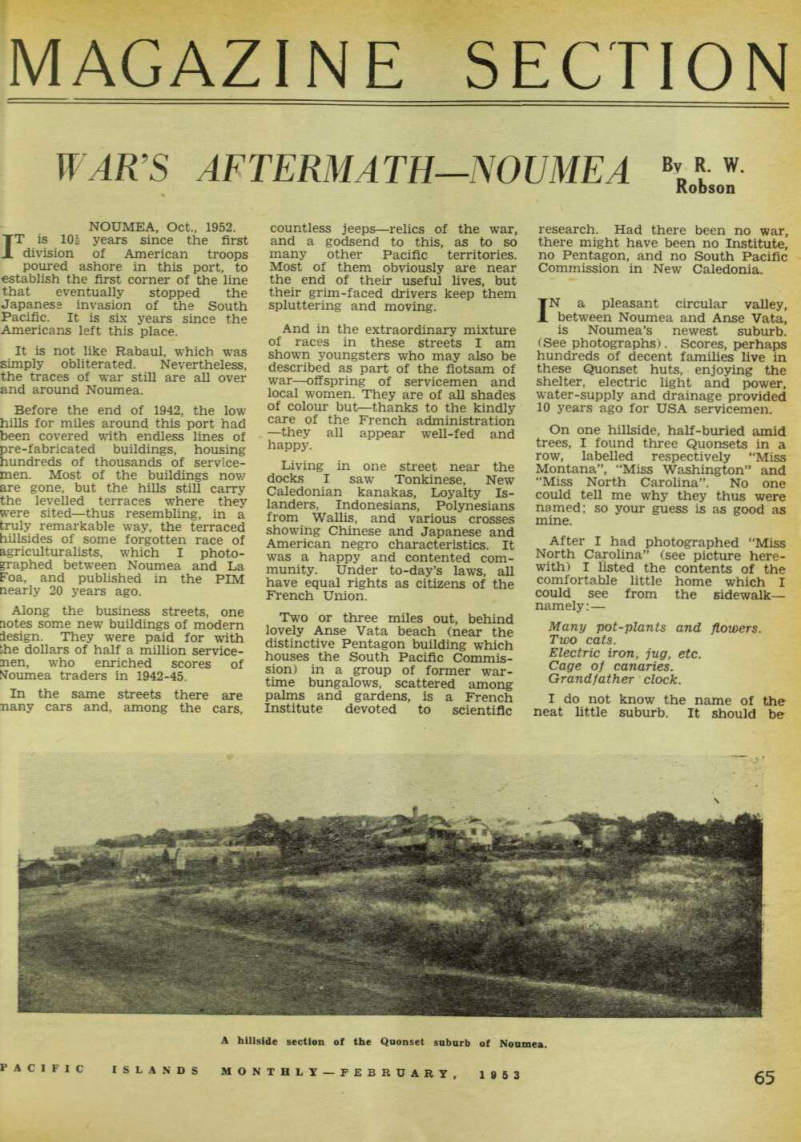
A hillside section of the Quonset suburb of Noumea.
called Quonset. It has Anse Vata beach on one side, and the town on the other, and is connected with both by a good bus service.
War is a curse, of course. But I seem to see the good burghers of Noumea regarding war’s aftermath with a certain amount of com
placency.
leadmg
of tv. Br ° th l r A u lphonsus ’ no w anst ° rder > who has given ™ ! es ? 64 yCarS educatl ° nal work in Fiji, were each awarded an
MBE in the New Year Honours, There wa s an MBE also for Warrant Officer Ernest Bolton, of the RNZAF, f or good service at the Laucala Bay station.
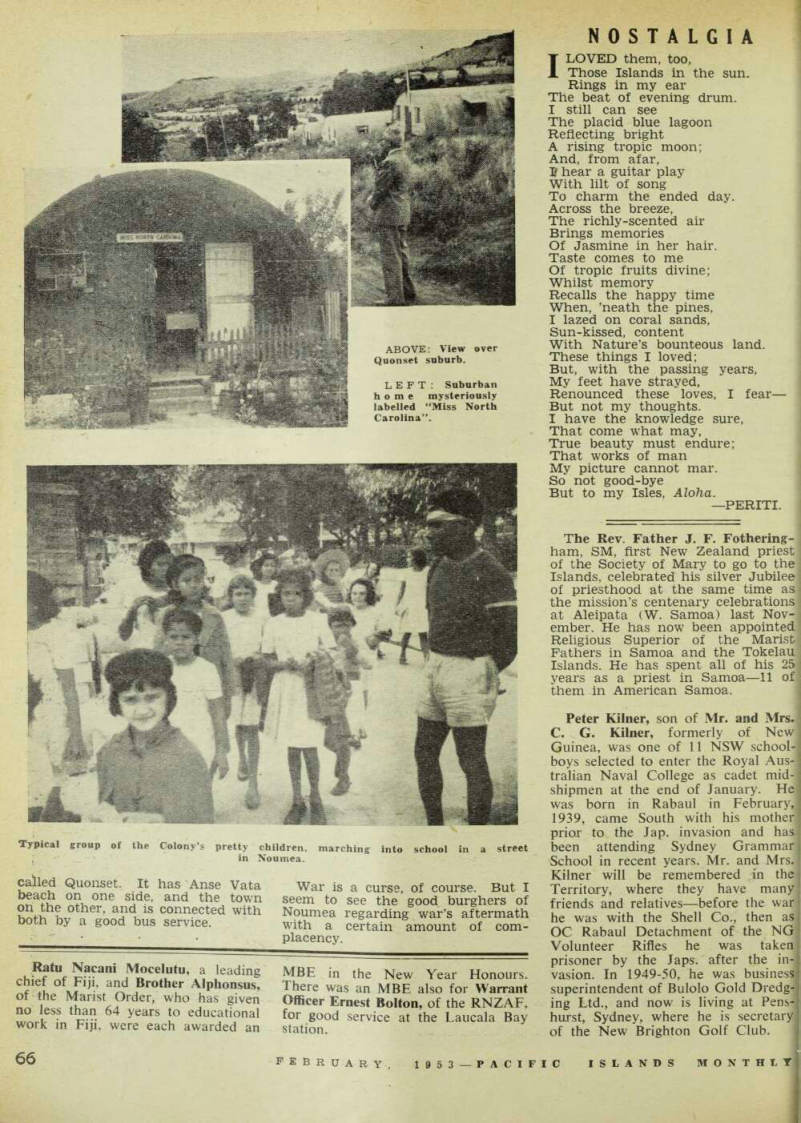
ABOVE: View over Quonset suburb.
LEFT: Suburban home mysteriously labelled “Miss North Carolina”.
Typical group of the Colony’s pretty children, marching into school in a street in Noumea.