The Loss of The Carnegie
p. 65 · Read in the full issue
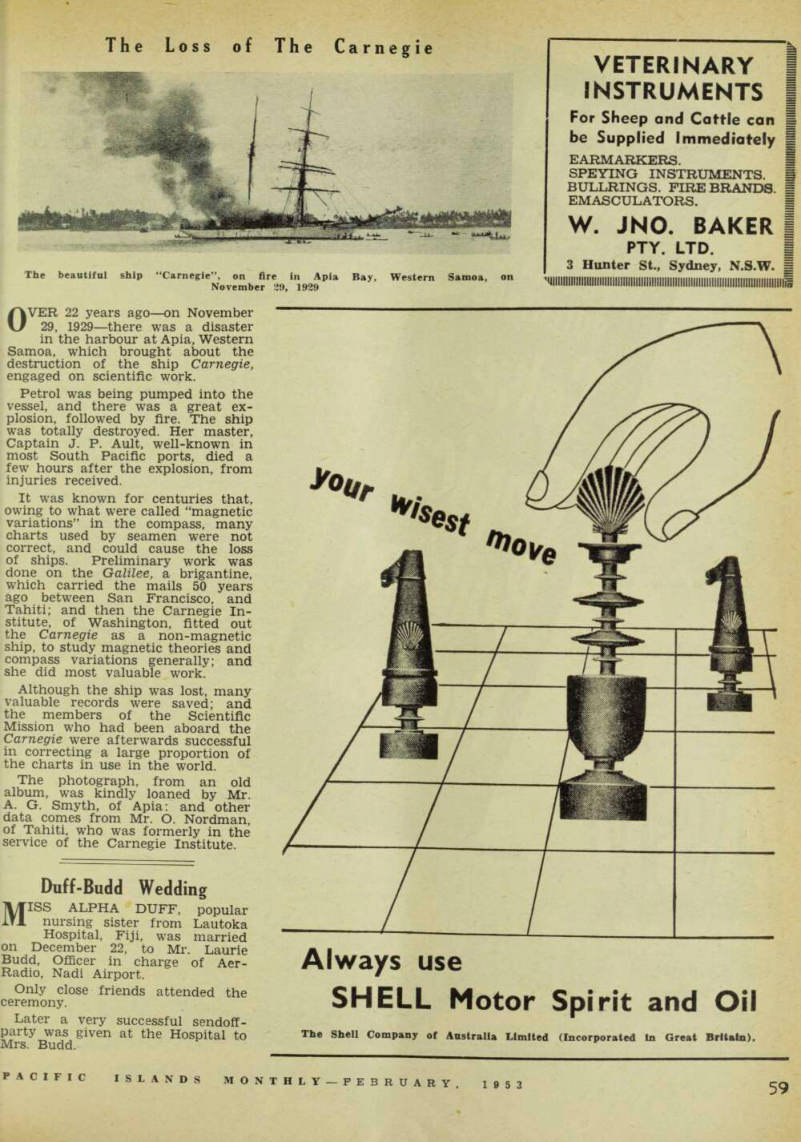
OVER 22 years ago—on November 29, 1929 —there was a disaster in the harbour at Apia, Western Samoa, which brought about the destruction of the ship Carnegie, engaged on scientific work.
Petrol was being pumped into the vessel, and there was a great ex plosion, followed by fire. The ship was totally destroyed. Her master, Captain J. P. Ault, well-known in most South Pacific ports, died a few hours after the explosion, from injuries received.
It was known for centuries that, owing to what were called “magnetic variations” in the compass, many charts used by seamen were not correct, and could cause the loss of ships. Preliminary work was done on the Galilee, a brigantine, which carried the mails 50 years ago between San Francisco, and Tahiti; and then the Carnegie In stitute, of Washington, fitted out the Carnegie as a non-magnetic ship, to study magnetic theories and compass variations generally; and she did most valuable work.
Although the ship was lost, many valuable records were saved; and the members of the Scientific Mission who had been aboard the Carnegie were afterwards successful in correcting a large proportion of the charts in use in the world.
The photograph, from an old album, was kindly loaned by Mr.
A. G. Smyth, of Apia: and other data comes from Mr. O. Nordman, of Tahiti, who was formerly in the service of the Carnegie Institute.
The beautiful ship “Carnegie”, on fire in Apia Bay, Western Samoa, on November 29, 1929