The Editors' Mailbag
pp. 20-22 · Read in the full issue
Stainless Steel Murnan
Completes Circumnavigation
Remember Bill Murnan, who was in the South Pacific Islands in the stainless steel yacht Seven Seas II in 1948 and 1949, and who left Port Moresby in mid-1950, headed for Indonesia and South Africa? He reports cheerily from Miami, Florida, under date January, 1953.
The trustworthy little metal ship was sold in New York last October; and Bill thereupon bought a huge Ford “ranch waggon”, which he and his wife named Seven Seas 111, and in which they now are engaged in wide-flung land-cruising. (One suspects that the attractive Mrs.
Bill does not like the motion of the wide seas which her circum navigating husband has conquered).
Bill, all alone in Seven Seas 11, was buffeted cruelly in the Indian Ocean; but by mid-1951 he was round the Cape of Good Hope and away across the South Atlantic.
He spent eight weeks in St. Helena with “the nicest and most sincere people of the entire trip” (pleasant words for former South Pacific-ites Trevor Johnston and Sir George Joy); and then he had 3,240 miles of delightful sailing, in 35 days, to the West Indies. He spent some months among those archipelagoes; sped across to the American coast; and proceeded by inland waterways to New York, a year after leaving Capetown.
This cruise clear around the world in a small yacht, lone-handed most of the way, in four years, by Bill Murnan, almost without accident, is a really noteworthy feat of navigation. Bill wants his Islands friends to know that letters now can catch up with him at 645 NW Bth Street, Miami, Florida,
Usa.
If Only . . .
From a very competent observer, who retired from the British Colonial Service not long ago, after many long years of service in the South Pacific: “Fiji is lucky to have our mutual friend Ronald Garvey to help deal with some of its modern problems. If only —IF ONLY—the Indians could throw up a leader who could show them how to live and let live. The Indians and Fijians have got to learn how to live and grow up together. Aimee Ragg’s solution, to send all Indians back to India, is no solution at all. .
Battle Facts Mixed
Very mildly, considering the egregi ous character of the error, a reader in Manus, New Guinea, directs our attention to a statement in a recent PIM article about “The Bombard ment of Papeete.”
Our article stated that the Ger man Admiral Von Spec’s fleet of four ships was destroyed at the Battle of the Falkland Islands in January, 1915, by a British squadron under Admiral Craddock. Actually, the battle took place on December 8, 1914, and the Germans had five ships, and the British Commander was Admiral Sturdee.
What actually happened was that the German fleet, after leaving Tahiti, trapped a British squadron under Admiral Craddock off the Chile coast, and sank the British cruisers Good Hope and Monmouth.
Craddock went down with his ship.
Five weeks later, at the Falklands, von Spee also went down with his ship. One small German cruiser escaped from the Falklands, and was caught and sunk by HMS Glas gow in February, 1915.
Our writer was sadly astray.
Old Photographs
A home for a collection of 50years-old photographs is still being sought by Mr. E. Nixonwestwood (PO box 957, Wellington, NZ). They show people and scenes in the moun
tains of Papua, and especially depict
natives of villages 5,000 feet above sea-level. They were taken by Guy Manning when he and Nixonwest wood were clearing Lolorua planta tion, in behind Konosia, at the Galley Reach headwaters. If you are in terested, write to him. (This adver tising space donated in the cause of
science.)
The Von Luckner Treasure
To the note on Von Luckner in December PIM may be added some later news concerning the Sea
Devil and the well-known barque Pamir.
A Swede, Mr. Bernt Leube, arriv ing in Auckland in mid-January, brought a message of goodwill from Von Luckner to readers of the Auckland Star. Mr. Leube’s father is a close personal friend of Von Luckner. He reported that an American-Swiss film company is currently making a film covering the story of the German raider Seeadler. The part of Seeadler is being taken by the barque Pamir, and Von Luckner is, of course, the “star” of the film.
It is also evident from Mr.
Leube’s statement that the Count now 72, has completely recovered from a thrombosis attack which partly paralysed him for some time The Count and Countess (who is Swedish) have made their home near Malmo, in Sweden. They shortly plan another visit to America where Von Luckner has already made several lecture tours and has appeared on television.
There is no mention of any planned treasure hunt to the Pacific, but, from the evidence contained in the Reuter despatch published last month, it would seem more likely that the treasure island where “on a stone are chiselled names of about 80 ships which had been there for the gold” would be Cocos, the Costa Rican island south-west of Panama, rather than Mopelia.
Cocos has been the scene of many treasure hunts and its cliffs carry the names of the many expedition ships and yachts that have called there. Von Luckner, it is thought, called at Cocos in his round-the world cruise in the yacht Seeteujel in the 1930’5. The late Sir Malcolm Campbell was one of many who tried his luck at Cocos—unsuccess fully—but told the story of the tremendous difficulties facing all such Cocos treasure hunters in his book, My Greatest Adventure.
Fiji’s Silliest Controversy
With much acid comment, a very old resident of Fiji sends to us a series of cuttings from the Fiji Times, indicating the fury with which Indian writers of “letters to the editor” are supporting their argument that Indians should have equal rights with Europeans in the use of the Municipal Swimming Baths in Suva. (See news article elsewhere).
This squabble develops at inter vals. A special bathing enclosure for Indians was provided years ago, but the Indians would not use it.
“We are as good as Europeans,” said they, “and we insist on sharing the bath with them.” The whole silly business clearly stems from that inferiority complex which seems to torture the average Indian in Fiji, as elsewhere. It is made so much worse because the average j Indian has no sense of humour.
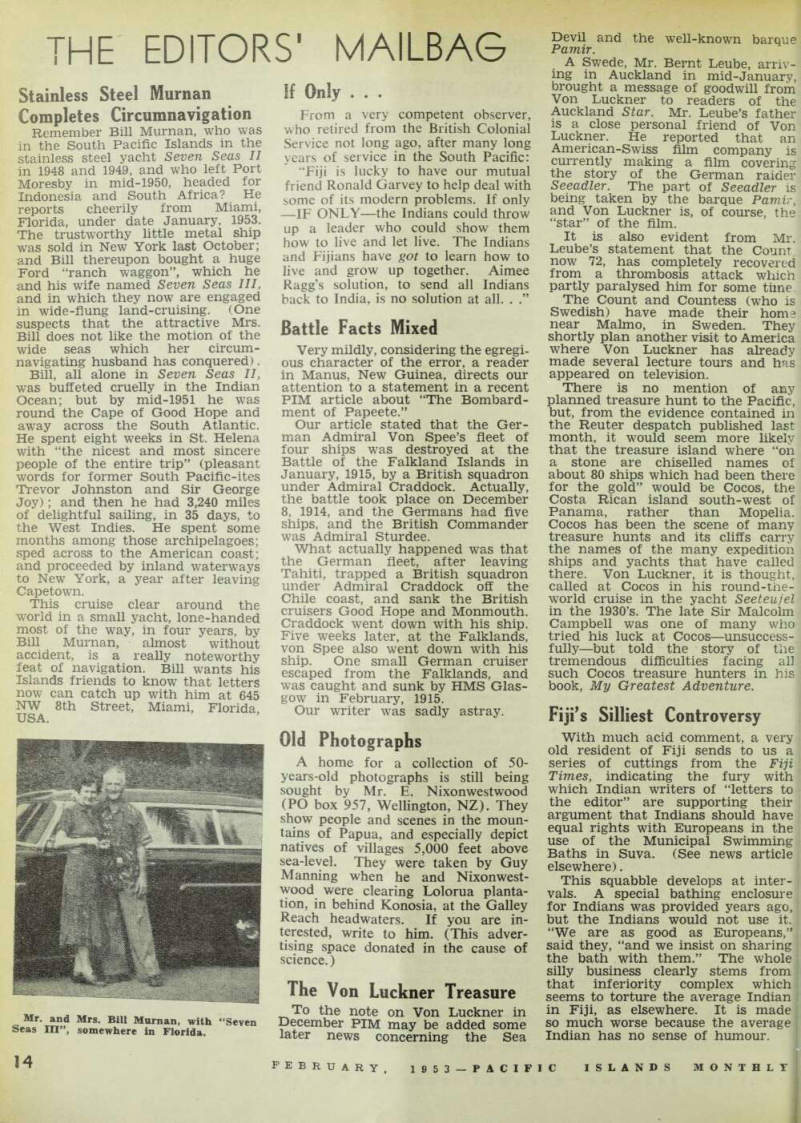
Mr - and Mrs. Bill Murnan, with “Seven Seas III”, somewhere in Florida.
In the court of human rights, there is absolutely no difference be tween Indian, Chinese, Fijian and European. Fijian, European and Chinese adheres each to his own ways of living, and regards the other fellow’s ways with a kindly tolerance. Maybe, each laughs at the other —human beings generally are funny—but there is nothing malicious or unfriendly in it, and the races live happily enough to gether.
But it is not so with a certain class of Indian. His egotism is such that he wants to live in European areas, enter European clubs and hotels and —in this case —go swimming with Europeans. If the Europeans or Fijians or any other community want to keep to themselves, why in the name of commonsense cannot the Indians accept that, and themselves become exclusive? Europeans (except may be a few pin-heads) do not regard themselves as superior beings.
Heaven forfend!—they were bar barians long after the Indians had established a magnificent civilisa tion. But they, and the Chinese and the Fijians, do wish that in their home life and their social relationships they may be free from the embarrassments caused by close contact with people of other races who have quite different con ceptions of life and living. It is not a matter of snobbery, or exclusiveness —it is simply a matter of comfort.
The Suva swimming baths squabble is the silliest thing that has come out of Fiji in years. Why cannot the Indians, in their social activities and organisations, be as exclusive and good-natured to wards other races as other races are towards them?
Rhino Beetle On a New Diet
From Wellington, NZ, Mr. F. H.
E. King, once of Western Samoa, sends us a cutting from the Evening Post. A representative of the E.P. recently visited the Islands, and wrote the article contained in the clipping—on a subject dear to the hearts of New Zealanders — bananas! On surveying the possi bility of boosting Islands production so that NZ-ers may eat two bananas per head per week, the writer refers to the devastating effect rhinoceros beetle has on W.
Samoan production. We agree with Mr. King when he says:— “It looks as if someone has been pulling his leg over the rhinoceros beetle and the damage it does to the banana plantations. Of course, these critters may have developed a taste for bananas since I left Samoa in 1946, but I doubt it.”
Then Mr. King goes on to other subjects: “Various references to the quality of food served at hotels in the South Seas that have appeared in recent issues of PIM have reminded
me of our experience when we ar rived in Samoa and went to stay at an hotel that had better be name less. It was our first introduction to the tropics and we were eagerly looking forward to all manner of luscious tropical fruits; but —our first dessert was steamed pudding!
“I enjoy your feature Small Ships News; Viria, referred to in last April’s issue, must have gone to New Guinea from New Zealand, as she came here from Sweden about four years ago. One Dalhoff, a Swede, came to this country with the intention of establishing a pre fab. house factory in Nelson. The ship, which he brought out from Sweden, was to be used in dis tributing the houses round the country. The factory was never established: Dalhoff is now in partnership with an indent agent.”
Who is Tahiti’s Outstanding
Artist ?
There are those who firmly con test the statement made in January PIM (p. 65) that Edgar Leetag is Tahiti’s outstanding artist to-day.
While admitting that he certainly is one of Tahiti’s notable crafts men, they declare that his work is in demand more because of its un usual nature —being painted on velvet—than from merit alone, though artistic value is not lacking.
Some who claim to know their art declare that the work of the 73-
years-old Monsieur Gouwe, a Dutch man who lives quietly in the coun try and who was recently per suaded to exhibit, will stand the test of time above that of any other artist living in Tahiti to-day.
Supporters of Gouwe say that he lived for many years on Raiatea, adopting the native way of life, and is undoubtedly deeply sympathetic with the “atmosphere” of Poly nesia, which his brush interprets.
While not trying to discount the talents of M. Leetag in any -way, they feel that it would give a false impression to make no mention of Gouwe —and, in the medium of etchings, of the talented Jacques Boullaire, whose work is to be seen on the French Oceania postage stamps. (Leetag Killed—see p. 122.)
Would-be Islands Tourists
Nostalgic note from A. G. Sheat, of Auckland, who would like very much to have another look at the places in Polynesia which he once loved, but who is appalled at the cost of air travel:— “Once there was a steamer leav ing Sydney or Auckland every week or two for the Islands, and it was quite easy for plain people to pay for a passage out and home, with a delightful stay-over in some hospitable island. Now there is only a high-flying Coral Route for Dollar Tourists, and journalists on the free list.”
Let not our friend be misguided in relation to the “privileged press”.
Once, newspaper men travelled often and freely as guests of the shipping companies; but to-day there are very, very few ships with a vacant berth, while the air-lines now are subject to some ruthless international regulation which pro vides rack and torture-chamber for any high executive who hands out “complimentary” tickets, except on very special occasions.
Thousands of people want to visit the Islands—witness the crush When the Orient liners reintroduced their “cruises” the other day—but no one seems able to devise a travel system to take care of the person of modest means, under modern conditions.
Concerning Beer
A public servant from New Ireland is eloquent on the subject of dis comforts suffered as a passenger
Z^\^ lekula - There * nothing
much that is new in his recital of woes; but what he says about liquor is interesting:— M 4 Y £ U 1° , h °P efull y into the 6 ft. * f ft- . k ar > an d seek to ease your unhappiness with a cold drink. But !w re i s no besr far Passengers— not a drop. Before you can get out
again, the place is invaded by a party of crew members, who push you around. They are lining up for their daily ration of Australian beer. They get that by law—under the dictation of their Red Union, I suppose—but there is no beer for the passenger, no matter how much currency he waves around.”
HCL In Vanikoro
A European who has been work ing for a lumber firm in Vanikoro, British Solomon Islands, complains bitterly of the high prices he is forced to pay for food and common necessities, and encloses a copy of his stores to prove his points.
He was charged 6/3 per pound for butter, 50/- for 6 dozen eggs, 10/3
per pound for tea, 35/- for 28 pounds of potatoes, 45/- tor 12 tins of peas, 12/- for 2 tins of cherries and many other items at stoilar rates ‘ hat n are bought
2perVemJ
the goods pay 17i per cent. Cus toms duty, for the BSI Govern ment; and the Co. itself then adds on a substantial charge for its work as distributor, .
ab^u e t «e M
Vanikoro
an< ? the Europ'eans who Se^mto
a two-years engagement, have to endure more than 20 months of almost complete isolation.