Notes Made In The Pacific
pp. 23-113 · Read in the full issue
Third Instalment,
By R. W. Robson
Another Complication
HESE international complica tions! I already have described how a blown-away native of the kelaus, fetching up in French
ritory (Futuna), created head
les in Noumea, Paris, Welling i and Apia. Here is another ex ple of the worries of poor old reaucracy. forth of Tahiti, out in the wide lan spaces between the Northern 3k s and the Marquesas, there are ee tiny islands, Flint, Caroline 1 Vostock, and they belong to the itish Crown. Why Britain re ns them, Heaven knows —they je no population, nothing except :ew groves of healthy coconuts.
Jut coconuts nowadays represent ney and, under some formal angement, the Bambridge in ests of Papeete sent labourers •ench) to Flint and Caroline to ke copra. The labourers took iir wives along; and three wives st inconsiderately produced off ing.
Lccording to the law’s strict in pretation, those babies, having m born in British territory, are tish subjects. The Chancelleries Great Britain and the French ion, are arguing heavily about Probably an Act of Parliament I be needed to put the matter tit.
Jut the farce does not end there, e enterprise produced 85 tons of ira. Because it was produced on tish territory, it is not rated as ;nch, and therefore cannot get French Metropolitan bonus, e thoroughly fed-up Papeete rchants finally offered it to the rpenter crushing mills, in Fiji, 1 Carpenters bought it, and it
came in as British copra, duty free.
That stirred up certain Fiji plant ing interests —they insisted it was French copra, and should be treated accordingly. Merchants and bureaucrats were still discussing the matter, with animation, at the year’s end.
J. P. Bayly’S Cattle
IN all this growing talk about the possibilities of developing the cattle industry in the tropical Islands, I was interested in the ex perience of my friend, Mr. J. P.
Bayly, one of Fiji’s landowners. He makes a comfort able income out of grazing, handling about 5,000 head of cattle at the south-western corner of Viti Levu, and his success is based on obser vation and experience. He breeds the ordinary English types on the dry and fairly high country around Nadi and then, for fattening, he transfers them to the lush green valleys above Sigatoka. Thence they are sold to retail butchers.
There is little disease to plague cattle in Fiji and, with careful supervision, the industry, in Mr.
Bayly’s opinion, has big possibilities.
There is a lot of good natural pasture, but the grazier has to be always seeking improvement in grasses. His greatest trouble in that area is the wild guava—a strong, tenacious plant that, if neglected, will grow eight or 10 feet high and choke all other vegetation.
Once it gets a hold, it has to be torn out with machines, and the land planted with Para, Guinea Grass, or something of that sort.
On this experience, Mr. Bayly does not consider that the Cebu or Brah min cross is necessary for suc cessful cattle production in Fiji.
Young Hooligan Problem
THE wave of petty village crime in the central archipelagoes is giving the local governments a lot of concern. It is seen mostly in a mean type of theft, and especi ally in the practice of young men of creeping into other people’s gardens and carrying off their bananas, taro and other common foodstuffs. There also is an increas ing amount of intereference with young women—there have been some unpleasant rape cases. This evidence of growing hooliganism is worst in Western Samoa, but there has been a good deal of similar trouble in Tonga, and some evid ence of the same trend in Fiji.
From observations made in Samoa, I think there has been police weakness there—too easy a relationship between officers and villagers. When there is general prosperity, as in Samoa, there is a tendency among youths towards “flashness”; and the answer is stern discipline—stern in this case mean ing the prompt application of a cane in the place designated by Nature for that purpose, rather than court and prison procedure.
Happy Accident For Fiji
IT was just a happy accident that Warner Brothers film unit — which has now completed the making of the O’Keefe film— selected a location in Fiji, and left at least £250,000 in the Colony.
Two Warner Bros, executives, planning the enterprise, arrived in Fiji by air, en route to Samoa, which it was generally understood, would be the location. They had to wait a little while in Suva for transportation, and Mr. Robert Hewlett, Tourist Officer, of Nadi, was asked to show them some thing of Fiji during their stay. Mr.
Hewlett motored them along the South Coast road, and they liked what they saw.
They went on to Samoa; and then came back and had another look at the South Coast. They had no fault to find with Samoa’s scenery; but they thought that Fiji’s scenery was just as good, and Fiji could supply all sorts of film requirements —old-style street scenes, Chinese crowds, players’ accommodation and so forth, items of transport—which were not available in Samoa.
Finally, the choice fell upon Fiji; and, at the producers’ request, Mr.
Hewlett —the cause of it all—was detached from Tourism for six months to act as liaison officer between the big film organisation and the Government.
The experience has not soured his nature; but I notice that he has become fussy about his drinks, and is addicted to a Bala jacket,
Beetle-Conscious
1 FOUND the alert officials of the Fiji Agriculture Department very Rhino-beetle-conscious. The
(Continued on Page 109)
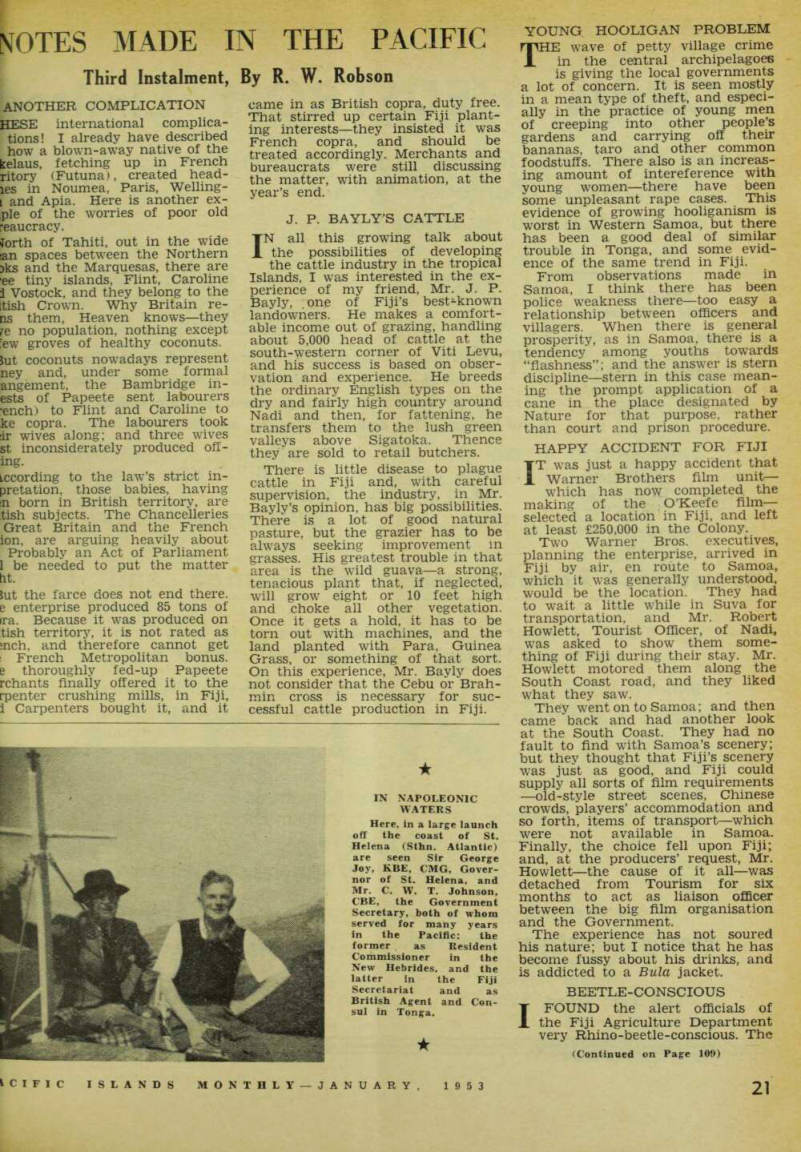
In Napoleonic
Waters
Here, in a large launch off the coast of St.
Helena (Sthn. Atlantic) are seen Sir George Joy, KBE, CMG, Gover nor of St. Helena, and Mr. C. W. T. Johnson, CBE, the Government Secretary, both of whom served for many years in the Pacific: the former as Resident Commissioner in the New Hebrides, and the latter in the Fiji Secretariat and as British Agent and Con sul in Tonga.
bpearance of the pest in northern bnga had shaken agricultural iji to its foundations. The beetle ies by night, and ships picking up ipra often work at night, while ley berth at wharves in Tonga, he beetle could live for some days i a ship. One beetle, getting loose i Fiji, could cost millions.
Therefore, Fiji officials are try g to prevent ships coming directly Fiji from Tonga; and, if they list come direct, they are urged to I well out “in the stream” at ghts, so that if there are beetles icard, and they go flying, they will U into the water. Shipowners do it like it much; but there is no Sguising the menace of the beetle.
The experts told me that they are especially to guard the ilbert and Ellice Islands. The iter’s only product is copra; and e pandanus nut also is an im rtant item in their economy. The lino beetle attacks both coconuts id pandanus nuts and, if it got >se in the G. and E. Colony, it ally would be a disaster.
[ J.S.K.B.’S Snake Farm
FIM” BORRON’S latest funny I story—he and Mrs. Borron have just returned from a visit to iited States and Britain—was in culation in the GPH, Suva,
When in New York, he called on a broker, on the 4th floor of a 45storey building; and he told the American that he had a plantation —a copra farm, he called it—on Mago Island, in the Lau group.
The interested broker asked how he kept his stock under control — what kind of fences did he use.
James said he had no fences — Mago was a self-contained island.
“Well, that must be very handy,” said the American. “But, tell me, how do you breed the things?”
“What things?” asked James, puzzled.
“These cobras,” said the Ameri can. “Guess you must have one of the biggest snake farms in the world.”
It took some sorting out, but the explanation is simple enough. “Jim”
Borron belongs to the old school of Pacific planters, who still pronounce the word “copra” as if the p were a b.
Industrial Development
Of Fijians
AS “Europeanisation” changes the living standards of the native Fijians, there is a growing need for the production by the
Fijians of goods which they can exchange for their daily require ments. I found that the chief Fijian leader, Sir Lala Sukuna, has been giving a lot of thought to this aspect of native life.
“The Fijians have commenced to grow sugar-cane for the mills,” he said, “and I expect that this in dustry will grow steadily. But it
is not intended that Fijian can growers shall enter the industry a way to create ill-feeling with t Indians, who are mainly responsii for cane-growing. We think tM we may be able to produce abc one-tenth of the quantity of cs produced by the Indians.
“We are aiming more at catti farming, and industries of tl kind, for the Fijians. I think tl a great deal can be done throu co-operatives.
“We have done a good d already with Fijian co-operat societies; but our chief weakness lack of efficient managers. I hs advocated the establishment ofi school for the training of operative managers—that would of real help to the Fijian econo of the future.
“The production of copra, as v as of bananas, is now an import; native Fijian industry—l calcul that copra production now ta care of about 50,000 Fijians.”
Orchid-Lovers, Please No R .
THE world’s array of orcb collectors promises soon rival the stamp collectors numbers, importance and enl prise. I found earnest orcl: growers in Suva —and none m enthusiastic that Mrs. Jai Maynard Hedstrom, who now e sides over the famous old H strom house, on the hill overlo ing the whole south-east distri Mrs. Hedstrom took me aroi
ie huge grounds, to show me some ling of the devastation wrought f the January hurricane among ie trees and gardens of which the te Sir Maynard was so proud. But was not entirely a disaster. The ees had grown so big that they ere choking the beautiful little irk, and the hurricane simply iped out two-thirds of them, and us restored the sunshine to many pely corners. Nature was rapidly mpleting the rehabilitation.
Everywhere there were orchids, id I learned that already she.has tablished there special and rare ants, from many parts of the >rld. She has some rare speci ;ns for exchange; and any orchid thusiast anywhere who wants to tablish a Fiji connection should ite to her—Mrs. J. Maynard sdstrom, Suva, Fiji, is sufficient. [ know nothing about this in guing jungle product; but I am sured that conditions in Fiji are sal for its growth. Mrs. Hedstrom eager to make contact with ;hid-growers in New Guinea.
Fiji Flower Exports
|UITE a flourishing little industry ; developed during 1952 in Fiji, based on the enthusiasm of ne Suva gardeners, the enterprise Agent Robert Hutchinson, and s airlines’ search for back loading New Zealand. The agent bought rden produce*—common orchids 4d per bloom, croton leaves iked into cartons at 6d per dozen, ngipanni and other common pical blooms at profitable rates; i airlines carried the packages to ckland; and New Zealand florists d the lot at remarkably high ces, especially in winter-time.
Iveryone was happy about it— iecially some elderly ladies in /a who are trying to live on a id income under inflation condi ns. Then, to paraphrase the ;ient poem, the NZ Departments Customs and Agriculture came vn on the infant enterprise like volf on the fold, and they were ) appeased by the scarlet and d of the lovely Suva flowers, ey said that blooms and foliage, *ught in in such a fashion, might reduce all sorts of pests, and each ikage, in future, must carry a nigation certificate, igent Hutchinson, when I passed ough, was defending his enter se doughtily, and appealing to h authority: but it seemed to , he was at the losing end of the ht. Air transport does create is that did not attend the much wer sea transport. On the other nd, the process and delay of nigation would almost certainly i the flower industry.
Trustworthiness
HE comparative trustworthiness of Islanders was the subject of discussion; and a Suva man, o has been 40 years in the
mtry, spoke interestingly.
“The best man of the lot is the old-time Solomon Islander —the sur vivors of those Melanesian labourers who were brought in here a long time ago,” he said. “They are com pletely trustworthy, and their loyalty has to be experienced to be believed. A ‘black boy’ attaches himself to your household, and takes your name, and nothing you can do is wrong.
“Most people criticise Indians," he went on. “I can say that the decent class of Indian, once he really knows you, can be trusted absolutely. I say that after a life time of experience. Of course, we all have a warm affection for our Fijians and they also are depend able; but, by nature and tempera ment, they are a bit unreliable in commerciar matters.”