Lose £1,000,000 P.A.
p. 18 · Read in the full issue
British Copra Producers May
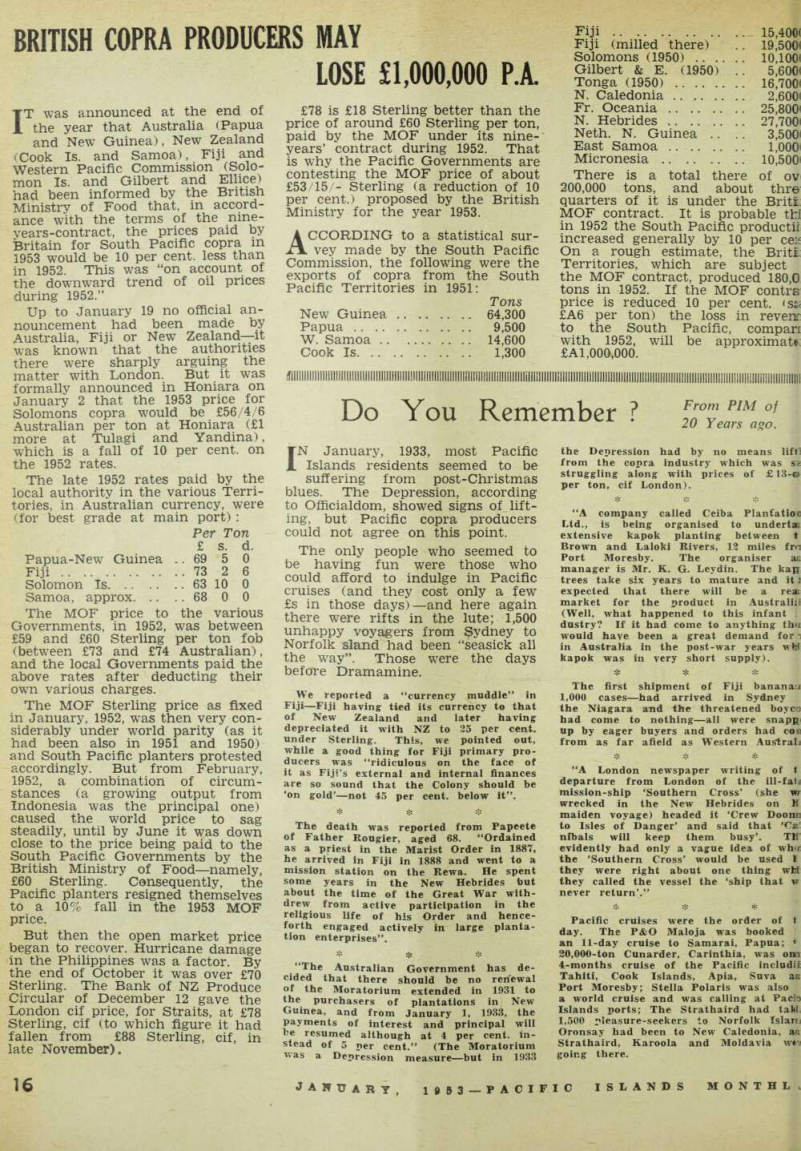
IT was announced at the end of the year that Australia (Papua and New Guinea), New Zealand (Cook Is. and Samoa), Fiji and Western Pacific Commission (Solo mon Is. and Gilbert and Ellice) had been informed by the British Ministry of Food that, in accept ance with the terms of the nine years-contract, the prices paid by Britain for South Pacific copra in 1953 would be 10 per cent, less than in 1952. This was “on account of the downward trend of oil prices during 1952.”
Up to January 19 no official an nouncement had been made by Australia, Fiji or New Zealand—it was known that the authorities there were sharply arguing the matter with London. But it was formally announced in Honiara on January 2 that the 1953 price for Solomons copra would be £56/4/6 Australian per ton at Honiara (£1 more at Tulagi and Yandina), which is a fall of 10 per cent, on the 1952 rates.
The late 1952 rates paid by the local authority in the various Terri tories, in Australian currency, were (for best grade at main port) ;
The MOF price to the various Governments, in 1952, was between £59 and £6O Sterling per ton fob (between £73 and £74 Australian), and the local Governments paid the above rates after deducting their own various charges.
The MOF Sterling price as fixed in January, 1952, was then very con siderably under world parity (as it had been also in 1951 and 1950) and South Pacific planters protested accordingly. But from February, 1952, a combination of circum stances (a growing output from Indonesia was the principal one) caused the world price to sag steadily, until by June it was down close to the price being paid to the South Pacific Governments by the British Ministry of Food—namely, £6O Sterling. Consequently, the Pacific planters resigned themselves to a 10% fall in the 1953 MOF price.
But then the open market price began to recover. Hurricane damage in the Philippines was a factor. By the end of October it was over £7O Sterling. The Bank of NZ Produce Circular of December 12 gave the London cif price, for Straits, at £7B Sterling, cif (to which figure it had fallen from £BB Sterling, cif, in late November).
£7B is £lB Sterling better than the price of around £6O Sterling per ton, paid by the MOF under its nine years’ contract during 1952. That is why the Pacific Governments are contesting the MOF price of about £53/15 - Sterling (a reduction of 10 per cent.) proposed by the British Ministry for the year 1953.
ACCORDING to a statistical sur vey made by the South Pacific Commission, the following were the exports of copra from the South Pacific Territories in 1951: Tons New Guinea 64,300 Papua 9,500 W. Samoa 14,600 Cook Is 1,300
Fiji 15,400( Fiji (milled there) .. 19,500' Solomons (1950) 10,100* Gilbert & E. (1950) .. 5,600( Tonga (1950) 16,700' N. Caledonia 2,600( Fr. Oceania 25,800' N. Hebrides 27,700' Neth, N. Guinea .. .. 3,500' East Samoa I,ooo* Micronesia 10,500* There is a total there of ov 200,000 tons, and about thre quarters of it is under the Briti: MOF contract. It is probable thl in 1952 the South Pacific productii increased generally by 10 per ceis On a rough estimate, the Britii: Territories, which are subject the MOF contract, produced 180,0 tons in 1952. If the MOF contrs price is reduced 10 per cent, £A6 per ton) the loss in revenr to the South Pacific, compan with 1952, will be approximate. £A1,000,000.
Per Ton £ s. d.
Papua-New Guinea .. 69 5 0 Fiji 73 2 6 Solomon Is 63 10 0 Samoa, approx 68 0 0