Which Colour Blue Or Rose?
pp. 15-16 · Read in the full issue
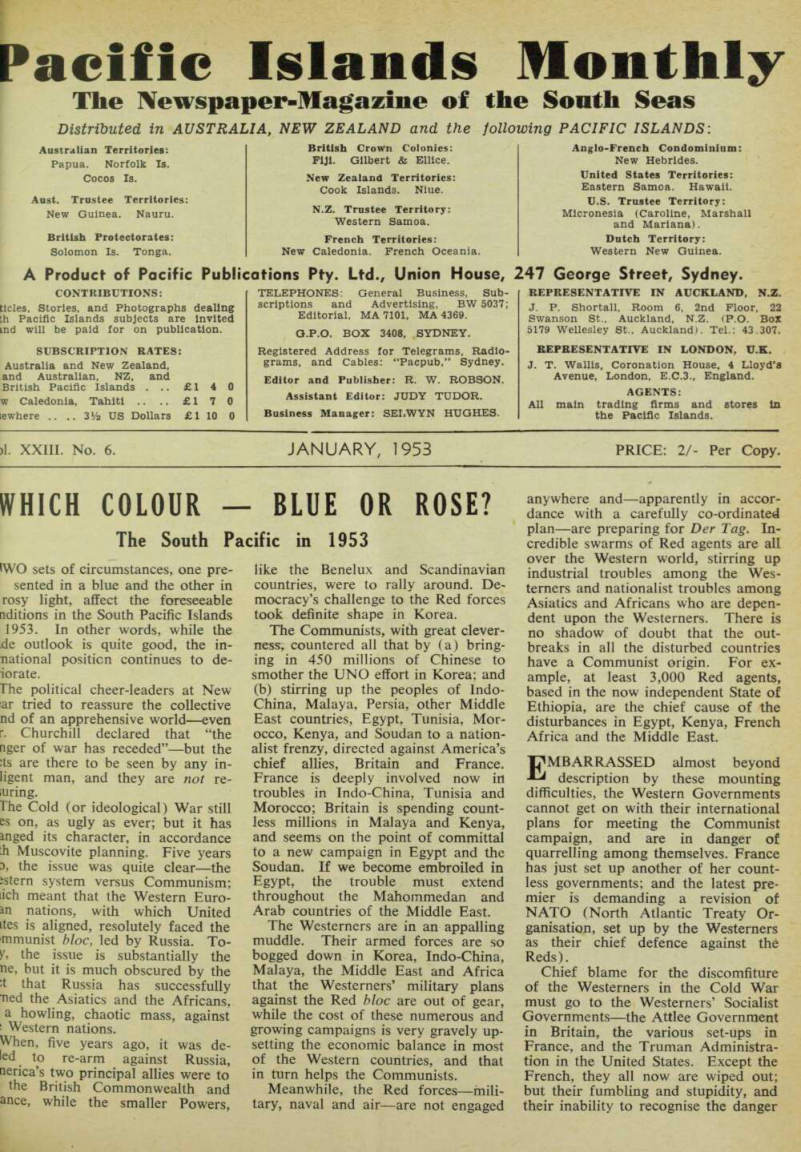
The South Pacific in 1953
IWO sets of circumstances, one pre sented in a blue and the other in rosy light, affect the foreseeable nditions in the South Pacific Islands 1953. In other words, while the de outlook is quite good, the in national position continues to de iorate.
The political cheer-leaders at New ar tried to reassure the collective nd of an apprehensive world—even r. Churchill declared that “the nger of war has receded”—but the :ts are there to be seen by any in ligent man, and they are not re aring.
The Cold (or ideological) War still es on, as ugly as ever; but it has anged its character, in accordance :h Muscovite planning. Five years 3, the issue was quite clear—the -stern system versus Communism; tich meant that the Western Euro m nations, with which United ites is aligned, resolutely faced the mmunist bloc, led by Russia. To- Y, the issue is substantially the ne, but it is much obscured by the ;t that Russia has successfully ■ned the Asiatics and the Africans, a howling, chaotic mass, against ! Western nations.
When, five years ago, it was de led to re-arm against Russia, nerica’s two principal allies were to the British Commonwealth and ance, while the smaller Powers,
like the Benelux and Scandinavian countries, were to rally around. De mocracy’s challenge to the Red forces took definite shape in Korea.
The Communists, with great clever ness, countered all that by (a) bring ing in 450 millions of Chinese to smother the UNO effort in Korea; and (b) stirring up the peoples of Indo china, Malaya, Persia, other Middle East countries, Egypt, Tunisia, Mor occo, Kenya, and Soudan to a nation alist frenzy, directed against America’s chief allies, Britain and France.
France is deeply involved now in troubles in Indo-China, Tunisia and Morocco; Britain is spending count less millions in Malaya and Kenya, and seems on the point of committal to a new campaign in Egypt and the Soudan. If we become embroiled in Egypt, the trouble must extend throughout the Mahommedan and Arab countries of the Middle East.
The Westerners are in an appalling muddle. Their armed forces are so bogged down in Korea, Indo-China, Malaya, the Middle East and Africa that the Westerners’ military plans against the Red bloc are out of gear, while the cost of these numerous and growing campaigns is very gravely up setting the economic balance in most of the Western countries, and that in turn helps the Communists.
Meanwhile, the Red forces—mili tary, naval and air—are not engaged
anywhere and—apparently in accor dance with a carefully co-ordinated plan—are preparing for Der Tag. In credible swarms of Red agents are all over the Western world, stirring up industrial troubles among the Wes terners and nationalist troubles among Asiatics and Africans who are depen dent upon the Westerners. There is no shadow of doubt that the out breaks in all the disturbed countries have a Communist origin. For ex ample, at least 3,000 Red agents, based in the now independent State of Ethiopia, are the chief cause of the disturbances in Egypt, Kenya, French Africa and the Middle East.
Embarrassed almost beyond description by these mounting difficulties, the Western Governments cannot get on with their international plans for meeting the Communist campaign, and are in danger of quarrelling among themselves. France has just set up another of her count less governments; and the latest pre mier is demanding a revision of NATO (North Atlantic Treaty Or ganisation, set up by the Westerners as their chief defence against the Reds).
Chief blame for the discomfiture of the Westerners in the Cold War must go to the Westerners’ Socialist Governments—the Attlee Government in Britain, the various set-ups in France, and the Truman Administra tion in the United States. Except the French, they all now are wiped out; but their fumbling and stupidity, and their inability to recognise the danger
between 1945 and 1951. laid the foun dations of the present dreadful mess.
Strength and firmness, and the ruth less employment of force, were the qualities mainly called for in those years; but the Socialists played into Red hands by trying political appease ment and a policy of sweet tenderness towards Asiatic and African Brother —whose chief purpose in life is to cut European throats.
Non-Socialists now are in control in USA and Britain; but maybe it is a little too late now to employ strength and ruthless force. The fat is in the fire —and the fire is sweep ing across the world in a manner literally terrifying. At the earliest possible moment after the American election, Churchill went to America —talks with Eisenhower —a con ference of the gravest moment for all humanity.
No one can guess at the outcome of those talks. We only know that something must be done, and soon— this Cold War, in its latest shape, cannot go on. In other words, a stop must be put to the mischief-making of the Muscovite Reds.
APART from all that, the outlook, as we see it in the South Pacific, is pleasant and stimulating. We see, in all directions, developing oppor tunities for new industries and new trade, and capital in sight to finance
them. Huge funds still are in circula tion in Papua-New Guinea, and there are big things afoot in that country.
The research work of the South Pacific Commission, carried out over the past three years by a band of devoted men in the Research Council, is beginning to have a real effect on South Pacific economy. This soon should be translated into real action through the member nations. It is an unhappy reflection, however, that the six member nations—United States, France, Holland, and the three British countries of United Kingdom, Australia and New Zealand—are directly and deeply involved in the Cold War. This could have a bad reaction through the SPC.
The brightest aspect of South Paci fic affairs —and it is purely coinciden tal—is the almost simultaneous ap pearance in the chief South Pacific countries of three new men of out standing ability—Sir Ronald Garvey, Governor of Fiji; Mr. D. M. Cleland, Administrator of Papua-New Guinea; and Mr. C. M. S. Stanley, High Commissioner for the Western Pacific.
There also are, at the moment, first class top men in French Oceania, Western Samoa and New Caledonia.
In other words, the South Pacific Islands, in 1953, are “all set to go”— if only the genie which control the Cold War can be captured and kept in a bottle!