“Bom-Bom ” Fishing At
p. 76 · Read in the full issue
Mal Island
By Sydney H. Chance
THE New Guinea and Papuan natives have many ways of catching fish—hand and rod lines, set lines, spearing, underwater spear (bow and arrow), fishing, trapping, netting, line trawling, trolling, poisoning with derris root (known, appropriately, as “New Guinea Dynamite”) and—probably the most spectacular of all—by kite fishing.
This article will describe what I shall call, for want of a better word, “Bom Bom” fishing, as practised in Ninigo region of the Western Islands, some 180 miles WNW of Manus; to be precise, at Mai Island, one of the outer islands surrounding the huge lagoon. Mai is well-named. It is one of the Mal-est places in the world—steaming hot, sandflies by the million, and more mosquitoes than Bioto (described by the Italian D’Albertis as another of the torments of Hades!) All the Western Islands are sur
rounded by a shelf of coral reef, any thing from a few to one hundred yards in width. In some casesj soundings of one thousand fathoms have been recorded not far off shore.
The only way to anchor is to put your “hook” on the reef edge and trust to the off shore wind to keep you off the coral. As a change ofi wind would spell disaster, skippers prefer to “lay off and on”—that is, keep well clear and just run up and down while waiting at each individual island.
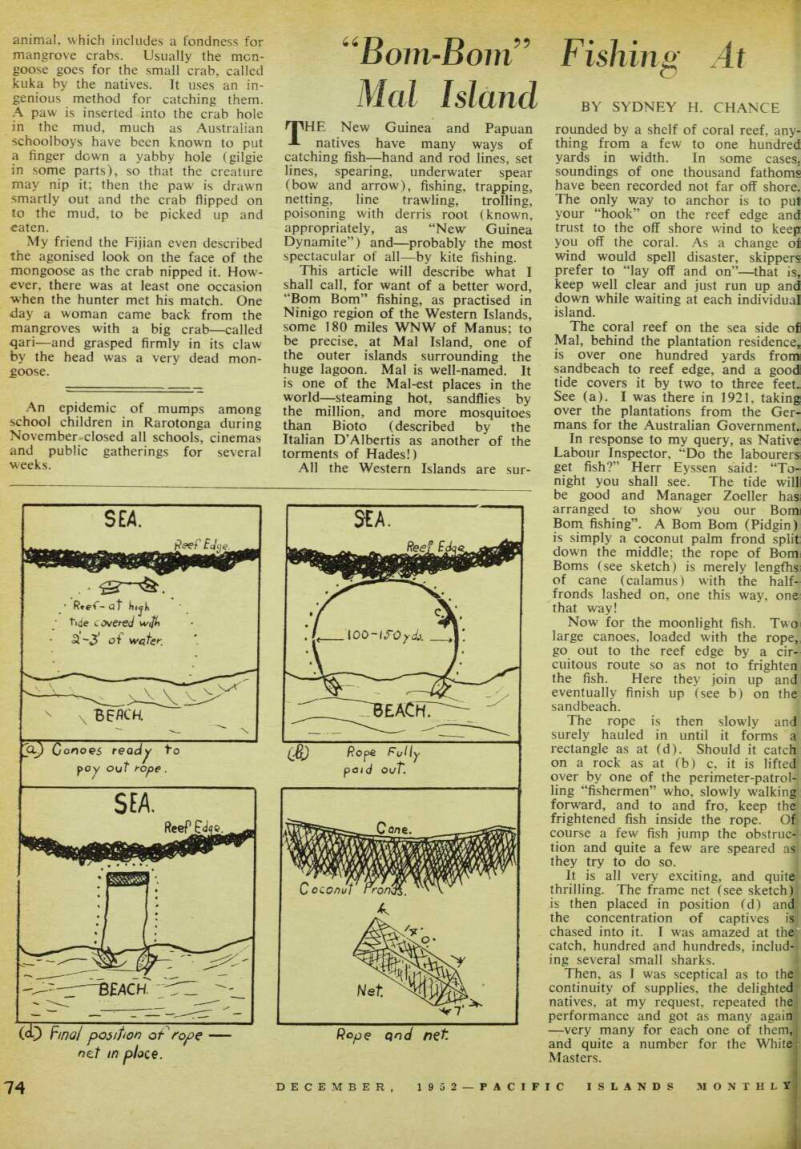
The coral reef on the sea side ofi Mai, behind the plantation residence* is over one hundred yards fromi sandbeach to reef edge, and a good! tide covers it by two to three feet..
See (a). I was there in 1921, taking; over the plantations from the Ger mans for the Australian Government., In response to my query, as Native; Labour Inspector, “Do the labourers; get fish?” Herr Eyssen said: “To night you shall see. The tide willl be good and Manager Zoeller has; arranged to show you our Bomi Bom fishing”. A Bom Bom (Pidgin) is simply a coconut palm frond split: down the middle; the rope of Born; Boms (see sketch) is merely lengths; of cane (calamus) with the half fronds lashed on, one this way, one; that way!
Now for the moonlight fish. Twoi large canoes, loaded with the rope,, go out to the reef edge by a cir cuitous route so as not to frighten the fish. Here they join up and eventually finish up (see b) on the: sandbeach.
The rope is then slowly and surely hauled in until it forms a rectangle as at (d). Should it catch on a rock as at (b) c, it is lifted over by one of the perimeter-patrol ling “fishermen” who, slowly walking forward, and to and fro, keep the frightened fish inside the rope. Of course a few fish jump the obstruc tion and quite a few are speared as they try to do so.
It is all very exciting, and quite thrilling. The frame net (see sketch) is then placed in position (d) and the concentration of captives is chased into it. I was amazed at the catch, hundred and hundreds, includ ing several small sharks.
Then, as I was sceptical as to the continuity of supplies, the delighted natives, at my request, repeated the performance and got as many again —very many for each one of them,: and quite a number for the White Masters.