Tropicalities
pp. 71-72 · Read in the full issue
Magazine Section
Teaching Grandad (Brown)
To Make Bows
pHERE is an enthusiastic if small band of amateur archers in Vic toria who not only fire at large bulls syes but actually go hunting with bows and arrows. What is more, :hey make most of their equipment From local material and from all iccounts are making a better job of t than their yeoman forebears.
Recently Melbourne bowmen hunted up some souvenir bows from New Guinea and the Solomons, re shaped the wood to give proper bend and action and fitted sights to them.
They say the result is double the range and twice the accuracy that Brown Brother ever got.
Nice to know that native arts and crafts are not altogether dying out.
Perhaps the Department of Territ ories would consider sending some of these bow-and-arrow hunters to P-NG to teach the natives the latest refinements of the art. Why not?
Practically every other “expert” has had a free trip to the Territory in the last six years.
The Things They Publish
In Papers!
fTHIS is what Jim Macdougall, Sydney Sun columnist wrote on November 8: Ever feel like chuckin’ it, going bush, living on yabbies and witchetty grubs just to lie back in the shade all day and hear the birds’ sweet music echoing down the blue halls of the sky and at night play music on the moonbeams? (A Sydney man) . . . recently in Fiji found a Sydney character who withdrew from business-life entirely and now paints in the silence of the Fijian countryside.
He’s Alfred Stone, who did a bit of daubing under Max Meldrum. Alf Is teaching the principles of painting to a class of 25 students, some of them Suva’s VlP’s, one of them being the Police Chief.
Twelve months ago Mr. Stone was certainly painting excellent pictures —maybe they were even after Max Meldrum. But in addition he was a qualified pharmacist (Burns Philps’ drug department), with a wife, a family, a car and a fixed domestic abode. Of course, since then he may have heard the call of the wild and gone to live on yabbies and witchetty grubs—or their Fiji equivalent. But this seems doubtful because the Sydney business man who so recently discovered him represents a well known manufacturer of chemists’ supplies.
Non-Bitter Orange Juice
PjPHE NSW Dept, of Agriculture and the CSIRO have announced in regard to orange juice experiments, that they are trying to produce an orange strain in which the juice will not go bitter when canned, or left standing in a refrigerator. They tried nine varieties of root-stock and found that the citrus variety known as trifoliata gives the best results under NSW conditions. Trifoliata has also been found capable of withstanding flooding and wet-soil conditions.
South Sea Prints’
From Japan
WE’RE all gone crazy on these hand-blocked South Sea prints”, said Mrs. Byron Haskin, of Holly wood, in a press interview when she arrived at Sydney from Fiji, where she had been working with the His Majesty O’Keefe film unit. Mrs.
Haskin said the material of her coat had been made in Samoa and that . the coat had been made up at Suva.
Although there is a Samoan artist at Apia who is producing occasional effective hand-painted designs on cotton, Samoa’s alleged textile indus try is a surprise. Virtually all the “South Sea prints” (called Bula shirt material in Fiji) come from the enterprising looms of Japan.
Vividly and well printed on material of surprisingly good quality, the stuff has had a big sale in the Islands.
Which side did win the war?—J.K. (When a PIM representative was in Fiji last year, she, like most other visitors, was struck by the neat Bula silk and cotton skirtings printed with special Fiji designs, and bought freely of same. The designs were far superior to the rampant pineapples and frenzied palm trees of similar American material. She was told that the material came from Japan but that before orders were placed, UK textile manufacturers were asked to quote. This was before things got tough in the textile trade, and the UK manufacturers would not play unless they had a firm order for millions of yards of the material.
The Japs were not so choosey and since 'have supplied miles of the material to Fiji and other Pacific areas at prices with which the Wel fare State could not hope to com pete. To what “war” does our cor respondent refer? If it is the textile war, the answer is obvious.). (Over)
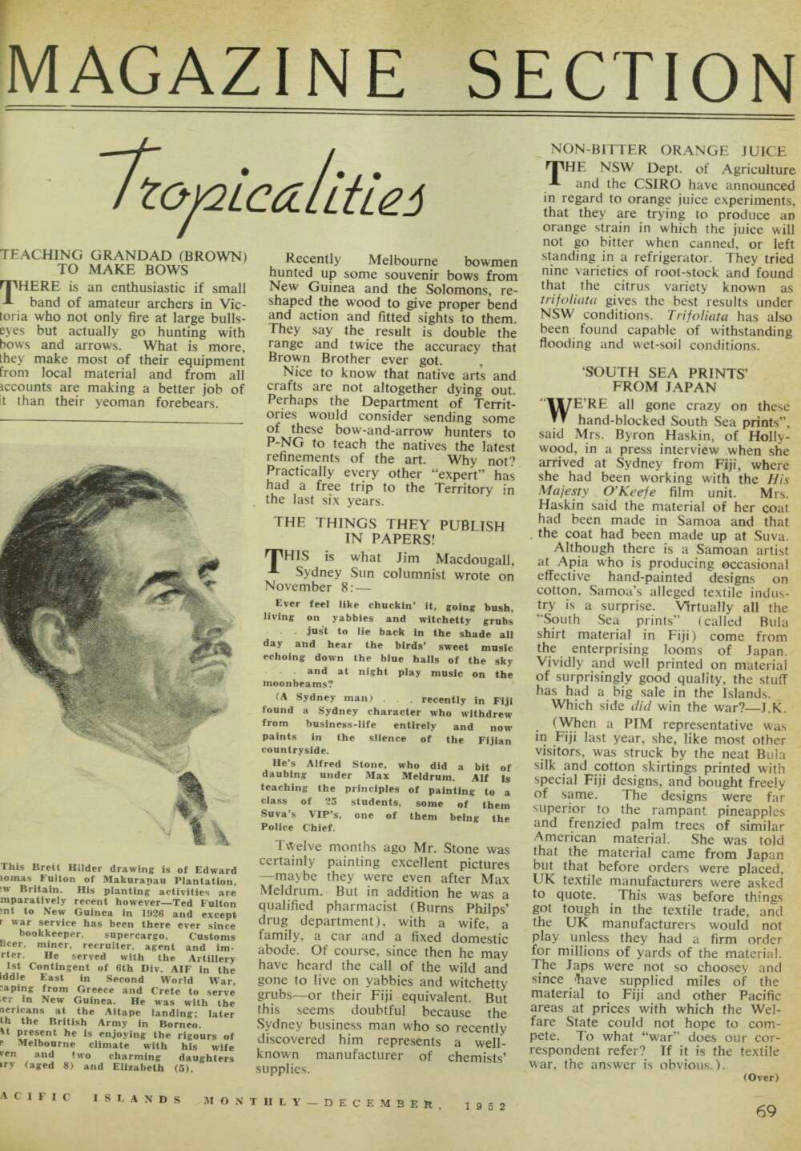
This Brett Hilder drawing is of Edward [?]omas Fulton of Makuranau Plantation, [?]w Britain. His planting activities are [?]mparatively recent however—Ted Fulton [?]nt to New Guinea in 1926 and except [?] war service has been there ever since bookkeeper, supercargo, Customs Beer, miner, recruiter, agent and im [?]rter. He served with the Artillery [?]lst Contingent of 6th Div. AIF in the [?]iddle East in Second World War, [?]aping from Greece and Crete to serve [?]er in New Guinea. He was with the [?]ericans at the Aitape landing; later [?]th the British Army in Borneo.
At Present he is enjoying the rigours of [?]e Melbourne climate with his wife [?]en and two charming daughters [?]ry (aged 8) and Elizabeth (5).
Much Passion On Anahatan
MRS. KAZUKO RIGA, a woman who spent five years alone on Anahatan, 70 miles north of Saipan, with 31 obviously woman-crazy Japs, lived to tell the tale—and is going to be paid for it at one of Tokio’s largest theatres.
It is said that six men were killed because of her while they were on the island—but she denies it. She says there were only two.
When her husband disappeared at sea she went to live with No. 1. This lasted three years—until someone shot him. She then lived with No. 2 but this lasted only 20 days— then he was drowned while out fishmg. Then she lived with No. 3 for two years but did not love him.
No. 4 entered her life, and as No. 3 was an embarrassment, No. 4 stabbed him to death. She lived with No. 4 for nine months until she surrendered to the Americans.
Presumably Anahatan is the island which only recently surrendered to the Americans. For about six years after the end of the war, the
handful of Japs who defended it re fused to believe that the fighting was over. *hey Ju st sat r °und picking one another off, for love of Mrs. Higa. x
Three Days Of ‘Islands’
Eats’ In Auckland
delicate odours of Islands’
J. dishes were drifting on the winds of upper Queen Street, Auck land, mid-November, when the Mor mon Church held a fair in aid of its new church, being built there, Maori, Samoan and Tongan church members, of whom there are a large number in Auckland, spared no effort to outpoint one another on three successive days of feasting. The Maori cooks set the ball rolling on November 13 with foods cooked in the hangi. Next day the Samoans rolled their sleeves up and produced their favourite foods, raw ingredients of which were specially imported from the Islands. Not to be out done, and with a two-day handicap of satisfied appetites, the Tongans took over the kitchens to show them
how—and no one noticed any food lying about when the fair disbanded Saturday night.
The Maori Community Centre had been the main seat of cooking opera tions, though much had been done in private homes throughout Auck land.
Island handcrafts were on sale at . the fair, which was declared an un qualified success. Labour for build ing the chapel has been almost en tirely voluntary.
Native Conchologists
THE occupants of No. 2 Adminis tration Hostel, Rabaul, New Guinea, were recently surprised to find their habitat a matter of interest to groups of natives who would walk slowly past, staring at the verandah.
Then one evening the houseboy inquired whether Missus would like sell “sampela samting” to the visitors who stated they came from Misima.
The desired object was a shell, faded and chipped, but the boys offered £2 for it though they were happy enough to accept it as a present. —EG.
Worms, To You!
THE latest Cook Islands annual report discloses that “fully 90 per cent, of the population” suffers from intestinal helminthiasis, (in other words, hook-worm), “the chief helminths being Ascaris, Trichuris ; and Ankylostoma”, and the re infection rate is nearly 100 per cent.
To combat the disease, the Cook Islands are going to see a lot more of those Rockefeller Foundation inventions—the little shack at the end of the jetty, and “slab and pedestal latrines”—during the com ing year, if intentions as expressed : in the annual report are realised.
All-Time Record For
Stowaways
CONSIDERED on a stowaways-1
per-ton basis, the record of A. B.
Donald & Co’s Cook Islands trader Charlotte Donald must never have 1 been equalled.
A day after the vessel left Aitutaki, ; on November 12, 13 stowaways were • discovered on board. Just where 13 I stowaways could successfully conceal j themselves in a 300-ton vessel can \ only be understood by those familiar with Cook Islands shipping and its s dense crowds of deck passengers.
The ship took them to her nextf island, Manihiki, where it was some days later announced that they had . been released from custody. As J Manihiki has one policeman and no ; gaol we imagine that custody wasi rather an exaggeration.