Fiji-cum-Yap
pp. 51-52 · Read in the full issue
O’Keefe Departs from Fiji-cum-Yap
Suva, Nov. 19.
PEOPLE connected with the film industry usually have big ideas bout money and, sometimes, about
their own importance. For the moment, however, highwater mark has been reached with the state ment by a member of the His Majesty O’Keefe personnel that “the unit’s visit has changed the life of Fiji.”
The film company spent a good deal of money in Fiji, but a sub
stantial part of it went into the pockets of the limited number of people who were in a position to benefit. Building contractors and firms which supplied goods and ser vices probably came off best. A few local people drew high salaries (in some cases, it is reported, over <£4o a week including “perks”) and
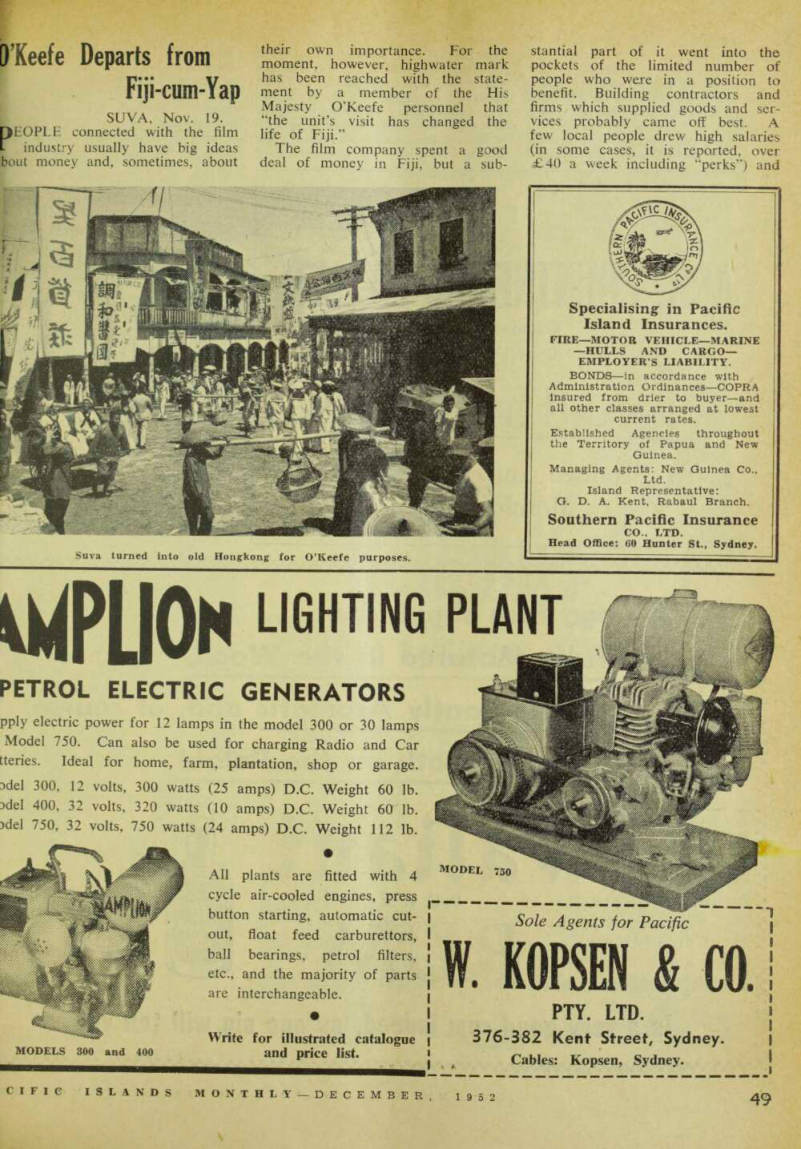
Suva turned into old Hongkong for O’Keefe purposes.
local extras and bit players did pretty well. But to the population at large, even in the Suva area, the nlrn unit s six months in Fiji was nothing more than a pleasant minor
diversion;
The woman who told a Sydney newspaper that O Keefe had changed
the life of Fiji also seems to have said that the film is “a story of the early buccaneering history of the island.” Presumably Yap, which has no connection whatever with the hundreds of islands and islets of Fiji.
Like almost every film set in the South Seas, whether good, bad or
indifferent, O’Keefe will show a si lime disregard of facts relating geography and history. There \ be some excellent colour phc graphy and some spectacular Fij mass-scenes, but the story says t nearly all of it happens on the ot] side of the Equator. But that, the words of a cynical film offic; is how movies are made.