Do You Remember?
p. 19 · Read in the full issue
From PIM of 20 Years ago.
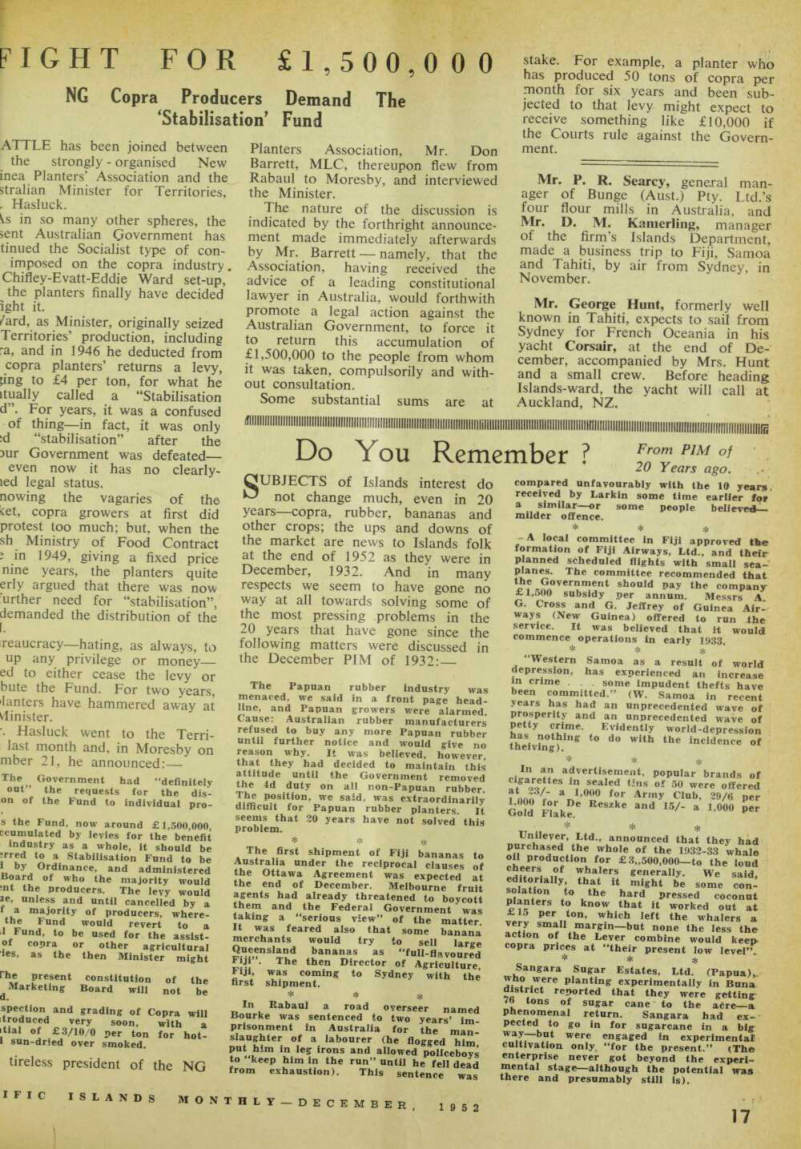
SUBJECTS of Islands interest do
not change much, even in 20
years—copra, rubber, bananas and
other crops; the ups and downs of the market are news to Islands folk at the end of 1952 as they were in December, 1932. And in many respects we seem to have gone no way at all towards solving some of
the most pressing problems in the
20 years that have gone since the
following matters were discussed in
the December PIM of 1932:
The Papuan rubber industry was menaced, we said in a front page head line, and Papuan growers were alarmed.
Cause: Australian rubber manufacturers refused to buy any more Papuan rubber until further notice and would give no reason why. It was believed, however, that they had decided to maintain this' attitude until the Government removed the 4d duty on all non-Papuan rubber.
The position, we said, was extraordinarily difficult for Papuan rubber planters. It seems that 20 years have not solved this problem. * * * The first shipment of Fiji bananas to Australia under the reciprocal clauses of the Ottawa Agreement was expected at the end of December. Melbourne fruit agents had already threatened to boycott them and the Federal Government was taking a “serious view” of the matter It was feared also that some banana merchants would try to sell large Queensiand bananas as “full-flavoured • The then Director of Agriculture Fiji, was coming to Sydney with the first shipment. * * * In Rabaul a road overseer named Bourke was sentenced to two years’ im prisonment in Australia for the man slaughter of a labourer (he flogged him put him in leg irons and allowed polfceboys to keep him in the run” until he fell dead from exhaustion). This sentence was
compared unfavourably with the 10 years, received by Larkin some time earlier for a similar—or some people believed milder offence. * * * A local committee in Fiji approved the formation of Fiji Airways, Ltd., and their planned scheduled flights with small sea planes. The committee recommended that ™ rt ° Ven i”! nt should pa y the company ±-1,500 subsidy per annum. Messrs A.
G. Cross and G. Jeffrey of Guinea Air ways (New Guinea) offered to run the service. It was believed that it would commence operations in early 1933. * * * “Western Samoa as a result of world depression, has experienced an increase m crime some impudent thefts have been committed.” (W. Samoa in recent years has had an unprecedented wave of prosperity and an unprecedented wave of petty crime. Evidently world-depression the S iv?ng)* in& 40 d ° Wkh the incidenc « of * * * advertisement, popular brands of _/ 99/ 1 i 7 nnn al^ d tlnS ° f 50 Were Offered a^ I,o £° for Army C,ub - 29 / 6 Per Gold Slke e C and 15A a P er * * Unilever LW., announced that they had purchased the whole of the 1932-33 whale oil production for £ 3,,500,000-to the loud ®|?f. ers . ,? f wbalers generally. We said, editorially that it might be some con *° t the hard Pressed coconut planters to know that it worked out at £l5 per ton, which left the whalers a very small margin—but none the less the action of the Lever combine would keep copra prices at “their present low level’V * * * Sangara Sugar Estates, Ltd. (Papua),, who were planting experimentally in Buna district reported that they were getting 7b tons of sugar cane to the a6re—a phenomenal return. Sangara had ex pected to go in for sugarcane in a big way—but were engaged in experimental! cultivation only “for the present.” (The enterprise never got beyond the experi mental stage—although the potential was there and presumably still is).