Solomons
pp. 131-133 · Read in the full issue
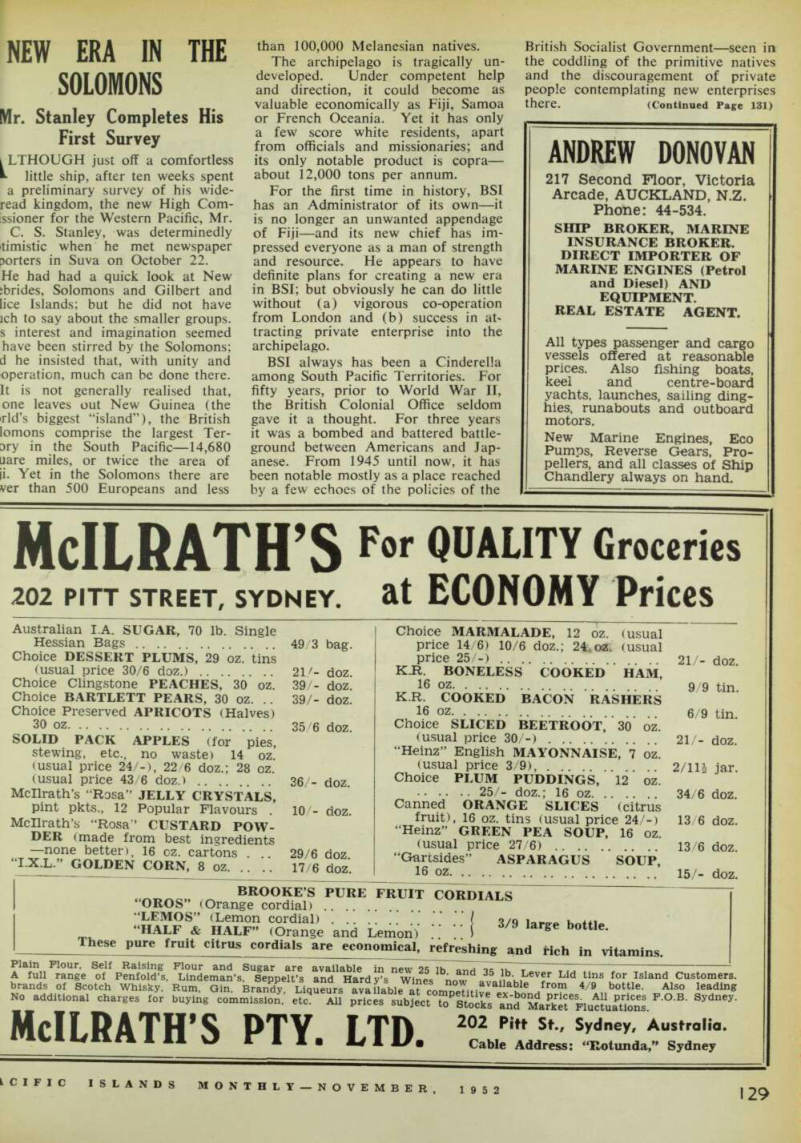
New Era In The
Mr. Stanley Completes His First Survey
l LTHOUGH just off a comfortless little ship, after ten weeks spent a preliminary survey of his wide read kingdom, the new High Com issioner for the Western Pacific, Mr.
C. S. Stanley, was determinedly timistic when he met newspaper porters in Suva on October 22.
He had had a quick look at New ;brides, Solomons and Gilbert and lice Islands; but he did not have ich to say about the smaller groups, s interest and imagination seemed have been stirred by the Solomons; d he insisted that, with unity and operation, much can be done there.
It is not generally realised that, one leaves out New Guinea (the dd’s biggest “island”), the British lomons comprise the largest Ter- Dry in the South Pacific—l4,6Bo Liare miles, or twice the area of ji. Yet in the Solomons there are ver than 500 Europeans and less
than 100,000 Melanesian natives.
The archipelago is tragically un developed. Under competent help and direction, it could become as valuable economically as Fiji, Samoa or French Oceania. Yet it has only a few score white residents, apart from officials and missionaries; and its only notable product is copra— about 12,000 tons per annum.
For the first time in history, BSI has an Administrator of its own —it is no longer an unwanted appendage of Fiji—and its new chief has im pressed everyone as a man of strength and resource. He appears to have definite plans for creating a new era in BSI; but obviously he can do little without (a) vigorous co-operation from London and (b) success in at* tracting private enterprise into the archipelago.
BSI always has been a Cinderella among South Pacific Territories. For fifty years, prior to World War 11, the British Colonial Office seldom gave it a thought. For three years it was a bombed and battered battle ground between Americans and Jap anese. From 1945 until now, it has been notable mostly as a place reached by a few echoes of the policies of the
British Socialist Government—seen in the coddling of the primitive natives and the discouragement of private people contemplating new enterprises there. (Continued Page 131)
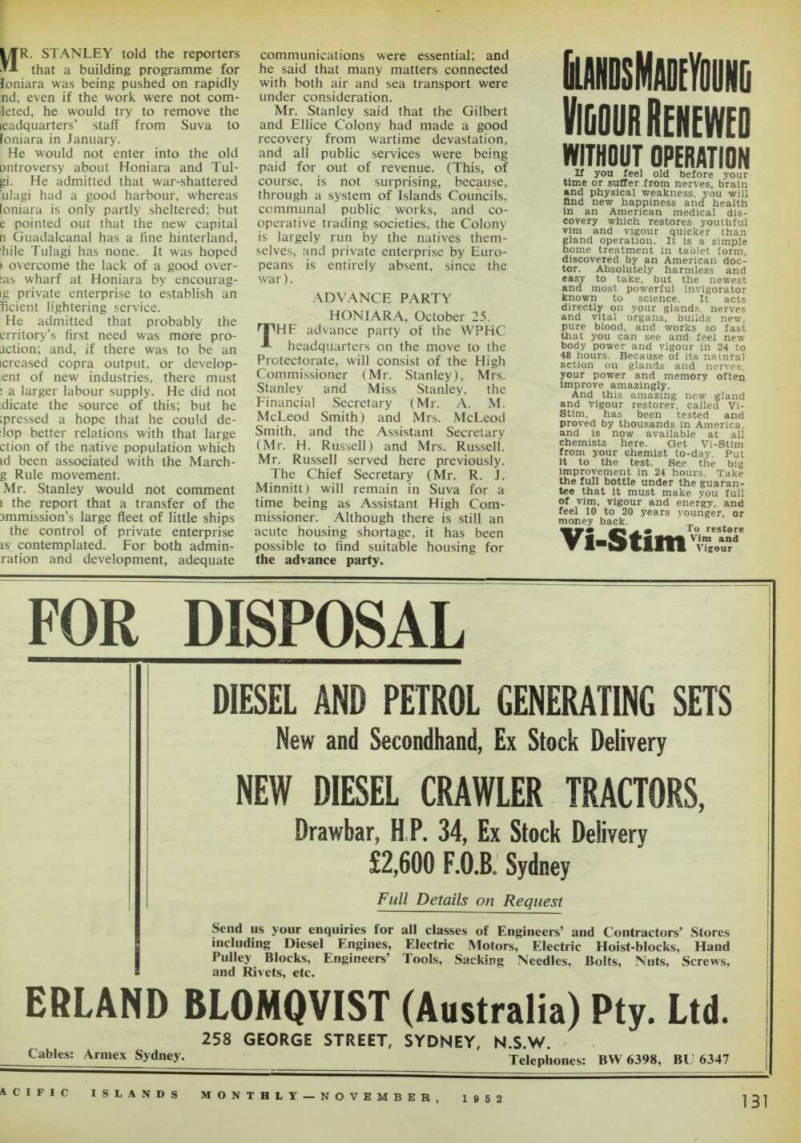
1/fR. STANLEY told the reporters ” that a building programme for loniara was being pushed on rapidly nd, even if the work were not comleted, he would try to remove the icadquarters’ staff from Suva to loniara in January.
He would not enter into the old ontroversy about Honiara and Tulgi. He admitted that war-shattered ulagi had a good harbour, whereas loniara is only partly sheltered; but e pointed out that the new capital n Guadalcanal has a fine hinterland, hile Tulagi has none. It was hoped ► overcome the lack of a good over- ;as wharf at Honiara by encouragig private enterprise to establish an ficient lightering service.
He admitted that probably the erritory’s first need was more proaction; and, if there was to be an icreased copra output, or developent of new industries, there must : a larger labour supply. He did not dicate the source of this; but he a hope that he could de- ;lop better relations with that large ction of the native population which id been associated with the Marchg Rule movement.
Mr. Stanley would not comment i the report that a transfer of the Dmmission’s large fleet of little ships the control of private enterprise is contemplated. For both adminration and development, adequate
communications were essential; and he said that many matters connected with both air and sea transport were under consideration, Mr. Stanley said that the Gilbert and Ellice Colony had made a good recovery from wartime devastation, and all public services were being paid for out of revenue. (This, of course, is not surprising, because, through a system of Islands Councils, communal public works, and co operative trading societies, the Colony is largely run by the natives them selves, and private enterprise by Euro peans is entirely absent, since the war).
Advance Party
ur .. IIAn A . HONIARA, October ..5.
T'HF advance party of the WPHC A headquarters on the move to the Protectorate, will consist of the High Commissioner (Mr. Stanley), Mrs.
Stanley and Miss Stanley, the Financial Secretary (Mr. A. M.
McLeod Smith) and Mrs. McLeod Smith, and the Assistant Secretary (Mr. H. Russell) and Mrs. Russell, Mr. Russell served here previously, The Chief Secretary (Mr. R. J.
Minnitt) will remain in Suva for a time being as Assistant High Com missioner. Although there is still an acute housing shortage, it has been possible to find suitable housing for the advance party.