For Pacific Radio Amateurs
pp. 87-88 · Read in the full issue
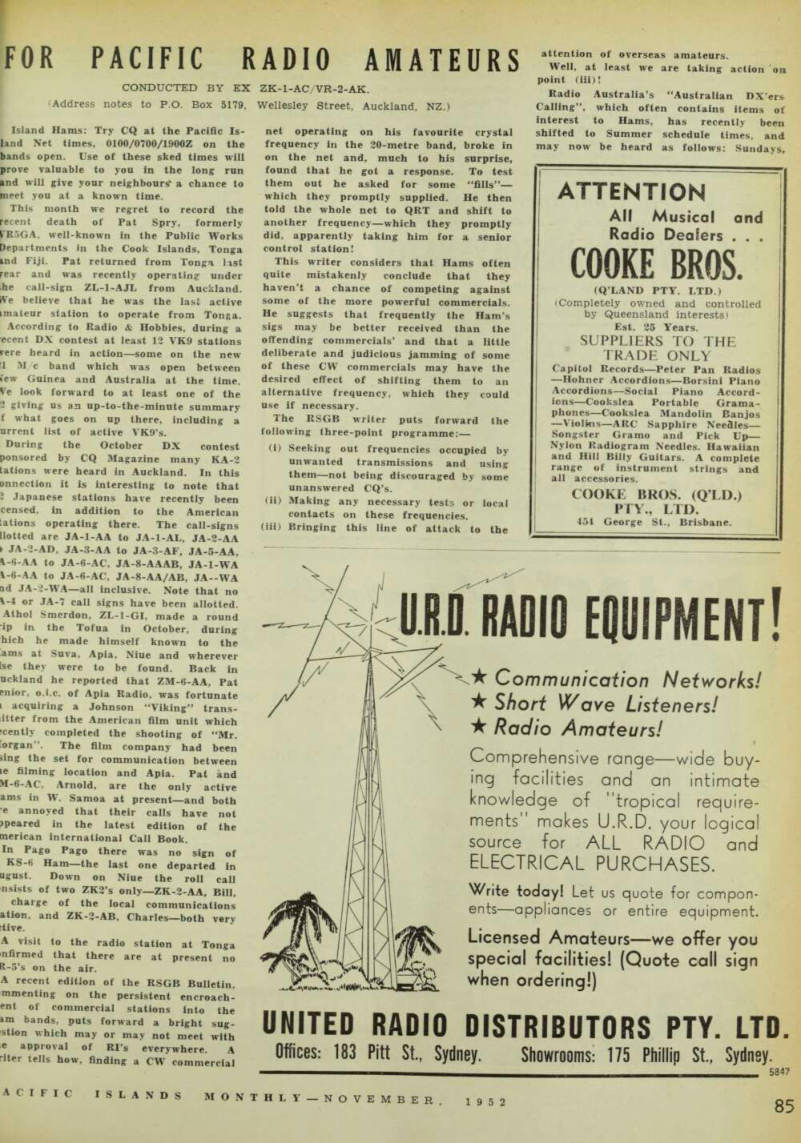

Conducted By Ex Zk-1-Ac/Vr-2-Ak.
'Address notes to P.O. Box 5179, Wellesley Street, Auckland, NZ.)
Island Hams: Try CQ at the Pacific Is land Net times, 0100/0700/1900Z on the bands open. Use of these sked times will prove valuable to yon in the long run and will give your neighbours? a chance to meet you at a known time.
This month we regret to record the recent death of Pat Spry, formerly ITRSGA,l T R5GA, well-known in the Public Works Departments In the Cook Islands, Tonga ind Fiji. Pat returned from Tonga last rear and was recently operating under fie call-sign ZL-l-AJL from Auckland. iVe believe that he was the last active imateur station to operate from Tonga.
According to Radio & Hobbies, during a ecent DX contest at least 12 VK9 stations rere heard in action—some on the new 1 M c band which was open between few Guinea and Australia at the time.
Ve look forward to at least one of the 2 giving us an up-to-the-minute summary f what goes on up there, including a urrent list of active VK9’s.
During the October DX contest ponsored by CQ Magazine many KA-2 tations were heard in Auckland. In this onnection it is interesting to note that J Japanese stations have recently been censed, in addition to the American tations operating there. The call-signs hotted are JA-I-AA to JA-l-AL, JA-2-AA
► Ja-2-Ad, Ja-3-Aa To Ja-3-Af, Ja-5-Aa,
\-6-Aa To Ja-6-Ac, Ja-8-Aaab, Ja-L-Wa
V-6-Aa To Ja-6-Ac, Ja-8-Aa/Ab, Ja-Wa
id JA-2-WA—all inclusive. Note that no \-4 or JA-7 call signs have been allotted.
Athol Smerdon, ZL-l-GI, made a round •ip in the Tofua in October, during hich he made himself known to the ams at Suva, Apia, Niue and wherever Ise they were to be found. Back in uckland he reported that ZM-6-AA, Pat enior, o.i.c. of Apia Radio, was fortunate i acquiring a Johnson “Viking” trans litter from the American film unit which scently completed the shooting of “Mr. [organ ’. The film company had been sing the set for communication between te filming location and Apia. Pat and M-6-AC, Arnold, are the only active ams in W. Samoa at present—and both e annoyed that their calls have not jpeared in the latest edition of the merican international Call Book.
In Pago Pago there was no sign of KS-« Ham—the last one departed in ugust. Down on Niue the roll call nsists of two ZK2’s only—ZK-2-AA, Bill, charge of the local communications ation, and ZK-2-AB, Charles—both very stive.
A visit to the radio station at Tonga niirmed that there are at present no R-s’s on the air.
A recent edition of the RSGB Bulletin, mmenting on the persistent encroach ent of commercial stations into the im bands, puts forward a bright sug stion which may or may not meet with e approval of Rl’s everywhere. A riter tells how, finding a CW commercial
net operating on his favourite crystal frequency in the 20-metre band, broke in on the net and, much to his surprise, found that he got a response. To test them out he asked for some “fills”— which they promptly supplied. He then told the whole net to QRT and shift to another frequency—which they promptly did, apparently taking him for a senior control station!
This writer considers that Hams often quite mistakenly conclude that they haven’t a chance of competing against some of the more powerful commercials.
He suggests that frequently the Ham’s sigs may be better received than the offending commercials’ and that a little deliberate and judicious jamming of some of these CW commercials may have the desired effect of shifting them to an alternative frequency, which they could use if necessary.
The RSGB writer puts forward the following three-point programme:— (i) Seeking out frequencies occupied by unwanted transmissions and using them—not being discouraged by some unanswered CQ’s. (ii) Making any necessary tests or local contacts on these frequencies. (iii) Bringing this line of attack to the
attention of overseas amateurs.
Well, at least we are taking: action on point (iii)!
Radio Australia’s “Australian DX’ers Calling:”, which often contains items of interest to Hams, has recently been shifted to Summer schedule times, and may now be heard as follows: Sundays,
0400 Z, 15.2 mc/s: 0530 Z, 15.2 mc/s; 6800 Z, 9.58/11.76/17.84 mc/s; 1402 Z, 9.58/15.32 mc/s.
During October the 20-metre band was particularly good at times, especially during the fourth week-end during the "CQ” DX contest, when many European and African stations were heard coming in well In the early morning. North
Pacific stations were the best of the Pacific boys heard in Auckland—the Oriental Net, collecting and passing traffic to the States, being notably present, Of these we heard KA2HP/IM/JS/JW/KW,
Ka3Rr, Kb6Al/Ao/Ax, Kr2Ks/Lp,
Kr6Ca/Hw/Iy/Ja And Ka-O-Ij.
Others heard at various times in re stricted early morning and evening listen
ing included KASHM, KA7LJ/OK/RC/SL.
KG6ACG / AEX / AAY / HL, KJ6AW
Kr6Hh/Ko, Kj6Aw, Kx6Ar, Vr2Cg And
Zk-L-Bc.
Other stations reported active in the latest issues of sundry Ham publications included KC6QY, KG4AF, VR2CO' VK2LN (Lord Howe), and FUBAC. Ot the VK9’s FN/GW appear to be the most active boys, though unheard in Auckland.
Dr. Tom Davis and the yacht Miru were creating considerable interest among American East Coast hams late in October. What call-sign the yacht is using we do not know, but he was reportedly in radiophone contact with Boston hams and others along the coast, so may be also active on DX bands.
As usual we look forward to notes of Ham interest from any quarter of the Pacific.
Mrs. A. E. Gordon, of Brisbane, left recently by air for Rabaul where she will stay several months with her daughter and son-in-law, Mr. and Mrs. J. Backhouse.
The world headquarters of the Seventh Day Adventist movement
reported from the United States in
October its intention of assigning
$25,000 to hurricane rehabilitation
in Fiji and $500,000 to missionary
work in New Guinea during the
coming year.