Green and Pleasant Land
pp. 75-77 · Read in the full issue
(Photos by NZ Tourist & Publicity Department.!
JOUTH Pacific Wonderland—that’s w hat the NZ Tourist & Pub :ity Department call their domain, ost important of all the South icific island groups. And that’s tiat they, and Tasman Empire irways jointly set out to prove to party of Australian press men en ute from Sydney to Tahiti along e Coral Route in October.
The trip was a fast one, through rt of the North Island of New aland and PI M’s representative :nt along to cast an eye over just iat this Wonderland has to offer ; sun-baked planter, the jaded bhc servant or the browned-off ands business man dreaming of >se precious weeks or months of rlough ahead, eager to put the •pics as far as possible behind him, the shortest possible time and at : lowest possible price, rhe untravelled New Zealander npletely fails to appreciate just w well endowed is his country scenery, climate, recreational fac-
Hides, transport, accommodation and in food. Many countries have one or other of these things in good measure but few indeed are so bounteously provided with all of them and, this especially, within so small a compass.
This wonderful compactness is one of the most attractive features of a furlough visit to New Zealand.
Based at say Rotorua in the heart of the North Island, or at Christ church in the South, the visitor is within easy reach of numerous and varied attractions.
What other country could offer the possibility of catching swordfish off the coast, a trout in some quiet fly-stream, shooting deer on the edge of some stand of native bush, making a ski-run in the mountains, swimming in a thermal pool or off an ocean beach, visiting a glow worm cave, a sheep-farm as good as any m the world, and a commercial orchard—and eating three good meals in three separate hotels, all
in one day? All these things and more are within two hours driving or less from any one of a number of excellent hotels in Rotorua.
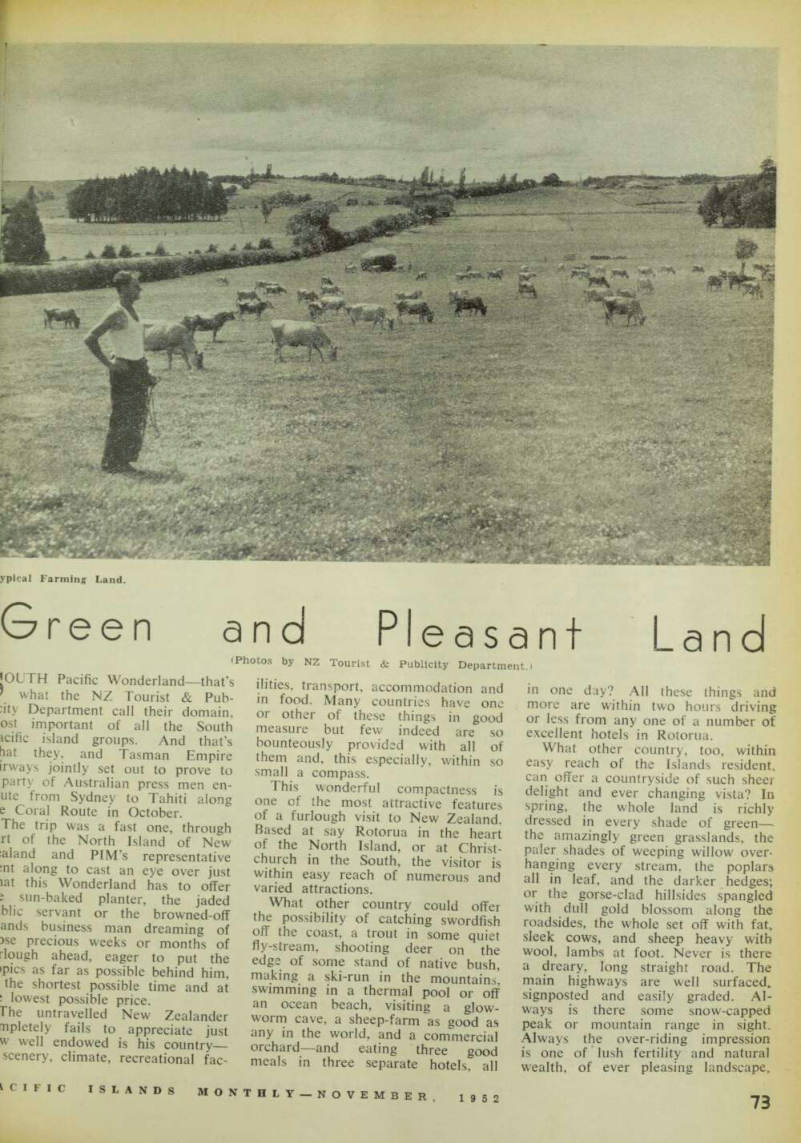
What other country, too, within easy reach of the Islands resident, can offer a countryside of such sheer delight and ever changing vista? In spring, the whole land is richly dressed in every shade of green—• the amazingly green grasslands, the paler shades of weeping willow over hanging every stream, the poplars all in leaf, and the darker hedges; or the gorse-clad hillsides spangled with dull gold blossom along the roadsides, the whole set off with fat, sleek cows, and sheep heavy with wool, lambs at foot. Never is there a dreary, long straight road. The main highways are well surfaced, signposted and easily graded. Al ways is there some snow-capped peak or mountain range in sight.
Always the over-riding impression is one of lush fertility and natural wealth, of ever pleasing landscape.
[?]ypical Farming Land.
whether in cruising by the excellent bus services or flying the network of airways that cover both main islands and extend to the distant Chathams and to Stewart Island in the south.
Despite some American criticism of New Zealand hotels the Austral ian Press Party was unanimous that the standard was generally higher than in the average Australian hotel.
Only the super-luxury class of hotel is in short supply. The food is ex cellent. Butter is 1/8 per lb in New Zealand—and milk 4id per pint— and both are available without the least restriction in every eating house in the country, all the year round.
For those who wish to avoid
hotels, who hire a car and set forth to explore the country by caravan, there are numerous beautiful camp sites, many with modern facilities, others, more secluded where, beside some quiet stream restful fishing, swimming and sun bathing can be enjoyed all through the summer— with sorties to the nearest city as de sired. New Zealand’s gifts to the visitor are essentially those of the outdoors.
Not all visitors from the tropics seek the bracing climate of the south. Those who do can visit and even walk upon the only accessible glaciers in the Southern Hemisphere with scarcely any climbing. By ar
rangement they can enjoy one of thes most moving experiences that thea Southern Hemisphere has to offer— the approach to the inner basin oft Milford Sound from the sea; a truly'< awe-inspiring experience. The largest!, ships can enter this world-apartt through the great two-mile deepq water rift in the coastal wall. With-i in, completely surrounded by moun-j tain peaks towering above to 6,0000 feet, snow-covered to their very feed in winter, nature displays itself inn its most impressive form. Hardlyy less impressive is the landward ap-( proach via a road surely as scenic as?; any in the world.
In contrast, the all-year-roundb
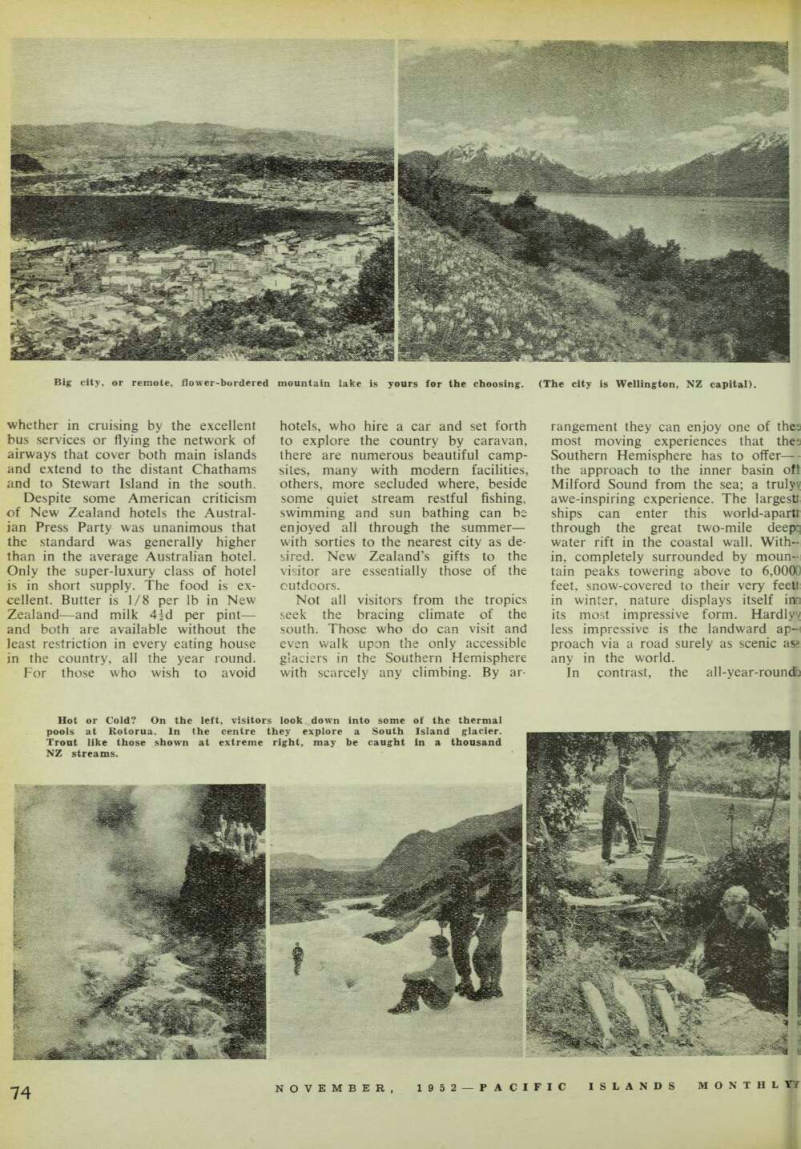
Big city, or remote, flower-bordered mountain lake is yours for the choosing. (The city is Wellington, NZ capital).
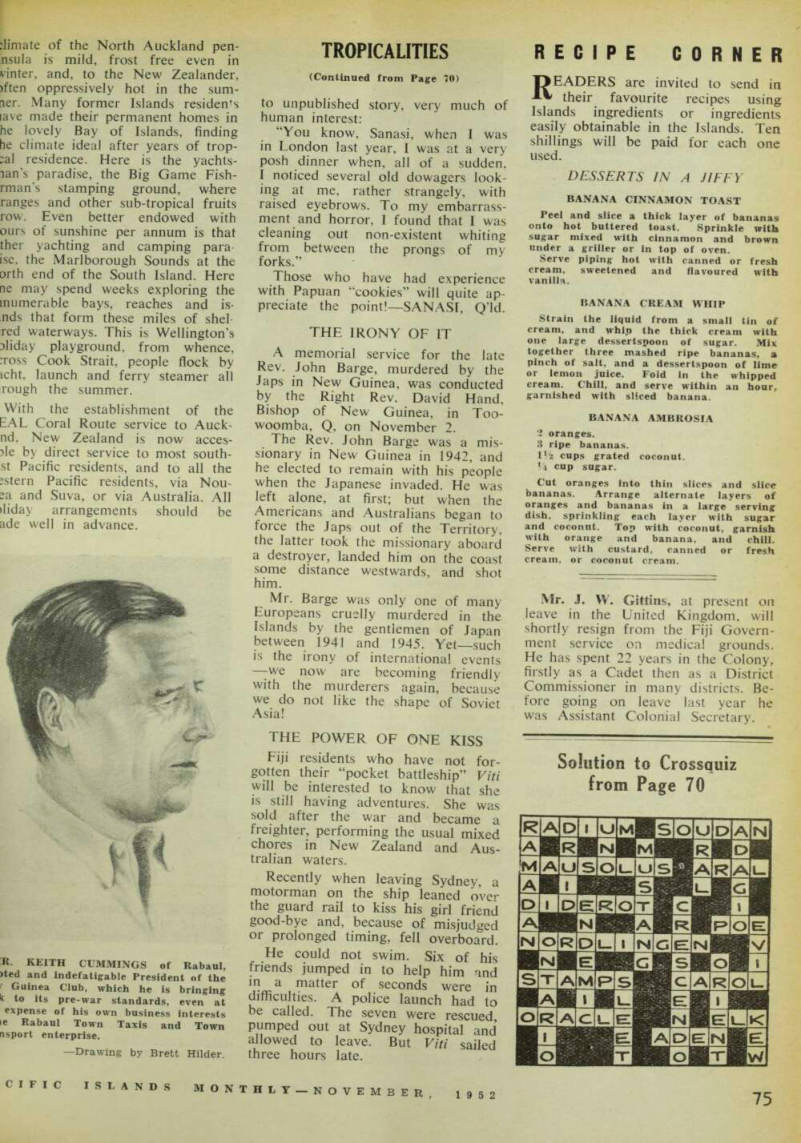
Hot or Cold? On the left, visitors look down into some of the thermal pools at Rotorua. In the centre they explore a South Island glacier.
Trout like those shown at extreme right, may be caught in a thousand NZ streams.
dimate of the North Auckland pen nsula is mild, frost free even in vinter, and, to the New Zealander, )ften oppressively hot in the sum mer. Many former Islands residents lave made their permanent homes in he lovely Bay of Islands, finding he climate ideal after years of trop :al residence. Here is the yachts lan's paradise, the Big Game Fish rman’s stamping ground, where ranges and other sub-tropical fruits row. Even better endowed with ours of sunshine per annum is that ther yachting and camping para ise, the Marlborough Sounds at the orth end of the South Island. Here tie may spend weeks exploring the (numerable bays, reaches and is nds that form these miles of shel red waterways. This is Wellington’s uliday playground, from whence, :ross Cook Strait, people flock by icht. launch and ferry steamer all rough the summer.
With the establishment of the EAL Coral Route service to Auck' nd. New Zealand is now acces ile by direct service to most south st Pacific residents, and to all the astern Pacific residents, via Nou sa and Suva, or via Australia. All diday arrangements should be ade well in advance.
R. KEITH CUMMINGS of Rabaul, ted and indefatigable President of the [?] Guinea Club, which he is bringing [?] to its pre-war standards, even at expense of his own business interests [?] Rabaul Town Taxis and Town [?]nsport enterprise. —Drawing by Brett Hilder.