Pat Mcgusty Comes Home
pp. 73-74 · Read in the full issue
A COUPLE of decades ago, in a collegiate school for young girls, n Hawkes Bay, New Zealand, there vere two teen-age lasses from Fiji, Patricia McGusty and Elizabeth Hennings.
Blonde and brunette, they were dike only in that they both were mall, vivacious and pretty. And they were close friends. One was the laughter of Dr. V. W. T. McGusty, Director of Medical Services in the Colony, and the other the daughter )f Mr. Gus Hennings, one of the )est-known and best-loved of Fiji’s dd-time planters.
In due course, both returned to *iji, and were members of the Colony’s smart Younger Set. Pat vas a prominent figure in Suva; but Elizabeth and her sister spent much )f their time on their father’s plan ation on Naitamba Island, in the Lau irchipelago.
At Government House parties, Miss McGusty met Ronald Garvey, me of the promising young officers >f the Western Pacific High Com nission; and they who saw the meet ng correctly forecast wedding bells.
Among those who attended the wedding reception in the Grand Pacific Hotel, in Suva, in the Thirties, was Ratu Sukuna, a cousin of Mr. Gus Hennings, and now the distinguished Sir Lala Sukuna.
For several years, Ronald Garvey was an increasingly important man in the South Pacific: He and his young wife moved from place to place, always on promotion.
December 6, 1941 (Pearl Harbour) found him on isolated Ocean Island, as Resident Commissioner of Gilbert and Ellice Colony. Fortunately his wife and their two small children were in Suva. Five months later, Mr.
Garvey and the Administration staff were taken off Ocean Island, under the noses of the Japs, at midnight, by a very fast French destroyer.
Soon after that, the Garveys left the South Seas they loved so much— he was transferred to an important post in Central Africa; thence to an Administratorship in the West Indies; and then, five years ago, he was ap pointed Governor of British Hon duras, and created KCMG. Sir Ronald and Lady Garvey had a full
term there, in one of the least com fortable colonies in the Empire.
In 1951, the British Colonial Office sought a man to fill another un comfortable Governorship—that of Fiji—uncomfortable because of a racial problem created by the ab normal growth of the Indian population. They wanted someone who had strength, wisdom, patience and who kept his head in a crisis.
Sir Ronald Garvey had disclosed those qualities in some ticklish situ ations in Central America; and he had a close personal knowledge of Fiji conditions, and the Indians. His appointment to Fiji was inevitable.
The appointment took Fiji some what by surprise. British Colonial officials come and go ceaselessly, and Garvey had been half forgotten.
When Suva realised that “young Ronald Garvey” and his attractive Suva-born wife were coming back, to occupy the big house on top of the hill, it hastily revived its memories of the pleasant young couple who were part of its social life in the Thirties. It liked what it remembered, and the new appoint ment was immediately popular . . .
AND so, on one of those rare mornings when Suva is bathed in hot golden sunshine, and the kindly trade-wind blows coolly out of the southeast, Pat McGusty came home. All Suva stood around eager to greet her, but waiting anxiously.
The little teen-age lass with whom they had danced and tennised and frivolled nearly twenty years ago was now Her Excellency. How formid able would she be?
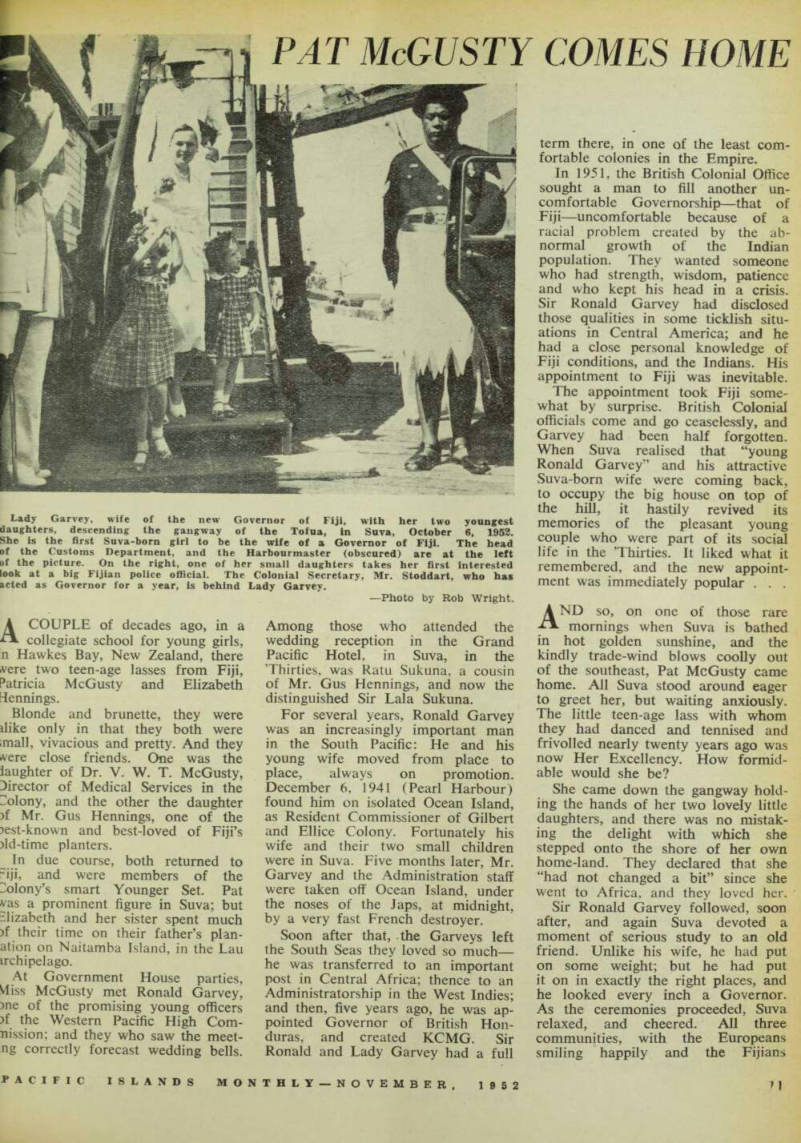
She came down the gangway hold ing the hands of her two lovely little daughters, and there was no mistak ing the delight with which she stepped onto the shore of her own home-land. They declared that she “had not changed a bit” since she went to Africa, and they loved her.
Sir Ronald Garvey followed, soon after, and again Suva devoted a moment of serious study to an old friend. Unlike his wife, he had put on some weight; but he had put it on in exactly the right places, and he looked every inch a Governor.
As the ceremonies proceeded, Suva relaxed, and cheered. All three communities, with the Europeans smiling happily and the Fijians
Lady Garvey, wife of the new Governor of Fiji, with her two youngest daughters, descending the gangway of the Tofua, in Suva, October 6, 1952.
She is the first Suva-born girl to be the wife of a Governor of Fiji. The head of the Customs Department, and the Harbourmaster (obscured) are at the left of the picture. On the right, one of her small daughters takes her first interested look at a big Fijian police official. The Colonial Secretary, Mr. Stoddart, who has acted as Governor for a year, is behind Lady Garvey. —Photo by Rob Wright.
vociferous, approved very definitely of their new rulers.
The day’s ceremonies concluded with an evening broadcast, and the broadcast ended on the happiest note of all. There was an address by His Excellency, and a brief greet ing by Lady Garvey; and then, quite unexpectedly, Lady Garvey said this: “I feel impelled to end my greet ing to you all, whatever your creed or race, in the tongue, so little used for many years, in which I first made known my wants:— “Au sa mar an vakalevu sara, e na bogi edaidai, n’iu sa kunei au tale e na kemuni maliwa oi kemuni na wekaqu bibi, ni vanua lomani k’au a sucu kina. Me vakavulai keda kece ko koya na Kaloulevu mai lomalagi.” (Freely translated: I am very happy indeed this evening, to be back in the land where I was born, and to be able to greet you all. My best wishes to you all, and may God bless you.) I wish Her Excellency had been at the receiving end of a radio, where I was, among Fijians, and seen the de light of those people, as they heard her speaking to them in their own tongue.
Story of Elizabeth Hennings
AND now—for there is a singular coincidence here—we return to Miss McGusty’s school-friend, Elizabeth Hennings. What has become of her?
In the late ’Thirties, the two Hennings girls, Elizabeth and Sophie —well educated, clever and very attractive—decided that plantation life in Fiji held too few opportunities.
Their father gave them some funds, and they set off to look the world over and see what they could make of life.
On the liner Mariposa, in the United States, and in London, they stuck together, fought off the wild wolves and ultimately got themselves jobs. Elizabeth (Liz to her friends) turned to good account a remarkable talent for drawing and designing.
The war came, and both girls held war jobs.
Sophie (Beau to intimates) be came an efficient pilot of planes. She was a passenger in a plane which ran into a London balloon barage, and she had a miraculous escape.
After the war, she married an Englishman with a double-barrelled name, and lives in England.
Liz followed on with designing, and had remarkable success with theatre commissions. As a measure af that success, it may be noted that she was closely associated with the Oliviers, in the design and presenta-
tion of their more important costumes.
By a happy chance, she was home in Fiji, for a spell, when the Warner Brothers sent their scouts out there to consider the production of “O’Keefe”. They planned to bring dress designers from Hollywood.
They were interested but not im pressed when Miss Hennings sought them out, and suggested she do the O’Keefe costumes. She was a strik ing personality—pretty, petite, self assured—but, after all, she was only a local girl. However, they said they would consider any drawings she submitted.
Liz went to work. Day and night, she dredged through old records of the O’Keefe period and places (50 years ago, in the Carolines and Hongkong and thereabouts) and then she did her sketches. I have seen the portfolio, and there is little wonder that they bowled over the Warner executives.
On top of the genuine old costumes, Liz put the product of her own artistic skill and vivid imagina tion; and the resulting designs must help much in the success of this film. The public will see them, in due course.
Warners “canned” all other plans, and took Fijian-born Elizabeth Hen nings and her designs to their heart, and literally give her carte blanche.
Sir Lala and Lady Sukuna put their Suva house at her disposal; she
assembled a large staff of assistants” scoured Fiji and the adjoining: islands for materials; and as the film: unit settled into Deuba and began: its six-months’ task, a mass "of; costumes began to move out fromi Miss Hennings’s work-rooms to the; studio. One has to see the huge task,, and the results, to appreciate the: qualities of this remarkable young: woman.
From what I have seen, I believe; that the O’Keefe film will be a com plete success, and the name of Elizabeth Hennings will be associated with that success.
Early in October, the Tofua brought Miss Pat McGusty home to Fiji, to preside over Government: House, on Suva hill, as Her Ex cellency. Early in October, as the Warner Brothers film unit began to put the finishing touches on its film achievement, the artistic triumph of Miss Hennings was being widely recognised. It was a remarkable co incidence that those two Suva ladies, who were friends together in that NZ school 20 years ago, and whose paths diverged so widely, should both have come back to Suva, the same year, to enjoy the happiest stage:
of their successful lives.-
Rwr.
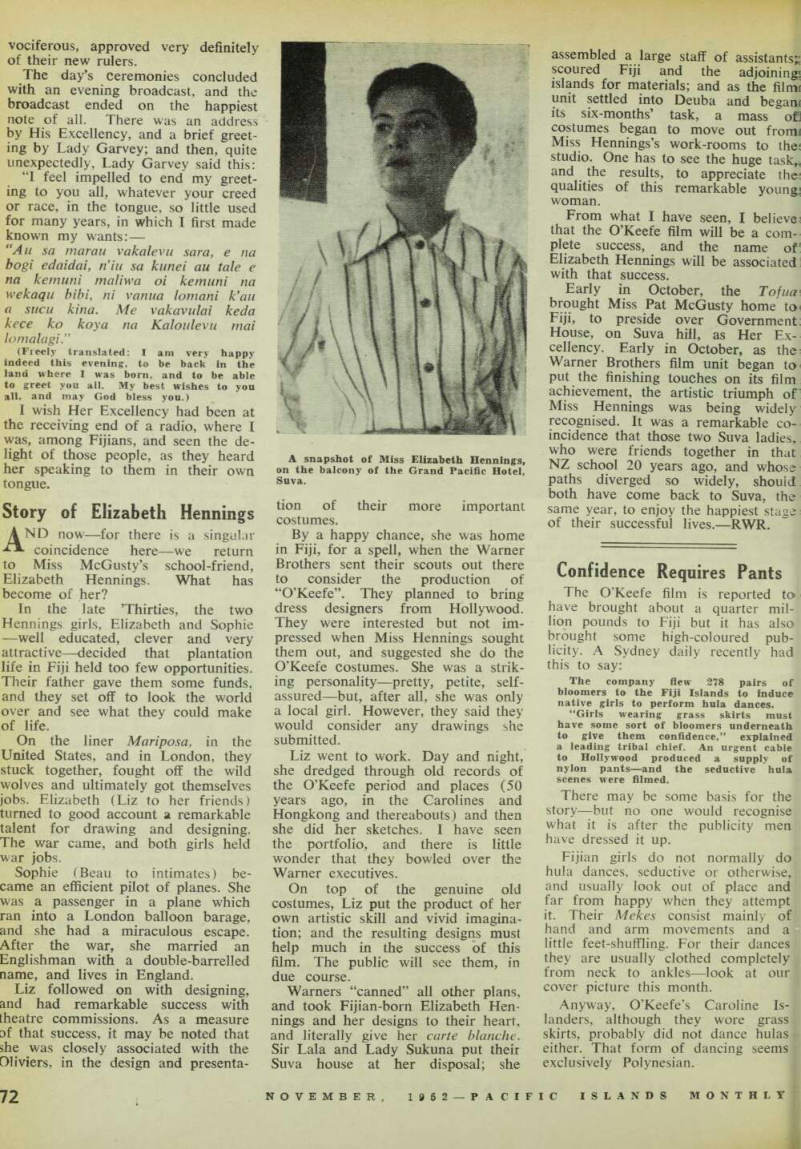
A snapshot of Miss Elizabeth Hennings,
on the balcony of the Grand Pacific Hotel, Suva.