Tropicalities
pp. 71-77 · Read in the full issue
Magazine Section
Blue Bags For Big Bananas
QUEENSLAND and NSW banana growers are experimenting with plastic bags tied around growing banana bunches. They say that it produces bigger and better fruit—to which consumers report that any thing is worth trying if it will im prove the inferior fruit sold in Aus tralia as bananas and currently cosi ng about 7d per piece.
The bags are made from the sort }f plastic used for shower-curtains jtc. Red, green, white, blue and yel ow have been tried but the blue )lastic gives the best results —no one mows why. The bags are drawn m over the bunch of bananas and ied with a drawstring to the stem.
Mr. Sydney H. Chance, former *apuan RM commenting on this new lotion comments: “Perhaps our Papua-New Guinea oons are not so primitive after all; ill old Territorians know how the latives wrap certain types of broad saves around the bunches of ban nas and what delicious fruit they reduce—so different from the near awdust fruit that is sold in Aus ralia. I do not think the natives ■rap it solely to keep off the fruit ats—l have seen them wrap it in reas that are free from these pests.” rHERE are lots of Papuan and NG old-timers around Brisbane but ne sees little of them, George Christie—looking younger than ever -Charlie Wurth and O. D. Shafer ave been sighted recently; but Peter ianta and Ned Rowlands seem a be in seclusion. Readers who re lember one-armed Bob Corney dll be pleased to hear that he is nding his days very peacefully and omfortably at the Eventide Home Sandgate (writes an old Territorian, ow a resident of Brisbane).
When last visited (22.9.52) old !ob, though very deaf and nearly lind, was able to tell of the days f the late nineties, when he was fading and recruiting. Now 87, he oes not think much of our copper
or gold: “Maybe there’s lots there, but I never found any of it. But they were a great crowd up there.
You only had to show you were a little bit crook, and out you went.”
Don’T Let’S Be Realist
James A. Michener Who (Al
though he says he has not) is believed to have made a fortune out of Tales from the South Pacific, the musical based on it called South Pacific, and Return to Paradise re cently visited Korea, Japan, Hong kong, Formosa, India, Pakistan, Malaya, Thailand, and Indonesia.
His new book, Voices of Asia has emerged from this last visit.
He makes his a realist’s approach —i.e. that the old Asia is finished and the best we can do is to enlist co operation. In his realism he says that since Australia can neither populate nor develop New Guinea, we should let the Japanese in, “treat them de cently, and pray that in time of trouble they will remain loyal.”
Few Australians
allow their realism to take them as far as this. They may have no solution to the New Guinea mystery but as far as Japs are con cerned the whole eight million of
them mutter “Over our dead bodies”— and mean it.
Michener sees the rise of Asia and the eclipse of the Western world.
In 50 years, he thinks, Great Britain will be remembered affectionately for her glorious past and the United States will be a museum relic like Greece.
He may be right at that. Un fortunately the ordinary individual who has been written at more in this age than in any other, is more con cerned with living in this world than reforming it. It is nice, occasionally, to toy with the idea of a world sans commentators, observers, realists or theorists.—MAC.
Churchman Looks At
Moviemakers
IN the Diocese of Polynesia Church Gazette, the Rev. C. W. Whons bon-Aston (Apia) makes his usual amusing contribution—this time an observation of movie-making and movie stars: “The whole of Apia is agog with excitement over the Aspen film pro duction, “The Return to Paradise,” in which Gary Cooper and Barry Jones figure as the stars proper. It is interesting to know that some of the most staid members of our con gregation will appear in the cast.
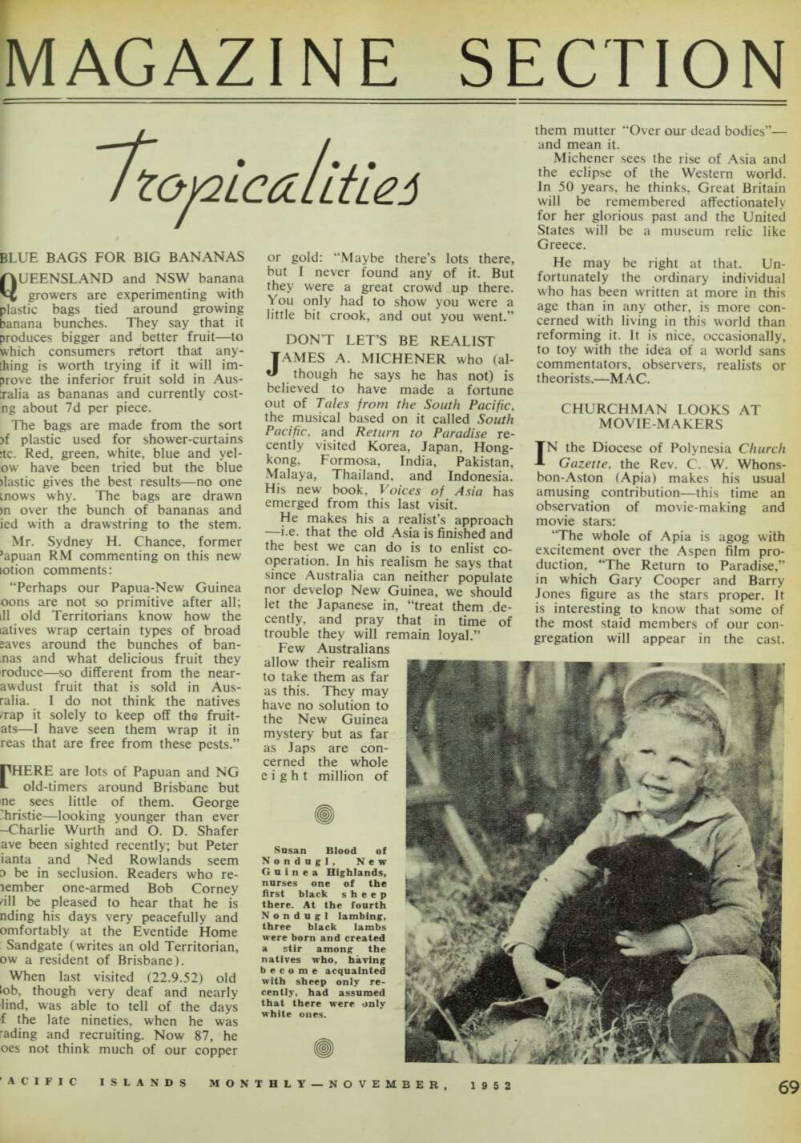
Susan Blood of Nondugl, New Guinea Highlands, nurses one of the first black sheep there. At the fourth Nondugl lambing, three black lambs were born and created a stir among the natives who, having become acquainted with sheep only re cently, had assumed that there were only white ones.
The picture should be an interesting one. for we gather that it deals with a missionary who is an enthus iast in protecting the morals of his flock, and a kind of beachcomber whose past has not been all it might have been, but who was looking for a Paradise where there would be but one beach, one moon, and one “dame.” The beachcomber, appar ently, made good, and the lion and the lamb sported together in the end.
Those who see the film will also see something of Samoan life. I may add that the principals of the com pany from the States have given us a new idea of such professionals and are welcome visitors to our com munity.”
The Perils Of English
THIS one is told in the October issue of the Southern Cross Log.
The Bishop of Melanesia (The
Right Rev. S. G. Caulton) and a member of his staff were visiting a district school on Santa Ysabel, BSI. and were browsing through some exercise books to see how the pupils were getting on. One exercise in English was “Give the masculine of” —and there followed a list of fem inines. The first was “hen”, and the answer, of course, was “cock”—and so on.
The last one was goddess, and the masculine of that, according to the Santa Ysabel schoolboy who wrote it, was “cock-goddess.”
Bounty Relic Goes Home
WHEN Mr. F. H. McCoy, great great-grandson of the original McCoy of the Bounty, returns to Pitcairn Island soon with his wife, he will take with him an iron axe head which he had taken down to New Zealand from Norfolk Island.
The axe was one of the articles salvaged from the Bounty before she was burnt by the mutineers in 1790. It was taken to Norfolk Island in 1856 when a part of the Pitcairn population was transferred there: and has lately been in the posses sion of Mrs. Nash Christian of Nor folk.
The axe will be deposited in the Pitcairn museum, along with other Bounty relics, which are gradually being reassembled.
A Bulldog For Biesel
late a good looking young Dutchman has been seen flitting from dog-kennel to dog-kennel ini Auckland, casting a speculative eye over the city’s bulldogs.
The Dutchman is Jan van Duiven boden—TEAL’s “Flying Dutchman”* now well known along the Corall Route. Normally an air traffic offi cer for the company in Auckland*, Jan, an ex-KLM (Royal Dutch Air lines) man, travels as interpreter and factotum aboard the big Solents from time to time, and in the process finds himself charged with some strange commissions for people along the way.
Latest of these is to purchase a bulldog for Papeete’s chief of police,, M. Biesel and late in October it was said that the Flying Dutchman now has at least a nodding acquaintance with every bulldog north of Handle ton. An aggressive looking twenty five guinea model is at present the hot favourite for the flight out of Auckland on November 11.
Monsieur Biesel already has a reputation for astuteness in crimin ology. Shortly after arriving in Papeete he tricked out some of his male staff in Paris models and sent them aboard an overseas ship, there by making some clever arrests for smuggling.
Now along the Coral Route they’re wondering whether we will soon hear of some equally clever arrest by means of a bulldog, ar rayed in bonnet and bib, operating from the latest in Paris prams.
Etiquette
THE late Sir Hubert Murray, of Papua, did not like his officers to scrape to him all the time. 1 found that if 1 gave him a “Your Excel lency” the first time I met him all that was required the rest of the day was an odd “Sir” now and again!
Once, travelling in the Laurabada with him, whilst we were partaking of the usual after-dinner-cocoa, he amazed me by telling me this hither
(Continued on Page 75)
to unpublished story, very much of human interest: “You know, Sanasi, when I was in London last year, I was at a very posh dinner when, all of a sudden, I noticed several old dowagers look ing at me, rather strangely, with raised eyebrows. To my embarrass ment and horror, I found that I was cleaning out non-existent whiting from between the prongs of my forks.’’
Those who have had experience with Papuan “cookies’’ will quite ap preciate the point!—SANASI. Q’ld.
The Irony Of It
A memorial service for the late Rev. John Barge, murdered by the Japs in New Guinea, was conducted by the Right Rev. David Hand, Bishop of New Guinea, in Too woomba, Q, on November 2.
The Rev. John Barge was a mis sionary in New Guinea in 1942, and he elected to remain with his people when the Japanese invaded. He was left alone, at first; but when the Americans and Australians began to force the Japs out of the Territory, the latter took the missionary aboard a destroyer, landed him on the coast some distance westwards, and shot him.
Mr. Barge was only one of many Europeans cruelly murdered in the Islands by the gentlemen of Japan between 1941 and 1945. Yet—such is the irony of international events —we now are becoming friendly with the murderers again, because we do not like the shape of Soviet Asia!
The Power Of One Kiss
Fiji residents who have not for gotten their “pocket battleship” Viti will be interested to know that she is still having adventures. She was sold after the war and became a freighter, performing the usual mixed chores in New Zealand and Aus tralian waters.
Recently when leaving Sydney, a motorman on the ship leaned over the guard rail to kiss his girl friend good-bye and, because of misjudged or prolonged timing, fell overboard.
He could not swim. Six of his friends jumped in to help him and in a matter of seconds were in difficulties. A police launch had to be called. The seven were rescued, pumped out at Sydney hospital and allowed to leave. But Viti sailed three hours late.