?Eal’S New Coral Route
pp. 31-33 · Read in the full issue

Will Develop
Both Trade And Tourism
Possibilities
Outlined
By R. W. Robson
WHEN did the French have an interest in this country?” sked an alert NZ journalist, when e stepped ashore at the new atapuala seadrome, 20 miles west of ipia, in Samoa, on October 14.
“The French were never here,” he ras told. “Those signs which you ?e around, in English and French, :ill smell of wet paint. They have ist been put up by TEAL”.
TEAL now are running the regu ir air service from Auckland to Fiji, amoa and Tahiti, and the new signs re the evidence of their thorough ess—they are catering for both nglish and French travellers.
Further evidence of forethought id planning was seen in the organi ition of the press party on the augural flight (“inaugural” be luse, although the TEAL planes ive been going to Tahiti since muary, they included the Samoa ill only as from October 13).
The chairman of TEAL, Sir jonard Isitt, led a party of 14 ustralian and New Zealand writers, eluding three women, from Auck nd to Suva (Fiji), Apia (Samoa), itutaki (Cook Islands) and Papeete Tahiti), in October—and it was a markable experience. Greeted and ted by all classes, decorated with s by the prettiest Euronesian girls Samoa and Tahiti, wined and led by friendly Administrators, ac mmodated in luxurious hotels and tertained at picnics and excursions shapely dancers and skilled native Lists, the writers could scarcely fail give maximum publicity to the mber and variety of tourist ractions along the new Coral mte.
The features likely to fascinate ;asure-seeking travellers always ve been there, in Fiji, Samoa and hid—all that is needed now are »anisation and publicity. The new ng in the situation is this TEAL ■vice.
U PERL ATI VES are needed to describe the seaplanes and the •y they are operated. From Auck
id back to Auckland—many
msands of miles—the Solent on lich we travelled ran like a first iss railway train, with security, mfort, amenities and a timetable :urate to the minute.
These planes leave the water at a
fixed time. It is announced that they will fly over certain islands during certain minutes; that they will descend onto the water at a nominated time; and in all the 12 days we were with the service, the
timetables were never altered.
The big plane (carrying 50 people
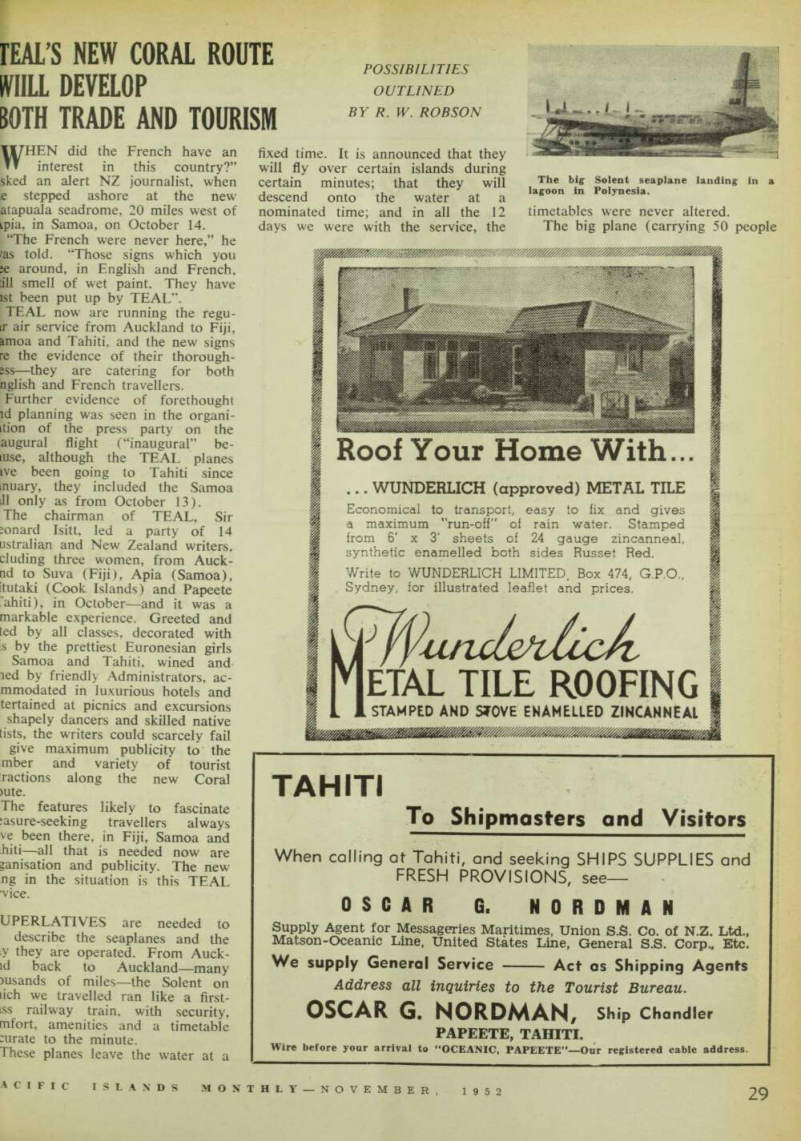
The big Solent seaplane landing in a lagoon in Polynesia.
in several compartments) seldom varied its practice. It would go quickly out of the tropical heat up to 7,000 or 8,000 feet and flatten out in sunshine, well above the clouds; fly steadily and firmly at
about 200 mph; and the passengers, relaxed in coolness and comfort, re ceived at short intervals, the choicest foods and drinks of the NZ caterers, Management and operation give a feeling of safety and security.
If this fine service is to be com pletely profitable, it should run righ through to Tahiti every week, full loaded. As it is, it goes to Tahit every fortnight, and to Samoa thre times a month, and it is not quit fully loaded. A big and lively touris traffic—which both TEAL and th Territories are entitled to on thei merits—would take up the slack ii the present set-up. Tourism for Fiji Samoa and Tahiti should be en couraged and assisted in every way The establishment of this servia opens a new and important era in th< development of the Polynesian Terri tories. if tourism does not make i pay, the Government must pa; subsidies.
THERE has been controversy a between sea and land planes fo this important TEAL service througl Polynesia. TEAL is committed t< seaplanes—with the result tha Western Samoa had to waste nin< months in the construction of a sea drome; and that Rarotonga and Pag( Pago, which cannot provide sea dromes, are now completely shut of from air services.
That is unfortunate: both Raro
tonga and Pago Pago could make substantial contributions to air traffic. Now they can only maintain connections through a slow sea service —Rarotonga with Aitutaki, and Pago Pago with Apia. Tonga also is not serviced just now—but that is Tonga’s own wish.
But the situation may change. It is announced that TEAL cannot get seaplane replacements for the service, any more—so the big company will presently have to turn over to big land-planes. Land-planes could go to Rarotonga, Samoa, Tonga and Pago).
But there would be serious compli sations in relation to Suva and Papeete. The strip nearest to Suva is at Nausori, 12 miles away, and it is not suitable for the largest planes —they must go to Nadi, 100 miles iway. The strip for Papeete is at 3ora Bora Island, a long way off. it is proposed to construct a strip >n an island alongside Papeete Bay, Hit that will be a big and very :xpensive job. Suva and Papeete are he two largest towns served by the PEAL Coral Route, and seaplanes in ;ach case come practically into the owns.
The substitution of land-planes nay solve some problems, but it yould create others more serious in haracter.
OLANES on TEAL’s new Coral t Route go 3,000 miles out east wards of Fiji, and come back along he same route. Papeete is a dead nd. It seems unlikely that it will emain so. It is probable that this ervice will continue from Tahiti orthward to Hawaii, or northeast irto Central America, West Indies nd on to Europe, via the northwest oast of Africa.
The Australian pioneer aviator, 'aptain P. G. Taylor, expects that he latter route will connect with 'entral America or perhaps South mierica via Clipperton Island, a line lat he surveyed personally a few ears ago. He says it is quite racticable.
TEAL, Pan American Airways and dr France are all watching develop lents: each would like to put in the nk that will connect Tahiti with the Americas. Unfortunately, such a link ould have to be subsidised, because iere is nothing even remotely ;sembling traffic to be picked up nywhere between French Oceania nd Hawaii, or America. In time, no oubt—such is the tourist fame of ahiti in USA—any airline connect ig French Oceania with North
America will get substantial tourist traffic.
An airline from Tahiti, through Clipperton Island, Central America, West Indies and Northwest Africa to France would give an almost straight line, across the globe, from Sydney to Western Europe.
Mr. Austin Brodein of Raiatea, Mr. Joseph Bunton of Newcastle upon-Tyne, and Mr. B. W. S. Wil son of Auckland were passengers in “Waihemo” from Tahiti early in September. Mr. Bunton left Eng land in the yacht “Inspire” and left that vessel at Rarotonga in 1951
after falling in love with Jeanine Ceran of Tahiti. Miss Ceran went to Rarotonga, they were married, settled in New Zealand. Mrs. Bun ton returned to Tahiti on a visit some time ago—and will soon bo returning to Auckland with a daughter. Mr. Wilson, of Auckland, was returning home after a period of interesting seafaring. He left Auckland as a member of the crew of “New Golden Hind” in April, 1951. When that vessel was sold in Tahiti, he was one of four who went to England to bring the Fair mile passenger vessel “Philante II” back to Tahiti. It is expected that the vessel will also be sold there.