Big Territories
pp. 23-120 · Read in the full issue
Impressions Of Four
Gained In An
Airways Tour
By R.W. Robson
New Caledonia
Fthis, the most disunited and cheerless Territory in the Pacific, a contest is going on between interests and classes which is not the less bitter because it is mostly out of sight. If it is possible to classify this heterogeneous community, it might be shown in five sections:— • French officials. They are cold and aloof, glued tightly to remark ably high salaries and allowances (the Governor is said to receive a sum equal to £600 Aust. per month), and they. deal with NC as it is, rather than on a basis of what it might be. • European Business Tycoons.
These constitute a hierarchy apart.
The structure is based on chrome and nickel—and, under the tolerant administration, it has virtually ruled NC for so long that it cannot imagine NC under any other set-up. • The poor whites. The convicts sent from France eventually were Freed, to establish themselves as colonists (Colons). They inter married freely with NC Melanesians, rhey now are the largest community in NC.
• The new-rich of World War 11.
Jap occupation of the Solomons caused the Americans to establish an enormous base in NC. Almost overnight, millions of US dollars lifted NC’s shrewder traders from the hopeless poverty which followed France’s 1940 collapse, to the edge of the Tycoon class. • A racial hotch-potch of Melanesians, Indonesians, Poly nesians, Chinese, Japanese—some holding together in little racial cells, but very many cross-breeding without fear, favour or plan.
The sections overlap in all directions. Some new-rich are accepted by the Tycoons. Some Tycoons have gone the way of much Pacific flesh, and are with the beach combers, in the lowest class.
Political Melting-Pot
NC went along without much social disturbance for over a half century. Then it was convulsed by a series of rapid events—France’s surrender and the Vichy-de Gaulle split; wartime controls and Yankee dollars; the advent in Paris of Socialist planners, who support a common roll; and the settlement in NC of Indonesians and Tonkinese.
Now the big Colony, politically, economically and socially, seems to be in the melting-pot. The lower classes—especially the Colons and the racial hotch-potch—are fighting hard for the common roll, in the belief that if they once can get con trol of the Council-General, they will get sweet revenge upon the Tycoon section (usually called the Nickel Combine) for the economic oppres sion which they think they have suffered for many decades.
The Tycoon section fears for its properties and privileges, and is re sisting the proposed changes with everything it has. It seems certain that if the common roll is established, so that political power is given the poorer classes, income taxation will be introduced.
In a way, it is the old struggle between the Haves and the Have nots, between Capitalism and Social ism. But here it is more directly concerned with local history, hates and prejudices than with the ’isms . . . It is a depressing picture.
For the casual traveller, NC has unusual interests, some old French charm, much lush tropical beauty on
its northeast side. NC would wel come tourist revenue. But there seems little hope of tourist traffic while the politico-economic fight is unresolved. n • • •
ri j i
FIJI’S broad smile of welcome is irresistible. After comfortless journeyings, I always go to earth in the well-run GPH with vociferous pleasure—endless hot water, deft and soft-footed Indian servants, food that is not too imaginative, a telephone service that really tries to do its best.
Suva is as deceptive as her exotic tropical beauty implies. She has been telling the world about her dreadful hurricane, and you go in looking for debris, derelict palms and smashed buildings. Actually, Suva is cleaner, tidier and more lovely than I ever have seen her.
The big wind blew away all the rubbish—the old fences and build ings and trees, the dead fronds of the palms, and the people have done a marvellous job of cleaning up. As so often follows a disaster, Nature is working overtime. The vegetation is more luxurious and greener, the colour of the abundant flowers more vivid. Even the impudent mynahs are chirruping on a brighter note.
The New Governor
Up to my departure on October 22, all classes and sections were praising the new Governor and his pretty and charming wife. In two weeks, they had made a wonderfully good first impression. I did not like it. Suva, as with all the perverse and lovable ladies of the tropics, is happiest when she has something to squabble about: this unanimity (about the Garveys) may start un reasonable criticism, merely for the sake of being different. But, so far, all is very well with them.
Sir Roland Garvey is confronted immediately with two first-class problems—economic and racial. Fiji’s overseas trade balance is too deeply in the red to be comfortable. The growth in the Indian population is providing headaches at all levels and in all directions.
But Sir Ronald starts off with an initial advantage enjoyed by no other Governor. He is almost completely au fait with Fijian affairs, and the background of the Colony’s adminis trative and personal troubles. He need not waste a year or two “learning, the job”—he is equipped to
(Continued on Page 113)
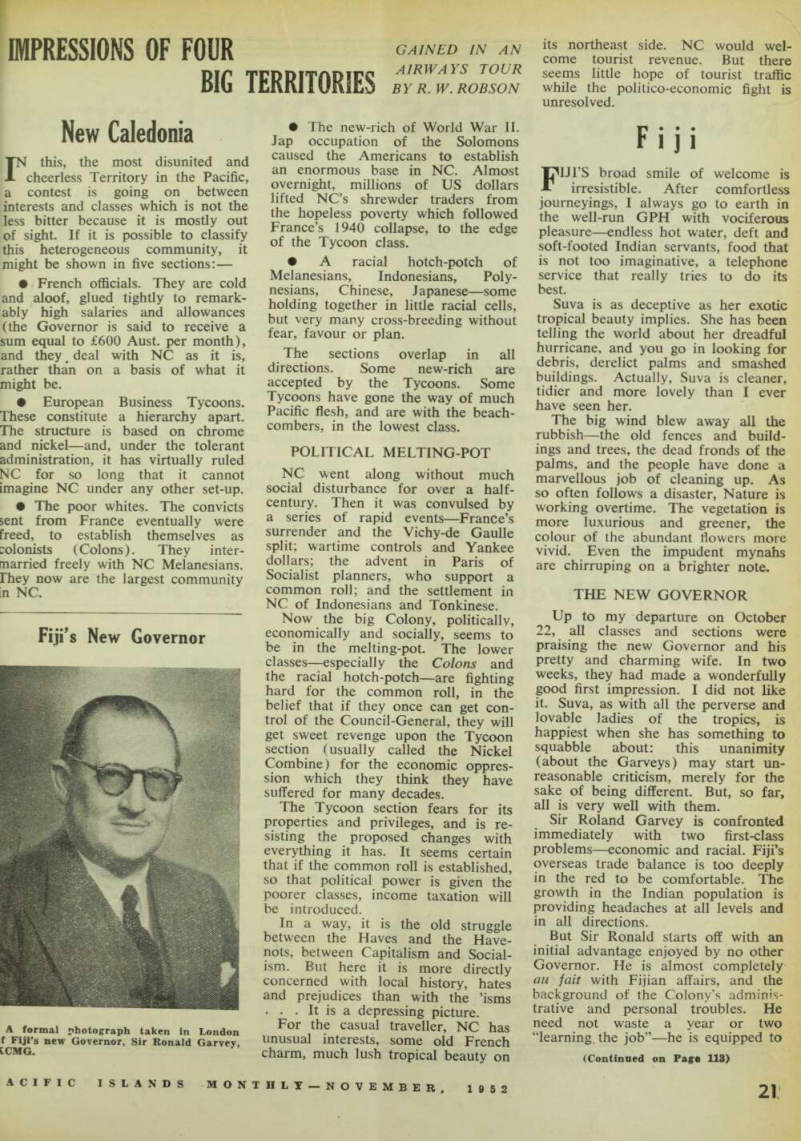
Fiji's New Governor
A formal photograph taken in London [?]f Fiji’s new Governor, Sir Ronald Garvey,
[?]Cmg.
lake prompt decisions, and he is le type who will make them.
Future Of The Indians
I was deeply interested in observ ig the attitude of the Indians to leir new ruler. The old Indians remed as “Dead Pan” and inscrut )le as ever, but the young indians -born in Fiji, English-speaking, alert id intelligent—appear to me to be oking to this young Governor with iendliness and real hope.
Shortly, in this journal, 1 am go g to discuss the future of the dian people in Fiji without any servations, and 1 cannot here at mpt to deal with such a vexed bject. But 1 believe that the ji-born Indian can provide the iswer to the problem the Indian [plantation created, and that there n be a peaceful and happy future r all races in this lovely archi lago. The Fiji-Indian, with help, n provide the answer to to-day’s Acuities; and the Fiji-Indian thus n earn his share of the future’s eet rewards. But the emphasis is Fiji-Indian —the man born in the untry.
Western Samoa
HATE that word “Paradise”—the Americans, trying to sell books d films about the Pacific, have wlderised it to the point of surdity. But I have seen practically the South Pacific islands, and if i one of them is entitled, on the •res of tropical colour, happiness its people, cleanliness, freedom m economic and political worry, lerous hospitality to the stranger hin its gates, and general at :tiveness, the title of “Paradise” •uld go to Western Samoa. have known the Country for 20 rs, I have as good a knowledge any of its history. On that basis, ive the credit for Samoa’s happi s to-day to the German colonists 1890-1914, and the New Zealand ialists of 1935-50. By establish the cocoa industry, the Germans de the Samoans rich. By rooting the Chinese, and giving the noans an increasing measure of -government, the New Zealanders ured their economic security and social welfare of the Samoans, he 20-miles drive from the new apuala seadrome to Apia, through alu’s richest territory, is a sheer ght. The swarming villages are neat, the people so healthy, the
abundant plantations so prolific, the lack of any sign of poverty so marked. Everything, from the medical statistics which show a popu lation of 100,000 close at hand, to the Customhouse figures which indi cate a growing surplus of wealth, and the education figures which point to a rapidly increasing percentage of literacy—all pay tribute to the good work of the caretaker nation (New Zealand).
Call For Discipline
All is not well, of course—it never
is. Overdoses of wealth and freedom have gone to the heads of the young Samoans, and there are disturbing stories of increasing village hooligan ism, and a positive pestilence of petty theft. One may not too hastily allot blame; but one gets the impression that the police system has been—and still is—far too easy and not very efficient.
There is reasonably good co operation between NZ Administration and the Samoan high chiefs. If the Samoan leaders are wise—and they have not lacked wisdom in the past —they will take early and drastic steps to impose a greater measure of social discipline in the villages. If
they don’t, they may lose some of their hard-earned freedom, and dis credit their lovely country.
Tourism For Samoa
If Samoa wanted more wealth— and I doubt if more wealth would be good for her—she surely could get it through organisation of the tourist traffic.
The three South Pacific countries which can develop an enormous tourist industry are Fiji, Tahiti and Samoa—and Samoa need not be in second or third place. Each has very special attractions to offer; each has its distinctive charm; and Samoa is completely different from all the other big archipelagoes in that it has no Asiatic community—it is the
only big Pacific country without major racial problem.
There are not 200 full European left in Samoa. There are about 5,0(1 people of European-Samoan blooo who mostly enjoy European statu and fit happily into the little natioi and supply most of its trading an professional classes; and there an some Chinese-Samoans (relics of th repatriated Chinese labourers) c really excellent type; but these group present no problems.
Except for tourism, I do not se any sign of new industries develoj ing in Samoa. In fact, Samoa seem to have all it needs. But if there ai any tendencies towards developmen they surely will be stimulated by tfc inclusion of Samoa in the magnified new air service just established t TEAL. You can be in this colourfi tropical paradise (that word again! 15 hours after leaving Auckland.
Tahiti
PAPEETE seems destined to b( come, in the South Seas, wh; Honolulu is in the North Pacific a place of glamour, and sensu: thrill, all adjusted to the syncopatia of canned Yankee music.
In general lay-out, Papeete an Apia are much alike. But wherea Apia’s bay is broad, and wind-ruffle*
ad shallow at the edges, so that lost ships lie out, Papeete’s is irrow, and deep and placid, like a irror.
One side of the main street in both pia and Papeete is the water-front; it whereas Apia’s waterfront is half ilderness, Papeete’s is a dock-side, here ships from the seven seas are oored end-on. As you walk along ipeete’s waterfront, you have the isy shops on the one side, and on e other scores of little gangways, iding from the side of the street ;ht onto the decks of innumerable ips.
Right behind the quay is a maze little streets, packed with Chinese ires; behind that the residences, ried in lush and colourful gardens; d. behind that again, steep, bare, m-looking mountains, out of which mes the little town’s abundant ter-supply. It is one of the most ractive and lively little ports in ! world.
Sin In Papeete
By reputation—supported by one’s t impression—Papeete’s chief in >try is Sin. An extraordinary per itage of the street population com ses pretty French-Tahitian girls; 1 a notable percentage of them e the stranger a roguish glance, I wriggle self-consciously. The nderer from colder climes soon Is that he is expected to adjust his t to the inescapable rhythms of the ned music, and put a Tahitian ver behind his ear (the customary t of a love-quest), otherwise he is tten down as a dull dog, and irofitable.
Quinn’s Bar, a bamboo-like icture in the centre of the town, famed for its lively and uncon tional atmosphere, and for the ius of the Yank-Tahitian tunes iposed by its manager, Eddie id; and the tempo of life in the t area generally seems to be erned by Quinns. The half-dozen :s and dance-halls give the place air of determined gaiety; and they ly get going on Saturday and day nights.
Jnlike the English-speaking Terri
es, Tahiti places no restriction itever upon the sale of liquor to itians and part-Tahitians; and the izy created by furious music, lal urge and alcohol frequently Is to scenes which spectators rwards describe with no lack of gination, in smoke-rooms and castles around the world. This, 'be, has given Tahiti a fame -h Tahiti really does not deserve, ome cf the Tahitian solo dancers
are great artists. In the front rank, at present, is Augustine. No entertamment is complete without this lovely and lively little creature, and her troupe of assistant dancers. Her hula—an extraordinary circular wriggling of the body, described by the visiting journalists as a “belly
flop'’ or an "abdominal snap’*—nas to be seen to be believed Probably it is completely based in sensualism! but it is nonetheless an artistic achievement,
Tahitian Communities
However, there is a great deal
lore to Tahiti than Quinns and the abdominal snap”—although the asual traveller is liable to be im lersed in those first impressions.
In a population of 60,000 there are erhaps 40,000 Tahitian villagers, ving quietly very close to the soil; ?out 10,000 Chinese traders and rtisans, who control most of the )mmerce that is worth while; and a rge community—their number can )t even be guessed at—of European ahitians, who fill a definite place itween the official French ad inistration, and the rest of the jpulace.
Nothing much is said; but some >w one senses an antagonism be een the official French and the iding Tahitians and part-Tahitians. le latter, like their counter-parts Samoa, Tonga and other Poly sian countries, would like to govern imselves, and be free of the white icial whose orders come from over ; seas.
Under French law, of course, all jse folk—Tahitians, part-Tahitians, hitian-born Chinese, and any izen of mixed blood—have equal tus. They are French citizens, and jy have exactly the same rights, d they can move around anywhere the French Empire with complete edom. That is the basis of the le ration created years ago by ance, called the French Union.
There may be much in a name; t it does not provide the solution the not-very-aggressive nationalist itiment of this country. The hitians and part-Tahitians have two lings; they hate the Chinese, and :y want to govern their own antry. The fact that the French zern them well and conscientiously. 1 pour a surprising amount of mch funds into public works, for good of the whole community, 2s not seem to alter the basic itiment of their hearts. They will you, in idle moments, of the high ces the Chinese pay for Tahitian gins, and of the large salaries re zed by the highest fonctionaires of Tahitian administration. :ahiti generally happy }n the whole, however, it is a >py-go-lucky community, without r serious problem of politics to p the fonctionaires awake at hts. The worst headaches are ial. fhere is too much disease about— erculosis, filariasis, and venereal. :ombination of French and Ameri interests is making a splendid >rt to rid the country of TB and riasis; but there is not much
chance of dealing effectively with the other thing while every barrier against freedom of sexual intercourse is discounted.
The country has four main sources of revenue; Vanilla exports, copra exports, phosphatic rock from Makatea, and the funds sent from Paris to pay for the administration.
Makatea is nearly worked out. This seems to provide a precarious kind of a budget; and high officialdom evidently is sensitive on the point, because it is very anxious to stimu late tourism. The opening of the TEAL service is therefore an event of the highest economic importance.
There are good hotels there—Les Tropiques, Royal Tahitian, etc.—and now there has been opened a most excellent hostelry, right on the waterfront at one end of the town, the Grand, and Papeete now can accommodate and entertain a large number of visitors. The latter will get all the beauty and charm of the South Seas in Tahiti, plus something that we may call Extreme Sophisti cation.
There are some ugly things under the surface; but the average tourist, being satisfied with the superficial, may easily be induced to leave with the conviction that he has had his
money’s worth.
Maybe, I had better stop here: and say no more about money, got 140 francs for my Australia £ and the price of goods and service in Papeete, on that basis, literally rocked me. Fifty-five francs for a 300-yards taxi-drive; 750 francs for a dinner for one, plus wine and s solo dance by Augustine—Tahiti i; no place for folk who value the bawbees. But Tahiti surely will be: increasingly, a playground for the rich; and it is being well organised! accordingly. Its friendly and very hospitable people deserve all that a big and growing tourism can give them.