For Pacific Radio Amateurs
pp. 83-85 · Read in the full issue
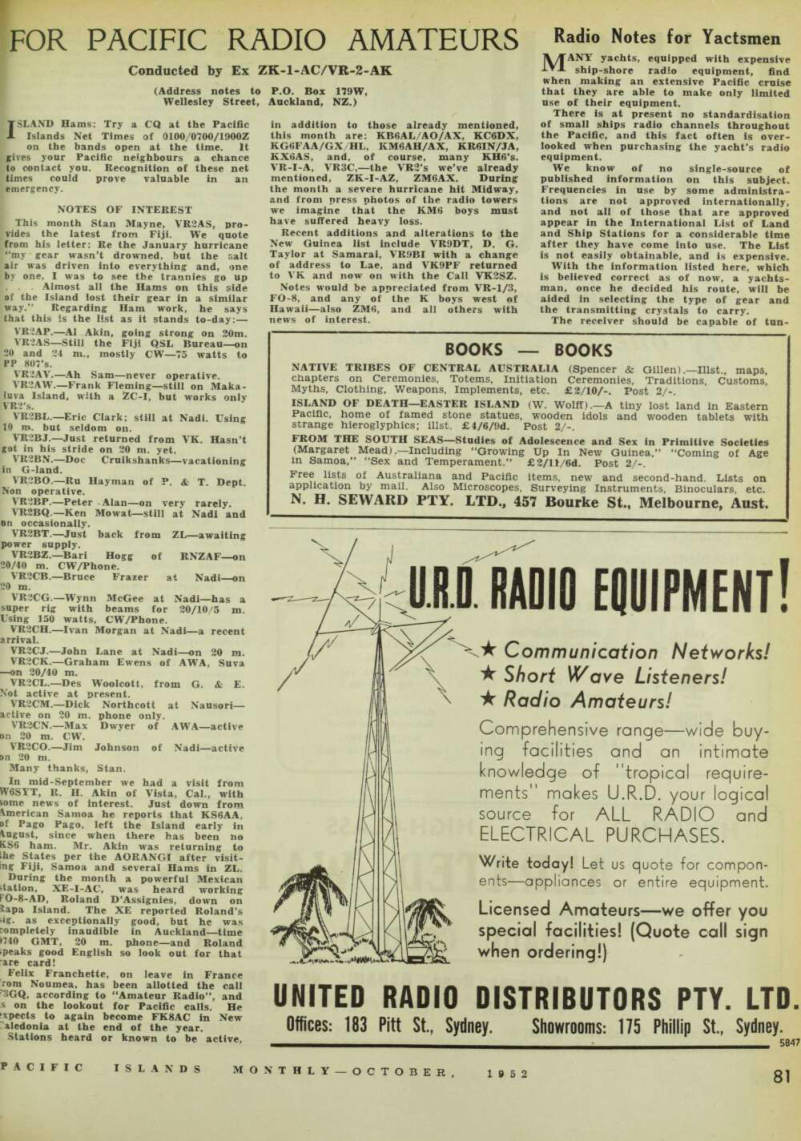
Conducted by Ex ZK-1-AC/VR-2-AK (Address notes to P.O. Box 179 W, Wellesley Street, Auckland, NZ.)
ISLAND Hams: Try a CQ at the Pacific Islands Net Times of 0100/0700/1900Z on the bands open at the time. It gives your Pacific neighbours a chance to contact you. Recognition of these net times could prove valuable in an emergency.
Notes Of Interest
This month Stan Mayne, VR2AS, pro vides the latest from Fiji. We quote from his letter: Re the January hurricane “my gear wasn’t drowned, but the salt air was driven into everything and, one by one, I was to see the trannies go up Almost all the Hams on this side of the Island lost their gear in a similar way.” Regarding Ham work, he says that this is the list as it stands to-day:— VR2AP.—AI Akin, going strong on 30m.
VR2AS—Still the Fiji QSL Bureau—on 30 and 34 m., mostly CW—75 watts to PP 807’s.
VR3AV.—Ah Sam—never operative.
VR3AW.—Frank Fleming—still on Maka luva Island, with a ZC-I, but works only VR3’s.
VR2BL.—Eric Clark; still at Nadi. Using 10 n>. but seldom on.
VR2BJ.—Just returned from VK. Hasn’t got in his stride on 20 m. yet.
VR2BN.—Doc Cruikshanks—vacationing in G-land.
VR3BO.—Ru Hayman of P. & T. Dept.
Non operative.
VR2BP.—Peter Alan—on very rarely.
VR3BQ. —Ken Mowat—still at Nadi and on occasionally.
VR2BT.—Just back from ZL—awaiting power supply.
VR3BZ.—Bari Hogg of RNZAF—on 30/40 m. CW/Phone.
VR2CB.—Bruce Frazer at Nadi—on 20 m.
VR2CG.—Wynn McGee at Nadi—has a super rig with beams for 30/10/5 m.
Using 150 watts, CW/Phone.
VR2CH.—lvan Morgan at Nadi—a recent arrival.
VR2CJ.—John Lane at Nadi—on 30 m.
VR2CK.—Graham Ewens of AWA, Suva —on 20/40 m.
VR2CL.—Des Woolcott, from G. & E.
Not active at present.
VR2CM.—Dick Northcott at Nausori— active on 20 m. phone only.
VR2CN.—Max Dwyer of AWA—active on 20 m. CW.
VR2CO.—Jim Johnson of Nadi—active on 30 m.
Many thanks, Stan.
In mid-September we had a visit from IV6SYT, R, H. Akin of Vista, Cal., with some news of interest. Just down from American Samoa he reports that KS6AA, of Pago Pago, left the Island early in \ugust, since when there has been no KS6 ham. Mr. Akin was returning to the States per the AORANGI after visit ing Fiji, Samoa and several Hams in ZL.
During the month a powerful Mexican station, XE-I-AC, was heard working FO-8-AD, Roland D’Assignies, down on £apa Island. The XE reported Roland’s sig. as exceptionally good, but he was completely inaudible in Auckland—time 1740 GMT, 30 m. phone—and Roland speaks good English so look out for that are card!
Felix Franchette, on leave in France Tom Noumea, has been allotted the call r 3GQ, according to “Amateur Radio”, and s on the lookout for Pacific calls. He expects to again become FKBAC in New Faledonia at the end of the year.
Stations heard or known to be active,
in addition to those already mentioned, this month are: KB6AL/AO/AX, KC6DX,
Kg6Faa/Gx/Hl, Km6Ah/Ax, Kr6In/Ja,
KX6AS, and, of course, many KHfi’s.
VR-I-A, VR3C,—the VR3’s we’ve already mentioned, ZK-I-AZ, ZM6AX. During the month a severe hurricane hit Midway, and from press photos of the radio towers we imagine that the KM6 boys must have suffered heavy loss.
Recent additions and alterations to the New Guinea list include VR9DT, D. G.
Taylor at Samarai, VR9BI with a change of address to Lae, and VK9PF returned to VK and now on with the Call VK3SZ.
Notes would be appreciated from VR-1/3, FO-8, and any of the K boys west of Hawaii—also ZM6, and all others with news of interest.
Radio Notes for Yactsmen
TV/TANY yachts, equipped with expensive -*-▼-1- ship-shore radio equipment, find when making an extensive Pacific cruise that they are able to make only limited use of their equipment.
There is at present no standardisation of small ships radio channels throughout the Pacific, and this fact often is over looked when purchasing the yacht’s radio equipment.
We know of no single-source of published information on this subject.
Frequencies in use by some administra tions are not approved internationally, and not all of those that are approved appear in the International List of Land and Ship Stations for a considerable time after they have come into use. The List is not easily obtainable, and is expensive.
With the information listed here, which is believed correct as of now, a yachts man, once he decided his route, will be aided in selecting the type of gear and the transmitting crystals to carry.
The receiver should be capable of tnn
ing at least two of the WWV/WWVH continuous time-signal frequencies. The 5 and 10 mc/s frequencies are likely to be as consistently well received as any. especially the 5 via Honolulu-WWVH.
A reciever which also covers the broad cast band could be useful in some cases —e.g. in the Samoa area, where weather broadcasts are given only on that band, but it is not essential. State interference is usually bad in the tropics—and news and music broadcasts are available in plenty on h.f.—so if a choice must be made between a good communication-type short-wave re ceiver and a less-efficient dual-wave set, choose the h.f. set. It will serve all needs, even if the yacht does not carry a transmitter.
Most licensing administrations, require that, unless a radio operator with a Second Class (or better) PMG certificate is carried the equipment must be crystal-controlled.
This, while ensuring that the inexperienced operator does not get his trans mitter off-frequency means that separate, and expensive crystals must be carried for each transmitting frequency. Because no Pacific Ad ministrations, including Australian and NZ, standardise on channels the yachts man has to decide in advance what channels he plans to use, as once away from civilisation crystals will be difficult to obtain.
Provided that prior arrangements are made, by letter or radio, most Island main radio stations will arrange definite scheds. once or twice a day with yachts, if these land stations do not normally keep a scheduled watch on specfied frequency for smallships. The yacht may stipulate its own transmitting frequency, or frequencies, and the coast station will listen on them as requested.
But, in the past yachtsmen have fallen into disfavour with these stations by. failing to regularly keep the sohed. or by being late on sched. Most of these stations are busy. They have many overseas scheds. which have to be kept to the minute, and if the yachtsman is late important scheds to other stations may be interfered with. Having requested a sched, keep it promptly.
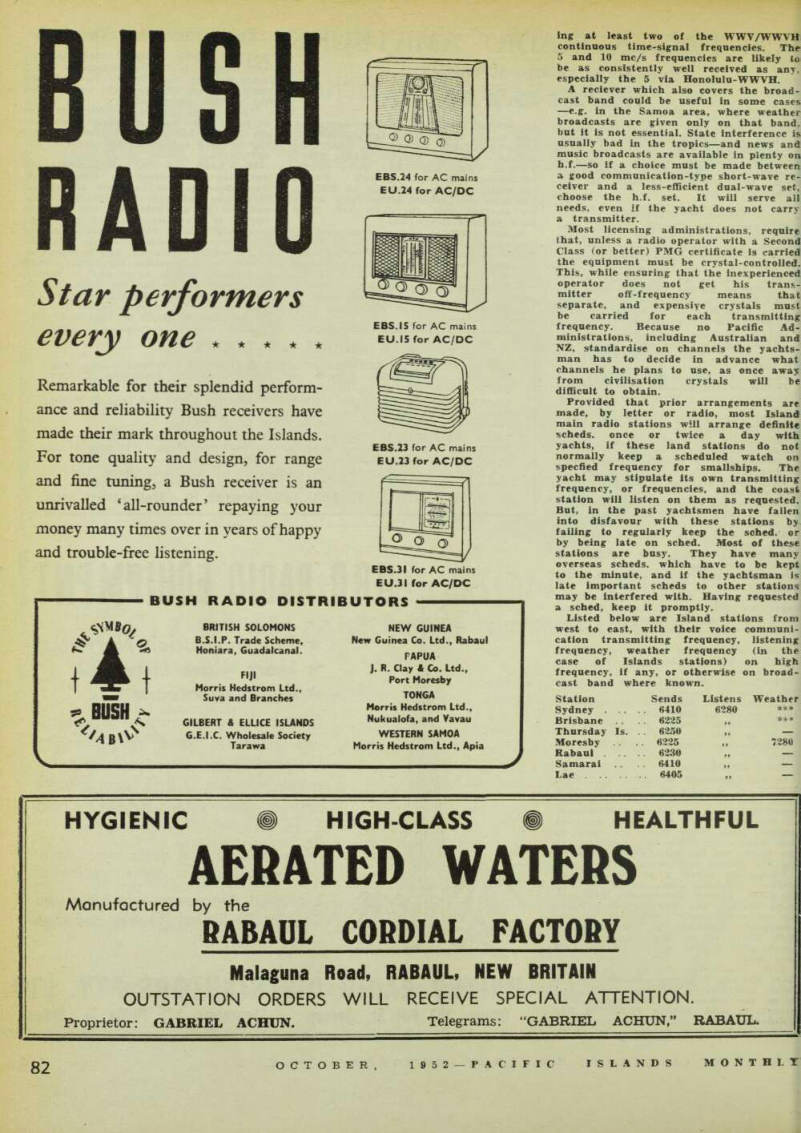
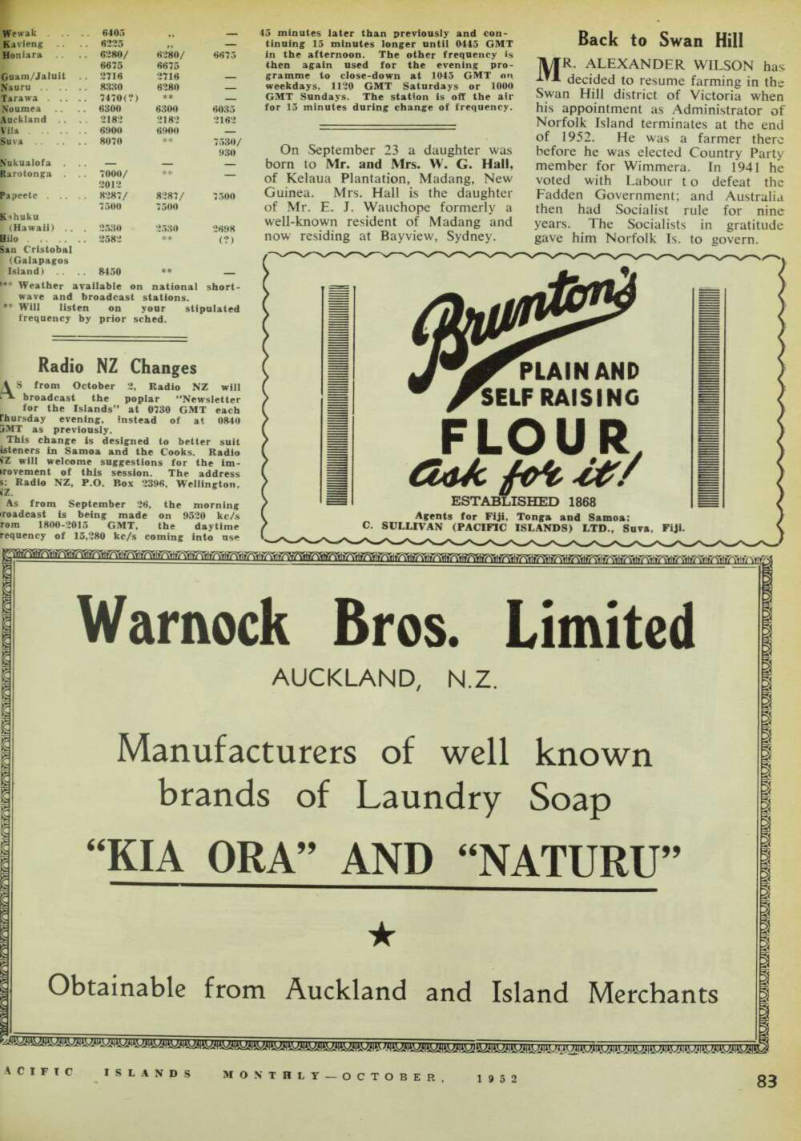
Listed below are Island stations from west to east, with their voice communi cation transmitting frequency, listening frequency, weather frequency (in the case of Islands stations) on high frequency, if any, or otherwise on broad cast band where known.
Station Sends Listens Weather Sydney . . . . 6410 6280 *** Brisbane . 6225 *** Thursday Is. .. 6250 — Moresby . 6225 7280 Rabaul . . . 6230 — Samarai 6410 ,, — Lae 6405 —
Weuak 6405 „ Kavieng 6225 „ — Honiara 6280/ 6675 6280/ 6675 6675 Guam/Jaluit 2716 2716 — Nauru 8380 6280 Tarawa . . . 7470(7) ** Noumea 6300 6300 6035 Auckland 2182 2182 2162 Vila 6000 6900 Suva 8070 ** 7530/ 930 Nukualofa — — Rarotonga 7000/ 2012 ** — Papeete . .. 8287/ 7500 8287/ 7500 7500 K <huku (Hawaii) . 2530 2530 2698 Hilo 2582 *♦ (?) San Cristobal (Galapagos Island) 8450 ** — *** Weather available on national wave and broadcast stations. short- ** Will listen frequency by on your stipulated prior sched.