Cattle-Raising Possibilities In New Guinea
pp. 57-60 · Read in the full issue
Interesting Signs of a Developing Industry
BECAUSE the world’s visible meat supplies are not keeping pace with increasing world popula tions, long-visioned people are giving much attention to the pastoral indus tries. The possibilities of cattle raising in the great islands of Papua- New Guinea have been getting a lot of quiet attention.
There are huge areas in Australia where cattle might grow; but every so often the Australian cattle-men are wiped out by droughts. New Guinea has no droughts.
Some people (mostly gentlemen labelled “Dr,” whose knowledge has been gained only in academies) say New Guinea is unsuitable for pas toral enterprises. Other types of planners—especially the products of the Ward-Murray regime-oppose this kind of European enterprise because, they say, the region should be kept as a tight preserve for the natives.
But, while the arguments proceed, various interests—encouraged quietly by the Administration—are going steadily ahead with the introduction of cattle. Cattle-raising already had started in the ‘thirties, but invasion and war wiped out the industry.
Mr. Michael J. Leahy was one of the first in with cattle after the war.
At enormous personal cost, he has established a herd of fine cattle on his upland pastures at Mumeng (be tween Lae and the Bulolo) where he did valuable pioneering work in showing that European types will flourish on the natural grasses, under certain conditions.
The Department of Agriculture, working quietly and efficiently, has amassed a great deal of most useful data on cattle-raising, and has helped in a practical way every landowner who showed interest in cattle. It has a lot of literature now available.
THREE years ago, the Administra tion established in the Baiyer River Valley (in the Highlands, northward of Mount Hagen) a large station for the breeding-up of suitable stock for distribution in New Guinea, and a New Guinea veteran, Mr. W. A. MacGregor, was put in charge. Mr. MacGregor has taken up this task with enthusiasm and, recently, in a three months’ leave in Australia, he did a great deal of personal propaganda work for New
Guinea cattle-raising.
He now has 150 cattle, 300 sheep and 30 horses on good pastures at
4.000 feet, in Baiyer Valley, and already his experiments and observa tions are useful. He claims that at 4.000 feet, European cattle will do well—and most of the great valleys of the NG Highlands are 4,000 feet or more above sea-level. Under 4,000 feet, it is advisable to introduce the heat-resistant Cebu strain. The stock generally thrive on the natural pastures of the Baiyer Valley— mostly Mitchell grass. The coarse and useless kunai covers much less of these lands than is generally sup
du?!d .
Mr. MacGregor believes firmly that there is a “tremendous” future f° r cattle-raising in the Territory— and not on ly > n the Highlands. He sa Y s that not many people know that there are hundreds of thousands of a cres of good cattle-country in the region behind Wewak—open grass country lying mostly at 600 to 1,000 feet, which he has personally ex amined. Unlike the Highlands— which area at present is wholly de pendant ori a,r J eommumcahpn-th.s Wewak country is accessible by water. Marienberg, a deep-water
station on the lower Sepik, would be quite a handy port.
Mr. MacGregor has a working corps of 90 Highland natives in the Baiyer Valley, and he is defying the rice solution of the food problem by growing his own food supplies— mostly corn, sugar-cane, pineapples and pawpaw.
The cost of getting cattle into the Territories is enormous; but Mr.
MacGregor is confident that from these herds the Administration soon will be able to distribute acclima ; tised and disease-resistant stock to any landowner who wants them.
Plantation - Owners In
Papua are showing an increasing interest in the importation of Aus tralian cattle, for acclimatisation.
Recently, a specially chartered ANA freighter aircraft carried 20 heifers from the Cardington Station herd, near Townsville, to Sengari Planta tion, outside Port Moresby. The cost of transportation was surpris ingly low and, if the cattle settle down well, there probably will be an extension of this traffic.
At the end of June, 19 heifers were flown from Cairns to the Lutheran Mission at Lae.
In mid-September, a Qantas DC3 aircraft carried 23 heifers and two
bulls (all AIS breed) from Malanda Station, near Cairns, to the Francis can Catholic Mission at Aitape, Northern New Guinea. Another 25 head of cattle are to be flown to the Catholic Mission at Alexishaven, Madang.
A North Queensland cattle man, Mr. Con O’Leary, said that he thought the AIS breed would do well in the first-class grazing country above Wewak—they were good all purpose animals, and would cross well with the Cebu.
Mr. and Mrs. A. Shanley and daughter Hilary returned in Septem ber to Rabaul, NG after Australian leave.
Mr. S. H. Brenan, LDS, RCS (Eng.), formerly dental officer in Palmerston North, NZ, for the De partment of Health, left New Zea land for Apia early in September.
He will be appointed principal dental officer for the Administration of Western Samoa for the next three years.
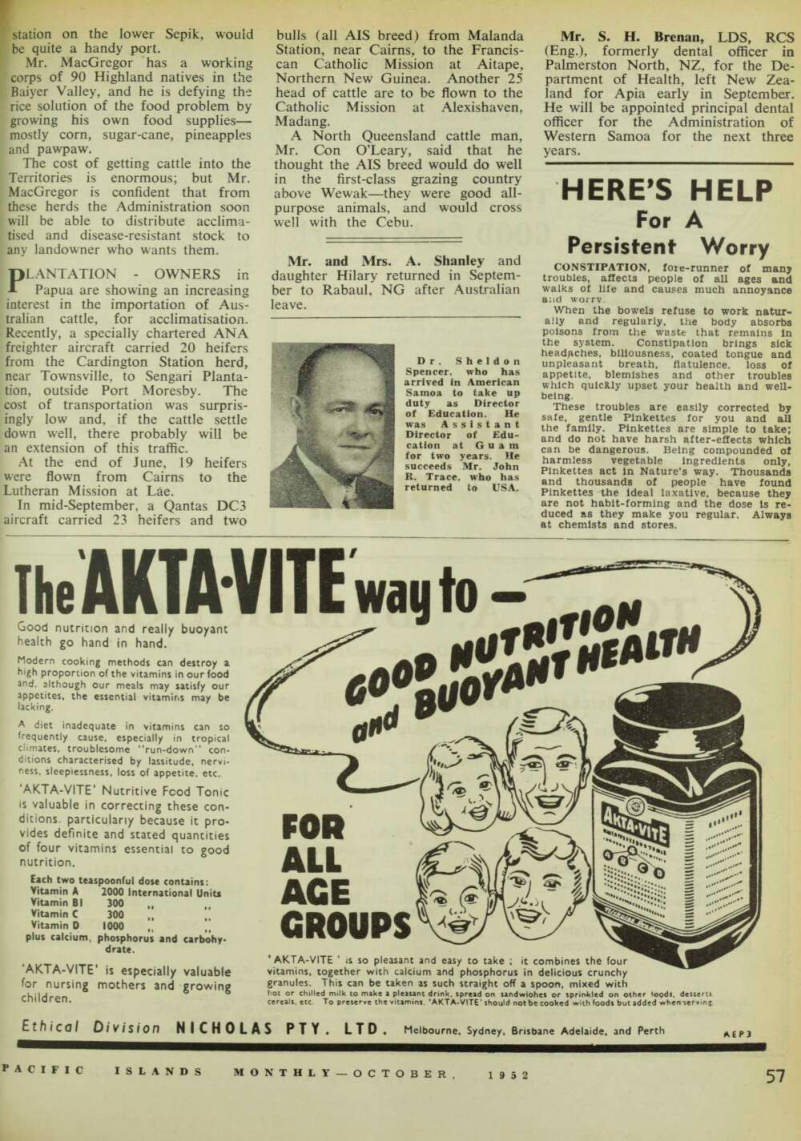
Dr. Sheldon Spencer, who has arrived in American Samoa to take up duty as Director of Education. He was Assistant Director of Edu cation at Guam for two years. He succeeds Mr. John R. Trace, who has returned to USA.
Mrs. Ereckson, wife of the Meteorological Officer at Tarawa, who came south to New Zealand early in the year, returned to the Gilberts with her three-months-old daughter by the Norwegian ship “Vilja” from Auckland in Septem ber.