Too Old, Say Owners
pp. 25-28 · Read in the full issue


Aorangi To Withdraw
Next Year
PRESENT indications are that the trans-Pacific passenger service now carried on by the 17,941-ton liner Aorangi will terminate in May 1953.
Unless some other ship goes onto the run in the interval, this will leave the once lucrative Sydney- North America service without a regular passenger ship.
The Canadian-Australasian Line, through the Union Steamship Co., announced on September 28 that the reason for the Aorangi’s with drawal was her age—2B this year.
Aorangi’s post-war life has been far from happy. After war service she had a two-years’ refit in Sydney
which is said to have cost £l * million (more than her original cost). Built 1924 to carry 947 passengers, her refit during the peak of Australia’s post-war industrial troubles and shortages left her with accommoda tion for less than half that number.
Much of the former passenger space was converted to improved accommo dation for the crew of over 300 which she now carries, Although none of the pre-war trans-Pacific passenger ships, includ ing the Matson liners Mariposa and Monterey, came back into service after hostilities had ceased and Aorangi had a monopoly of this trade, she began to run up heavy losses for her owners from her first post-war voyage in August 1948. This was due to three main factors: the competition of trans-Pacific air transportation, dollar restrictions in British Commonwealth countries which has sharply curtailed trade with America, and the high costs
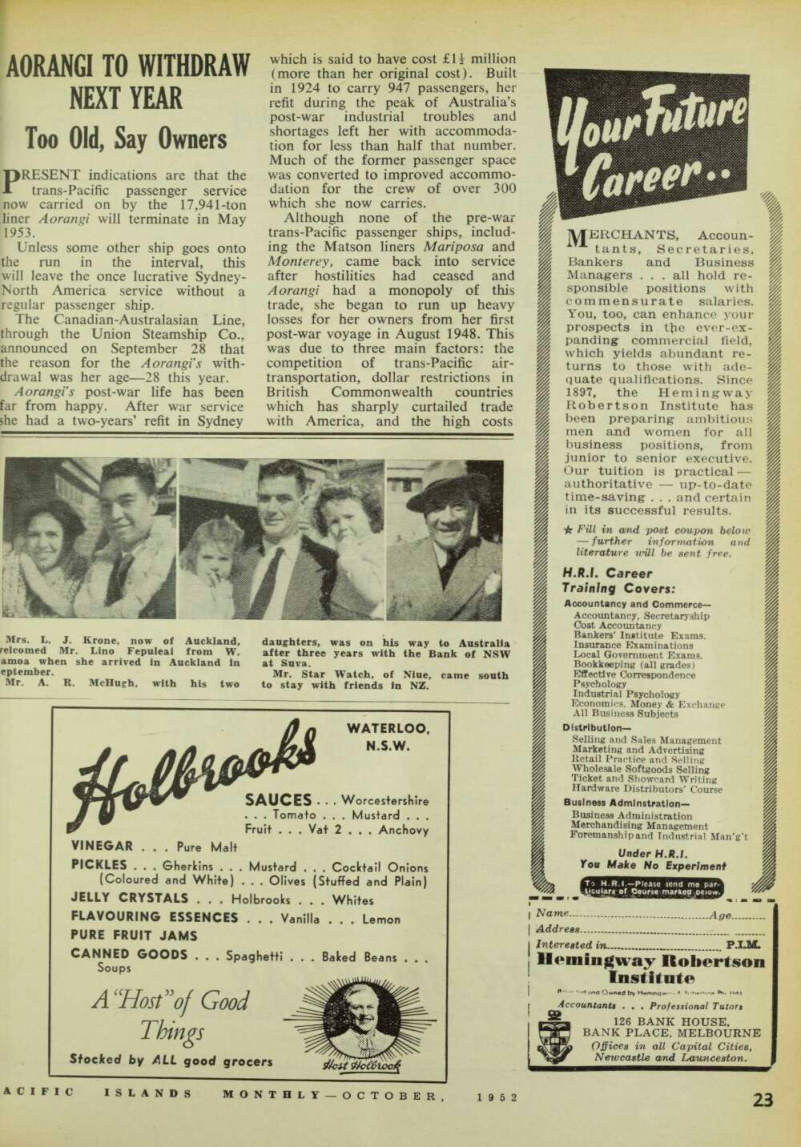
Mrs. L. J. Krone, now of Auckland, welcomed Mr. Lino Fepuleai from W. amoa when she arrived in Auckland in eptember.
Mr. A. R. McHugh, with his two
daughters, was on his way to Australia after three years with the Bank of NSW at Suva.
Mr. Star Watch, of Niue, came south to stay with friends in NZ.
nd wages involved in running ship ing to-day.
In 1950, Aorangi’s owners asked le governments of Australia, !anada and New Zealand for a jbsidy to keep the vessel on the irvice, the alternative being with rawal. She was withdrawn at the id of January, 1951, but went ick on the service in April of that ;ar after the governments con ;rned agreed to pay the subsidy, he subsidy was renewed for 12 onths early this year.
Reason for withdrawal now is not ibsidy trouble but age and unsuit »lity for the job. What will be her timate fate is anyone’s guess, wing to her size and class it seems obable that she will not be easy sell profitably.
Leturn Of Matson Ships
Nothing definite has been an mnced concerning the return of e Matson Line to the trans-Pacific issenger service, although there ve been recurring rumours since ariposa and Monterey were with awn shortly after the end of the ar. It is believed that if this mpany does enter the Pacific ser :e, they will either build or buy o small modern ships.
Commenting on Aorangi’s impend
ing withdrawal, the Australian Minister for Shipping said that he hoped that the Matson Company would soon restore the passenger shipping link between Australia and North America. This is probably as good an indication as any of the evil days on which shipping has fallen in 1952. Times were when no Cabinet minister would rejoice at the prospect of the withdrawal of a shipping company with local affilia tions, in favour of one of foreign origin. But from the point of view of Australian practical politics there is now much to be said for the substitution of Matson ships for the
Aorangi. The Matson ships would be the responsibility of that company and the United States; and the Aus tralian government would presumably be spared the necessity of paying a subsidy.
In mid-October discussions were continuing between the Australian Government and the Matson Co. with the object of getting Matson, ships on the run at an early date.
M. Launay, planter, of Santo r New Hebrides, lost his copra smoke house by fire on September 30. It was in operation at the time and the contents were also destroyed.
Besswicks Ltd., of Rabaul, NG, plan to erect a modern two-storey building, the ground floor of which will be divided into showrooms, rest rooms, offices, children’s clothing factory and bulk store. The first floor will be sub-divided into family living quarters and two bachelor flats.