The Editors' Mailbag
pp. 18-122 · Read in the full issue
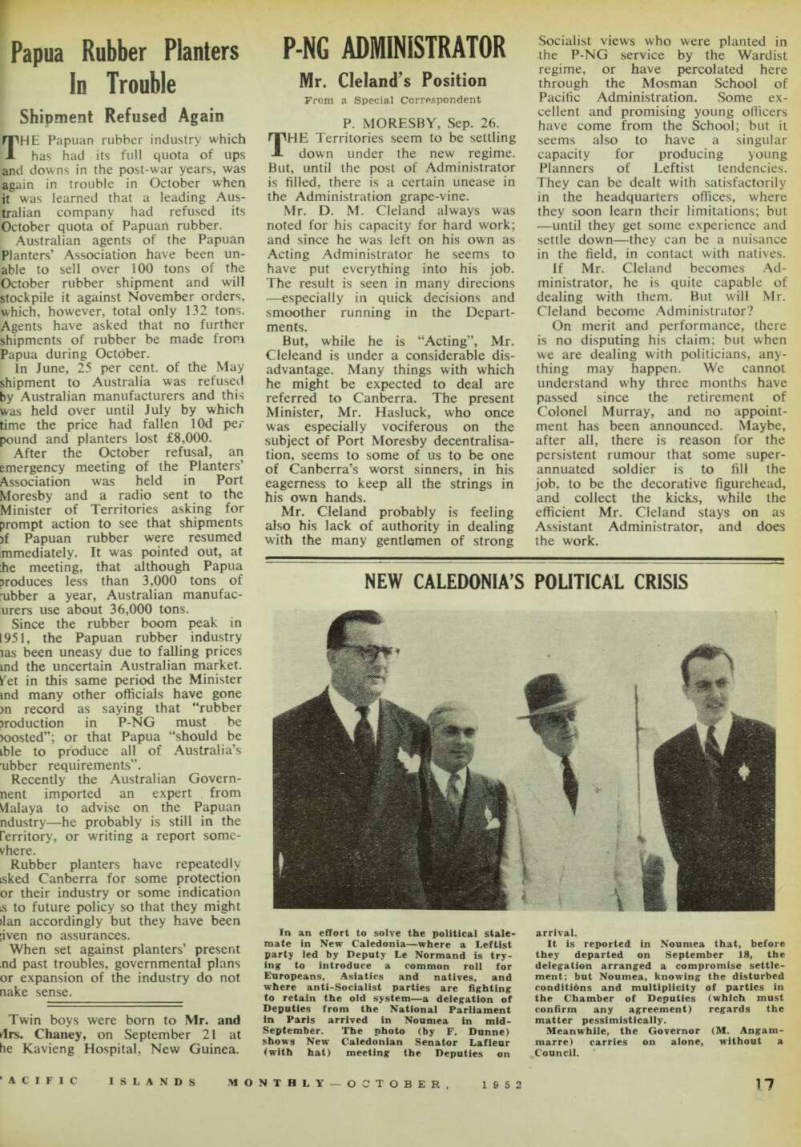
A Note About
Louise J. Kenny
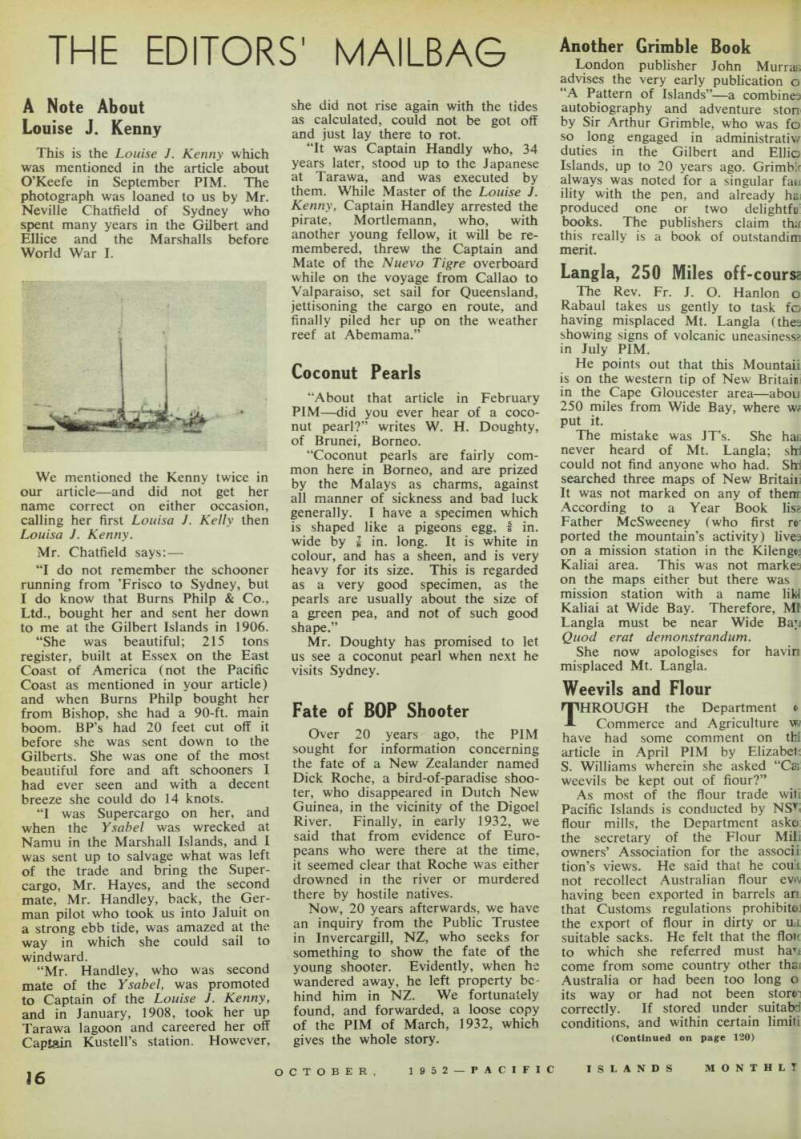
This is the Louise J. Kenny which was mentioned in the article about O’Keefe in September PIM. The photograph was loaned to us by Mr.
Neville Chatfield of Sydney who spent many years in the Gilbert and Ellice and the Marshalls before World War I.
We mentioned the Kenny twice in our article—and did not get her name correct on either occasion, calling her first Louisa J. Kelly then Louisa J. Kenny.
Mr. Chatfield says:— “I do not remember the schooner running from ’Frisco to Sydney, but I do know that Burns Philp & Co., Ltd., bought her and sent her down to me at the Gilbert Islands in 1906.
“She was beautiful; 215 tons register, built at Essex on the East Coast of America (not the Pacific Coast as mentioned in your article) and when Burns Philp bought her from Bishop, she had a 90-ft. main boom. BP’s had 20 feet cut off it before she was sent down to the Gilberts. She was one of the most beautiful fore and aft schooners I had ever seen and with a decent breeze she could do 14 knots.
“I was Supercargo on her, and when the Ysabel was wrecked at Namu in the Marshall Islands, and I was sent up to salvage what was left of the trade and bring the Super cargo, Mr. Hayes, and the second mate, Mr. Handley, back, the Ger man pilot who took us into Jaluit on a strong ebb tide, was amazed at the way in which she could sail to windward.
“Mr. Handley, who was second mate of the Ysabel, was promoted to Captain of the Louise J. Kenny, and in January, 1908, took her up Tarawa lagoon and careered her off Captain Kustell’s station. However,
she did not rise again with the tides as calculated, could not be got off and just lay there to rot.
“It was Captain Handly who, 34 years later, stood up to the Japanese at Tarawa, and was executed by them. While Master of the Louise J.
Kenny, Captain Handley arrested the pirate, Mortlemann, who, with another young fellow, it will be re membered, threw the Captain and Mate of the Nuevo Tigre overboard while on the voyage from Callao to Valparaiso, set sail for Queensland, jettisoning the cargo en route, and finally piled her up on the weather reef at Abemama.”
Coconut Pearls
“About that article in February PlM—did you ever hear of a coco nut pearl?” writes W. H. Doughty, of Brunei, Borneo.
“Coconut pearls are fairly com mon here in Borneo, and are prized by the Malays as charms, against all manner of sickness and bad luck generally. I have a specimen which is shaped like a pigeons egg, I in. wide by ? in. long. It is white in colour, and has a sheen, and is very heavy for its size. This is regarded as a very good specimen, as the pearls are usually about the size of a green pea, and not of such good shape.”
Mr. Doughty has promised to let us see a coconut pearl when next he visits Sydney.
Fate of BOP Shooter
Over 20 years ago, the PIM sought for information concerning the fate of a New Zealander named Dick Roche, a bird-of-paradise shoo ter, who disappeared in Dutch New Guinea, in the vicinity of the Digoel River. Finally, in early 1932, we said that from evidence of Euro peans who were there at the time, it seemed clear that Roche was either drowned in the river or murdered there by hostile natives.
Now, 20 years afterwards, we have an inquiry from the Public Trustee in Invercargill, NZ, who seeks for something to show the fate of the young shooter. Evidently, when he wandered away, he left property be hind him in NZ. We fortunately found, and forwarded, a loose copy of the PIM of March, 1932, which gives the whole story.
Another Grimble Book
London publisher John Murraß advises the very early publication o “A Pattern of Islands”—a combines autobiography and adventure storr by Sir Arthur Grimble, who was fo so long engaged in administrative duties in the Gilbert and Ellio Islands, up to 20 years ago. Grimble always was noted for a singular fau ility with the pen, and already hsj produced one or two delightfir books. The publishers claim th;x this really is a book of outstandim merit.
Langla, 250 Miles off-coursg
The Rev. Fr. J. O. Hanlon o Rabaul takes us gently to task fo having misplaced Mt. Langla (thes showing signs of volcanic uneasinesse in July PIM.
He points out that this Mountaii is on the western tip of New Britain! in the Cape Gloucester area—abou 250 miles from Wide Bay, where wf put it.
The mistake was JT’s. She hae never heard of Mt. Langla; shd could not find anyone who had. SW searched three maps of New Britain It was not marked on any of them According to a Year Book lisz Father McSweeney (who first re ported the mountain’s activity) lives on a mission station in the Kilengej Kaliai area. This was not markes on the maps either but there was mission station with a name likl Kaliai at Wide Bay. Therefore, MI Langla must be near Wide Bau Quod erat demonstrandum.
She now apologises for havin misplaced Mt. Langla.
Weevils and Flour
THROUGH the Department o Commerce and Agriculture w have had some comment on tbl article in April PIM by Elizabefi S. Williams wherein she asked “Ca weevils be kept out of flour?”
As most of the flour trade witi Pacific Islands is conducted by NS T < flour mills, the Department aske: the secretary of the Flour Mill owners’ Association for the associi tion’s views. He said that he cou'l not recollect Australian flour eviv having been exported in barrels atr that Customs regulations prohibit©) the export of flour in dirty or uji suitable sacks. He felt that the florc to which she referred must come from some country other that Australia or had been too long o its way or had not been storei correctly. If stored under suitabd conditions, and within certain limiti
(Continued on page 120)
weevils can be kept out of Aoul He said that during the war it wr found that a multiwall paper bat with moisture proof inner lining w;\ the best container, but these involve extra cost. NSW millers wc: jealous of their trade with the Pacit Islands and were very competitive f*' it. Flour is milled as close ; possible to the time of sailing » certain vessels and goes aboard fresh condition.
A woman reader commenting o the same weevily subject says thr she has never seen flour in Papux New Guinea in barrels, or sac: either. How Port Moresby « Rabaul housewives bought their flou she did not know but out on tl; plantations or in the bush they g' their flour in lever-lid tins. If nea stocks were received frequently an used quickly there was nothiii wrong with this flour; but if stow for long periods it too could develo weevils. In periods of long isolatio due to shipping breakdowns or othr accidents this could become quit unpleasant—it wasn’t weevils she oc jected to so much, it was when tl: grubs appeared, and if the cook-bo* had not sifted assiduously enouji their little remains could be trace through the loaves of home-bake bread!
This state of affairs was not tit norm however, and she says that sk got more weevily flour from a NS T < country storekeeper last sumrnti than ever she saw in New Guino She blames neither the storekeepq nor the millers for this, but thinks< is probably faulty storage by the dil tributor.
Tax-Gatherer’s Nightmare
From an investment viewpoint, til most beautiful thing we ever har seen is the annual statement of as counts of Placer Development Lin