Fiji Missed On Sheep Over
pp. 113-115 · Read in the full issue
40 Years Ago
By K. P. Wright, of Lomani, Quirindi, NSW.
N 1906 a number of wealthy men from New Zealand went to Fiji
eking investment—among them a
r. Studholme, who invested large ms in rubber at Qara-ni-Qio. [Among those who came (and went ray) was a Mr. Mason Chambers, io had a large sum for investment, id wanted a compact area of 40/ [,OOO acres of grazing land, and was epared to erect freezing and can ig works.
The Fiji Government at that time d a considerable area of such land ailable on Vanua Levu, which it d leased from the natives at, I be ve, 3d per acre per annum, for [years. Their terms for a sub-lease re too exacting, however, and Mr. lambers hired my services (I was ;n 23) to obtain land direct from 5 natives at Sigatoka, under an old itute which enabled a European idraw up a contract, with native tiers, giving him “the exclusive SE’ ” of the land. The contract i to be written in English and ian, and taken to the Stipendiary igistrate for his endorsement, ich made it binding on both par 5.
Fo cut a long story short. I ob ned the necessary areas of land 3ne area of 4,000 acres, at Rasi be, on the Sigatoka, and a further 000, known as “Conua,” lying be ;en the Sigatoka River to the west i VatuKarasa and Sovi, on the ist, to the east. These agreements re ratified by the local magistrate,
1 became binding.
Fwo weeks later I came in with an ■cement for another 25,000 acres Bemana, higher up the Sigatoka rer. rhe magistrate said he was sorry t he could not ratify the document, e Governor had heard of my ivities and had called a meeting the Executive Council, and nulli -1 the old law so that the magis te now had no power and the :uments had to go before the vernor in Council. I paid a call the Governor (Sir Everard-im- Jrn) but he was adamant. He i thart if Chambers wanted land, should take what the Government 1 offered him, either at Vanua 'U, or 44,000 acres lying between Sigatoka and Momi, to the west, dr. Chambers then withdrew, and k his money with him. He was ery fine man, and he financed me en a penniless youth) so that 1
could import sheep, and try out the industry. This my father and I did; and, on January 21, 1908, we landed 1,300 ewes at Rasikulu.
We did not, however, have sufficient capital to handle the big undertaking properly, and eventually we sold out to Messrs. Bryce & Howard, of Brisbane, in 1917.
There was a sequel to that. About 5 years ago a man who is in a big way in Queensland told me that he
had met there the late Governor of Fiji (Sir Brian Freeston) who had endeavoured to interest him in the establishment of a meat-freezing
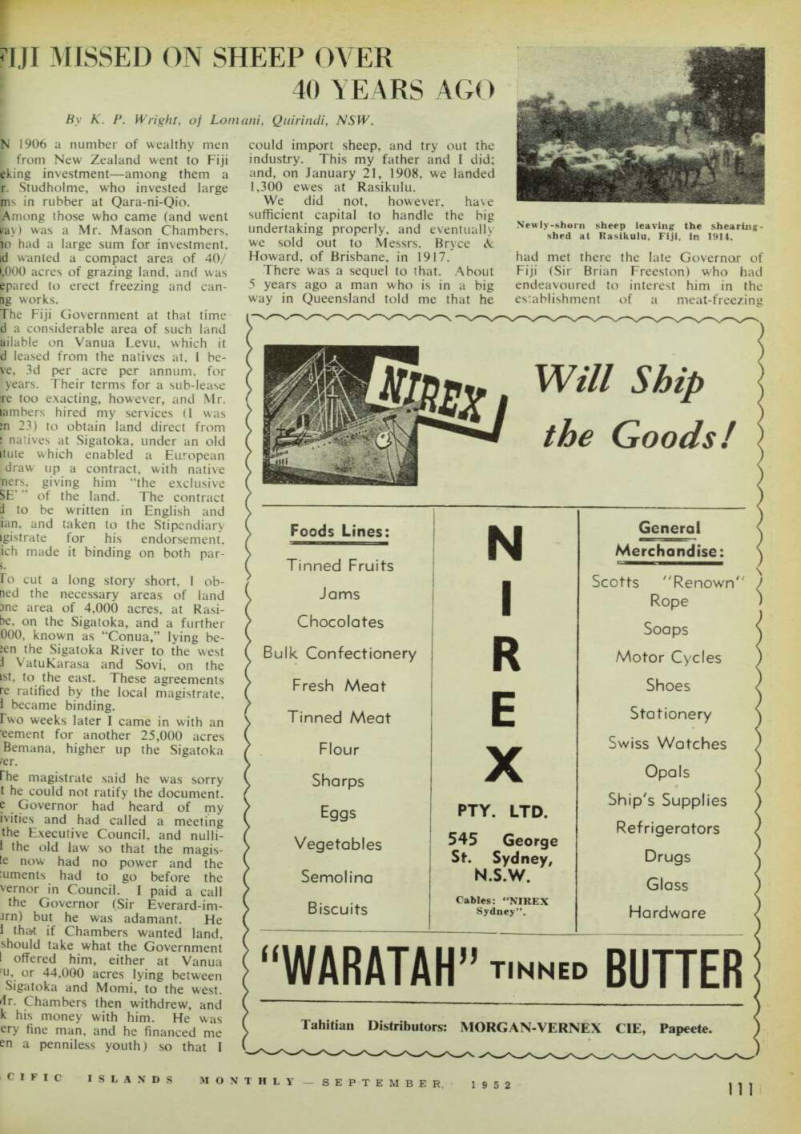
Newly-shorn sheep leaving the shearing shed at Rasikulu, Fiji, in 1914.
>rks in Fiji, and of the cattle and eep industry in a big way. My end had not known that I had ever en in Fiji; but I was able to give n much information and advice, iwever, I understand that he went further with the project.
The idea behind this plan, I be ve, was to establish the business the lines of the Tanganyika pea ts scheme—but to finance private terprise to do the actual work. The itish Government would provide ‘ cash, and the beef would go to itain. Thus, 40 years afterwards, attempt was being made to do tat Mr. Chambers and I were an
xious to do in 1906.
During World War I, when I was in England in 1915, I called upon Sir Everard-im-Thurn, who had re jected my agreements with the natives. Sir Eve.rard was extremely nice (he always was) and told me he “deeply regretted” having done as he did; but it was too late.
Mr. and Mrs. John Hohnen, and their four small children have re turned to Wau, New Guinea, after three months leave spent at ’ Bur leigh, Queensland. Mr. Hohnen is general-manager of New Guinea Goldfields at Wau.
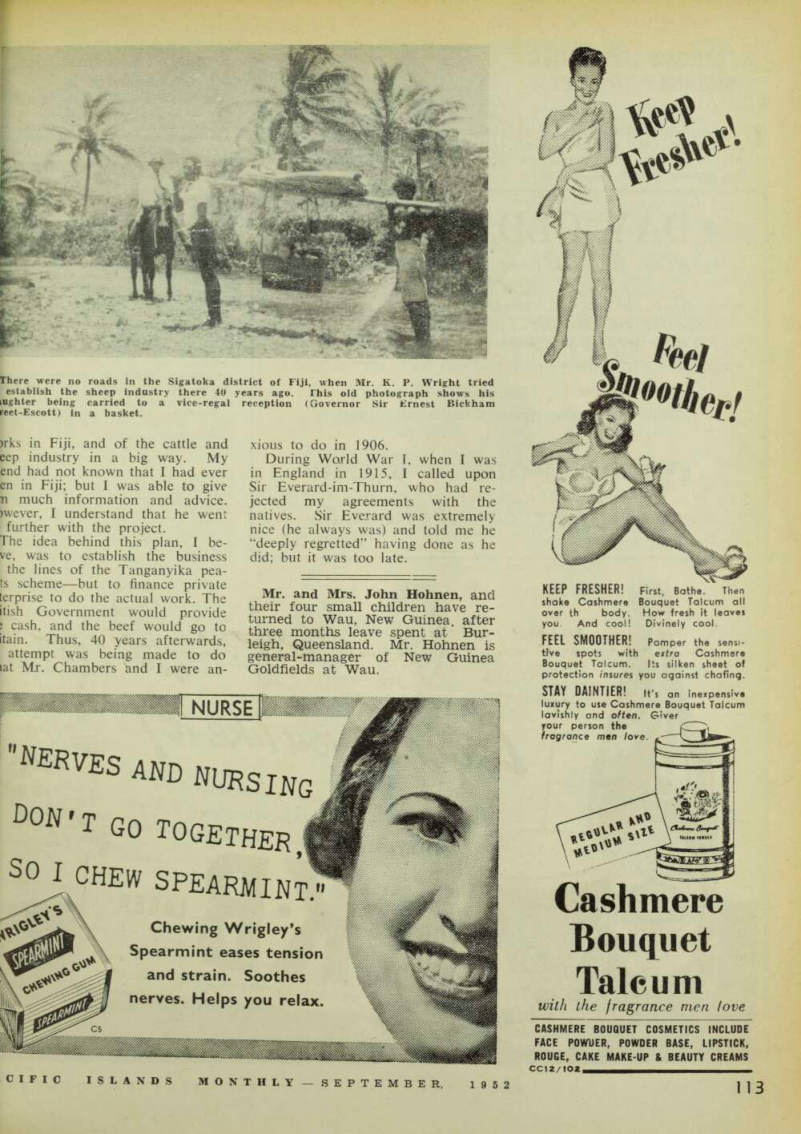
There were no roads in the Sigatoka district of Fiji, when Mr. K. P. Wright tried establish the sheep industry there 40 years ago. This old photograph shows his [?]ughter being carried to a vice-regal reception (Governor Sir Ernest Bickham veet-Escott) in a basket.