O'Keefe's Kingdom
pp. 70-72 · Read in the full issue
More About Mapia, Outpost of O'Keefe's Kingdom
IT is evident, from a perusal of Lawrence Klingman’s and Gerald Green’s biographical novel on the life of the Irish-American, David Dean O’Keefe, that John Riedel’s inquiry to us regarding Mapia atoll (PIM, April, p. 63) was almost certainly prompted by the appearance of this book in New ‘ York in 1950. It has just now appeared in an Australian edition—and, of course, a film about O’Keefe is being made in Fiji, From further interesting information supplied to us by Mr. H. C. Davenport of Auckland (PIM, July, p. 69 > it is very evident that the book is quite inaccurate —perhaps intentionally so—in certain im portant respects. It also makes no mention whatever of O’Keefe’s third family branch on Mapia atoll, and, indeed, only the barest mention of Mapia, though this was evidently a major out post of the O’Keefe kingdom. If ever a book should have dealt with the history of Mapia this was the book, but instead, perhaps to simplify the complex life-plot, parts of the Mapia story have been grafted onto the story of Yap. But for Mr. Davenport seeing mention of Mapia in PIM, we would, at least for the present, have remained in the dark as to the true story in so far as that island is concerned.
The present article gives the Mapia angle, as well as other interesting par ticulars.
IT is necessary to briefly re count the story as given in His Majesty O’Keefe. This tells of O’Keefe being wrecked on Yap, sole survivor of the Belvidere, in 1872, and being taken from there to Hong kong some time later by the Godef froy & Co’s schooner Oceania.
In Hongkong O’Keefe entered partnership with a Chinese dental surgeon, Sien Tang (who remained a sleeping partner). Equipped with a 70-ton junk, which he renamed Katherine after his wife back in the States, O’Keefe sailed on a pearling cruise to the Philippines, East Indies, New Guinea, Admiralties and Solo mons. From there he headed for Nauru.
At Nauru (this is all according to the Klingman and Green story) he found an escaped Australian convict named Harris as “King” of the is land and married to a Nauruan woman. Harris’s eldest daughter, Dalabo, sailed with O’Keefe and they were married in Hongkong.
From the profits of this voyage,
O’Keefe bought out Tang and headed for Yap. There, on the tiny islet of Tarrang he set up headquarters, gained a monopoly of the stone money wealth of the neighbouring islands, and made considerable real money in beche-de-mer, copra, and shell sold to the outside world.
By his first wife in America he had a daughter Louisa, who eventually became Mrs. Butler. Of this side of the family we hear no more until O’Keefe’s will is read. O’Keefe never set eyes on this wife or daughter again. The story tells of the wife Dalabo, and the two sons and three daughters borne by her to O’Keefe.
So much for the modern American version.
TI/IR. DAVENPORT shows that, in actual fact, Dalabo was a Yap woman—almost certainly of pure native blood. Whether or not there ever was a “king” of Nauru named Harris does not matter. In real life, O’Keefe did marry also a half- Nauruan girl, the daughter of Cap-
tain Henry Terry—an English Mas ter Mariner well-known and res pected in the Western Pacific at this time—and not the daughter of a man named Harris.
Lottie Terry went to Mapia with O’Keefe at a time when Nauruan labourers were employed there. She had a son, Harry, and two daughters, Nellie and Janie, by O’Keefe.
Nellie, the second daughter, even tually married a Dutch Resident Agent on Mapia with the English name of Lawrence—though perhaps not spelt that way.
Janie, the eldest daughter, married an English merchant-navy engineer named William S. Brown, at Hong kong, where she was sent to be edu cated. Brown took over the manage ment of Mapia from Mr. H. C.
Davenport’s father, Henry Daven port, in 1907, but died in Hongkong about 1920-21. There were no chil dren of this marriage, but Mrs. J. S.
Brown is undoubtedly the person to whom Mr. John Riedel referred as managing Mapia prior to World War
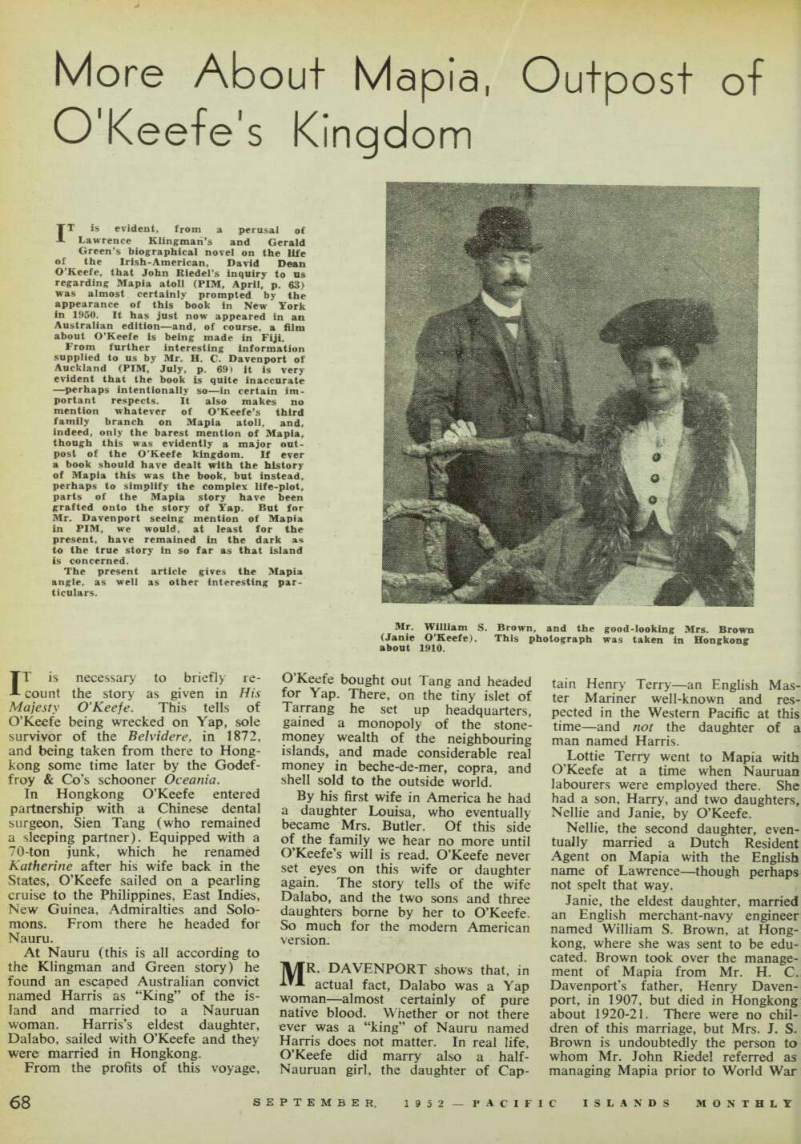
Mr. William S. Brown, and the good-looking Mrs. Brown (Janie O’Keefe). This photograph was taken in Hongkong about 1910.
'II We believe that Mrs. Brown is Ijagam in residence there, now. f The Davenport family’s associa tion with O’Keefe would fill a book and provide a story no less interest ing than that of O’Keefe himself.
Here, unfortunately, we may give Eonly the outlines.
H. C. DAVENPORT'S father, Henry Davenport, was born in London in 1862 and his parents took him to Christchurch, NZ when he three. Given a business educa tion he was engaged with his father in a tea business there, until going to Fiji to work for Henry Cave in the :1890’s. On that firm’s store being burnt out, Henry Davenport went into trading business on his own ac count. He married and Mr. H. C.
Davenport was born at Wainibokasi in 1898. There were two other sons —one still in Fiji and the other in Auckland.
About 1900. business not being good in Fiji, the Davenport family shifted to the Carolines, where Henry Davenport went into partner ship with a retired British Army captain named Bishop. The partners owned the large schooners Louisa J.
Kelly , and Hetty Smith, and the ketch Frolic. The schooners, built on the Pacific Coast, traded to ’Frisco, Hongkong, Sydney and elsewhere and Henry Davenport, who had mas tered navigation, was skipper of one or other of these vessels. However, little more than a year later Bishop became seriously ill and died in Syd-
ney. The Ponape business was dis banded —Burns Philp. incidentally, purchasing the Louisa J. Kenny.
At this time Captain Henry Davenport was evidently well known to O’Keefe and his Yap family, for in May, 1901, at about the time of Bishop’s death, when O’Keefe and his two Yap sons David (or James) and John were lost at sea, the Yap family immediately called upon Henry Davenport to assist them in establishing claim to the properties in the Marianas, Palaus, Hongkong, Manila and at Mapia.
It will be recalled that during the 30 years of the O'Keefe reign great political changes had taken place in the Western Pacific.
Yap had changed from a kind of Spanish no-man’s-land to German territory. Claims had thus to be settled in courts of German, British , , , • j and Dutch jurisdiction.
According to the book, O’Keefe had remitted money to his first wife from time to time, and it is evident that the Yap family were aware of her existence —as they also were of the Mapia family—because, on the death of O’Keefe (aged 73) one of Dalabo’s sons-in-law, a Britisher named Scott, who was managing the Yap interests, notified the first Mrs.
O’Keefe of his death. She des patched an attorney from America.
O’Keefe’s will was opened two years after his presumed death and— again according to the book—was revealed to leave half the O’Keefe property and interests to Dalabo and the other half to Mrs. Butler, daughter of the first Mrs. O’Keefe.
However, if this was the case it is evident, according to Mr. H. C.
Davenport, that the final settlement was on more complex lines than this.
Mrs. Butler eventually sold her inter est to the Hamburg Trading Co. for
the price of $lO,OOO per year for 50 years. Due to World War I the ag reement was never honoured in full The book gives the subsequent his tory of the Yap family and interests, We are concerned with Mapia.
Henry Davenport represented Dal abo and Lottie (O’Keefe’s wives on Yap and Mapia, respectively), in court proceedings at Hongkong and later at Batavia. The negotiations were protracted, with Scott appar ently endeavouring to gain control of the Yap business. By about 1904, Henry Davenport had completed the settlement of the Mapia interests in the court at Batavia, the assets and earnings being divided into six shares. one each for the rajah, Lottie O’Keefe, her daughters, Mrs. Brown, and Mrs. Lawrence, and their brother Harry, and the final share for Eu genia, eldest daughter of Dalabo on Yap—the wife of William Scott,
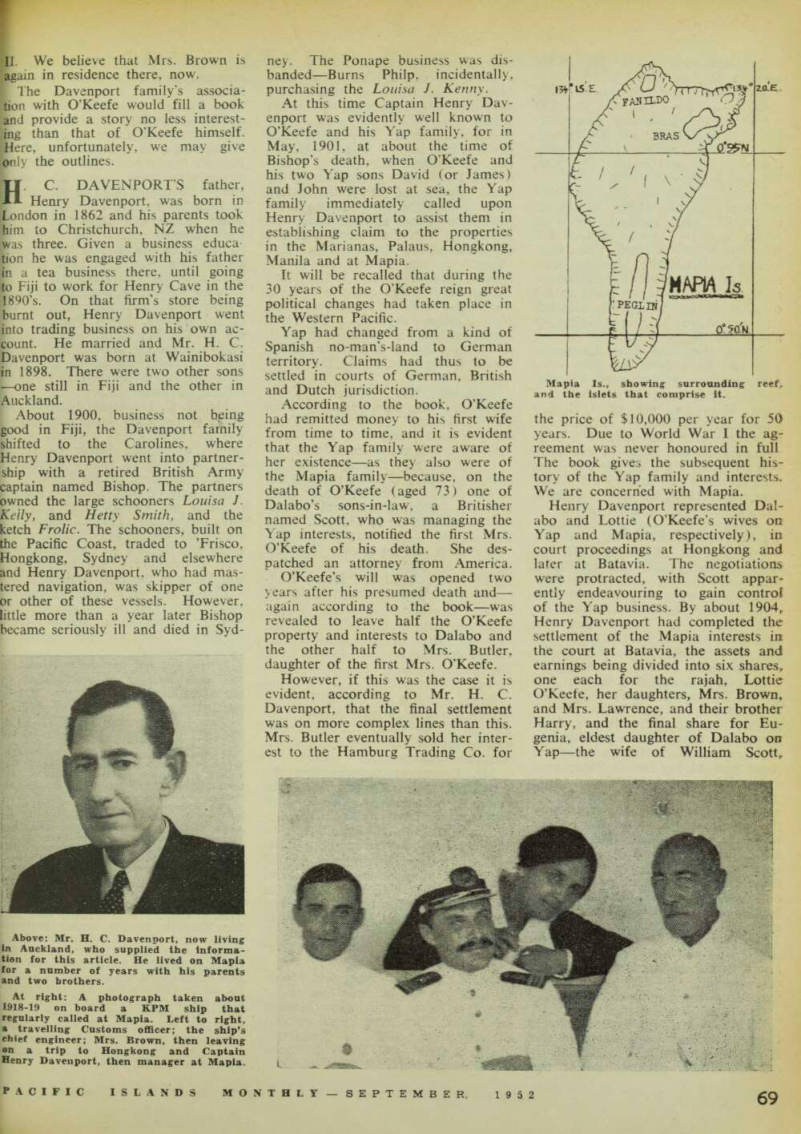
Above: Mr. H. C. Davenport, now living in Auckland, who supplied the informa tion for this article. He lived on Mapia for a number of years with his parents and two brothers.
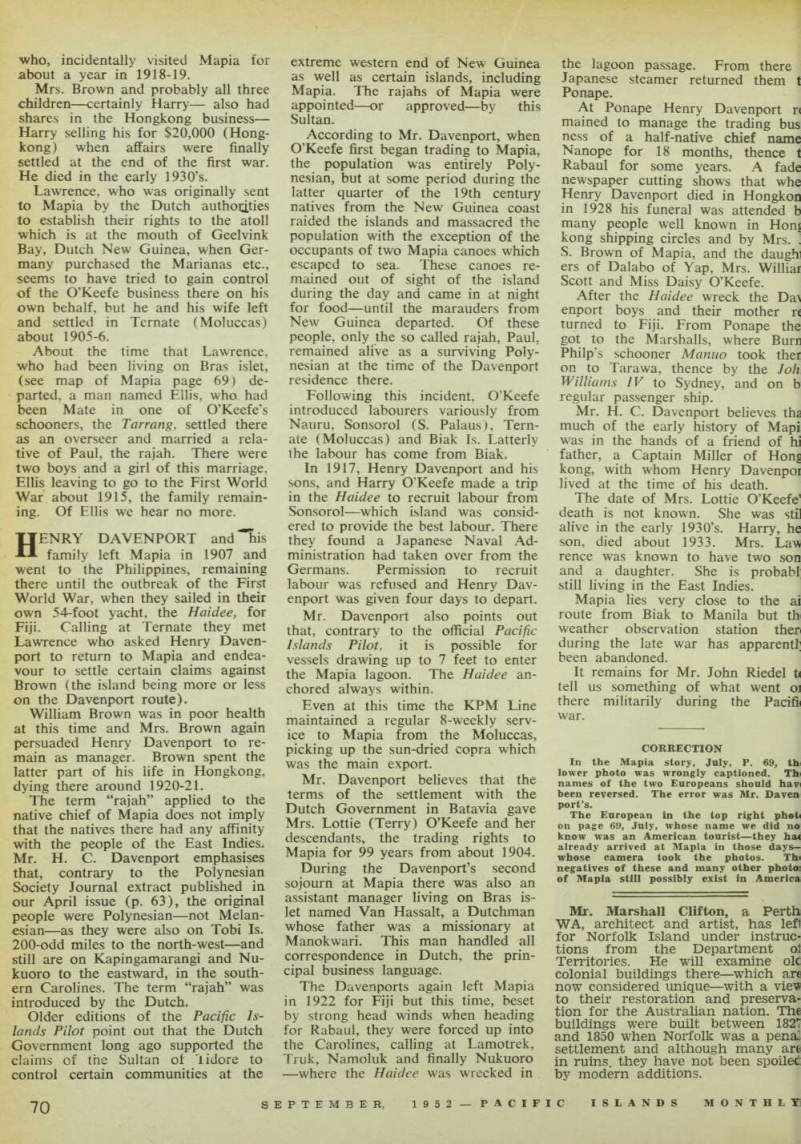
At right: A photograph taken about 1918-19 on board a KPM ship that regularly called at Mapia. Left to right, a travelling Customs officer; the ship’s chief engineer; Mrs. Brown, then leaving on a trip to Hongkong and Captain Henry Davenport, then manager at Mapia.
Mapia Is., showing surrounding reef, and the islets that comprise it.
who, incidentally visited Mapia for about a year in 1918-19.
Mrs. Brown and probably all three children—certainly Harry— also had shares in the Hongkong business— Harry selling his for $20,000 (Hong kong) when affairs were finally settled at the end of the first war.
He died in the early 1930’5.
Lawrence, who was originally sent to Mapia by the Dutch authorities to establish their rights to the atoll which is at the mouth of Geelvink Bay, Dutch New Guinea, when Ger many purchased the Marianas etc., seems to have tried to gain control of the O’Keefe business there on his own behalf, but he and his wife left and settled in Ternate (Moluccas) about 1905-6.
About the time that Lawrence, who had been living on Bras islet, (see map of Mapia page 69) de parted, a man named Ellis, who had been Mate in one of O’Keefe’s schooners, the Tar rang, settled there as an overseer and married a rela tive of Paul, the rajah. There were two boys and a girl of this marriage.
Ellis leaving to go to the First World War about 1915, the family remain ing. Of Ellis we hear no more.
Henry Davenport
family left Mapia in 1907 and went to the Philippines, remaining there until the outbreak of the First World War, when they sailed in their own 54-foot yacht, the Haidee, for Fiji. Calling at Ternate they met Lawrence who asked Henry Daven port to return to Mapia and endea vour to settle certain claims against Brown (the island being more or less on the Davenport route).
William Brown was in poor health at this time and Mrs. Brown again persuaded Henry Davenport to re main as manager. Brown spent the latter part of his life in Hongkong, dying there around 1920-21.
The term “rajah” applied to the native chief of Mapia does not imply that the natives there had any affinity with the people of the East Indies.
Mr. H. C. Davenport emphasises that, contrary to the Polynesian Society Journal extract published in our April issue (p. 63), the original people were Polynesian—not Melan esian—as they were also on Tobi Is. 200-odd miles to the north-west—and still are on Kapingamarangi and Nu kuoro to the eastward, in the south ern Carolines. The term “rajah” was introduced by the Dutch.
Older editions of the Pacific Is lands Pilot point out that the Dutch Government long ago supported the claims of the Sultan of lidore to control certain communities at the
extreme western end of New Guinea as well as certain islands, including Mapia. The rajahs of Mapia were appointed—or approved—by this Sultan.
According to Mr. Davenport, when O’Keefe first began trading to Mapia, the population was entirely Poly nesian, but at some period during the latter quarter of the 19th century natives from the New Guinea coast raided the islands and massacred the population with the exception of the occupants of two Mapia canoes which escaped to sea. These canoes re mained out of sight of the island during the day and came in at night for food—until the marauders from New Guinea departed. Of these people, only the so called rajah, Paul, remained alive as a surviving Poly nesian at the time of the Davenport residence there.
Following this incident, O’Keefe introduced labourers variously from Nauru, Sonsorol (S. Palaus), Tern ate (Moluccas) and Biak Is. Latterly the labour has come from Biak.
In 1917, Henry Davenport and his sons, and Harry O’Keefe made a trip in the Haidee to recruit labour from Sonsorol —which island was consid ered to provide the best labour. There they found a Japanese Naval Ad ministration had taken over from the Germans. Permission to recruit labour was refused and Henry Dav enport was given four days to depart.
Mr. Davenport also points out that, contrary to the official Pacific Islands Pilot, it is possible for vessels drawing up to 7 feet to enter the Mapia lagoon. The Haidee an chored always within.
Even at this time the KPM Line maintained a regular 8-weekly serv ice to Mapia from the Moluccas, picking up the sun-dried copra which was the main export.
Mr. Davenport believes that the terms of the settlement with the Dutch Government in Batavia gave Mrs. Lottie (Terry) O’Keefe and her descendants, the trading rights to Mapia for 99 years from about 1904.
During the Davenport’s second sojourn at Mapia there was also an assistant manager living on Bras is let named Van Hassalt, a Dutchman whose father was a missionary at Manokwari. This man handled all correspondence in Dutch, the prin cipal business language.
The Davenports again left Mapia in 1922 for Fiji but this time, beset by strong head winds when heading for Rabaul, they were forced up into the Carolines, calling at Lamotrek, Truk, Namoluk and finally Nukuoro —where the Haidee was wrecked in
the lagoon passage. From there Japanese steamer returned them t
Ponape.
At Ponape Henry Davenport r<
mained to manage the trading bus ness of a half-native chief name Nanope for 18 months, thence t Rabaul for some years. A fade newspaper cutting shows that whe
Henry Davenport died in Hongkon
in 1928 his funeral was attended b many people well known in Honf kong shipping circles and by Mrs. : S. Brown of Mapia, and the daughi ers of Dalabo of Yap, Mrs. Williar Scott and Miss Daisy O’Keefe.
After the Haidee wreck the enport boys and their mother n turned to Fiji. From Ponape the got to the Marshalls, where Burn Philp’s schooner Manuo took ther on to Tarawa, thence by the Joh Williams IV to Sydney, and on b regular passenger ship.
Mr. H. C. Davenport believes tha much of the early history of Mapi was in the hands of a friend of hi father, a Captain Miller of Hong
kong, with whom Henry Davenpoi
lived at the time of his death.
The date of Mrs. Lottie O’Keefe’ death is not known. She was stil alive in the early 1930’5. Harry, he son, died about 1933. Mrs. Law rence was known to have two son and a daughter. She is probabl still living in the East Indies.
Mapia lies very close to the ai route from Biak to Manila but th weather observation station then during the late war has apparent! been abandoned.
It remains for Mr. John Riedel U tell us something of what went oi there militarily during the Pacific war.
Correction
In the Mapia story, July, P. 69, thi lower photo was wrongly captioned. Thi names of the two Europeans should havi been reversed. The error was Mr. Daren port’s.
The European in the top right phob on page 69, July, whose name we did no know was an American tourist—they ha< already arrived at Mapia in those days— whose camera took the photos. Thi negatives of these and many other photo; of Mapia still possibly exist in America Mr. Marshall Clifton, a Perth WA, architect and artist, has left for Norfolk Island under instruc tions from the Department ol Territories. He will examine ole colonial buildings there—which are now considered unique—with a view to their restoration and preserva tion for the Australian nation. The buildings were built between 1827 and 1850 when Norfolk was a penal, settlement and although many are in ruins, they have not been spoiled by modern additions.