Tropicalities
pp. 67-73 · Read in the full issue
Magazine Section
How To Stop Express
Trains
THE pitfalls that await Fijian visitors to foreign parts is illus trated by the following:— When the Fijian Rugby team was travelling from Sydney to Brisbane in July, the captain, Apakuki Tuitavua, had reason to visit the washroom. There appeared to be no buttons to push, or levers to pull, so he pulled a small chain. The Brisbane express promptly made an unscheduled stop nowhere in par ticular.
In the ensuing confusion it was apparently decided to overlook the £lO fine with which travellers are threatened if they pull the communi cation cord without good reason.
The “communication cord” in Australian trains is about four inches of chain—and most washroom chains are there to be pulled, anyhow.
Fijian Money Spinners
SOMETHING between £9,000 and £lO,OOO profit was made during the short tour of the Fijian Rugby Union footballers who recently visited Australia—£2,ooo of this went home with the Fijians and the rest goes to the previously almost bankrupt Rugby Union in Australia.
As far as Australian Union goes, the Fijians were the best money spinners for a couple of generations and officials who, a few months ago, were taking a very dim view of the proposed tour are to-day wondering how soon Australia can have the Fijians back again.
No one has been able to pin down with exactitude, the secret of the visitors' success. Their tackling was poor and their op ponents often looked better com binations—but results speak for themselves. Possibly it was their amazing speed once tfiey got posses sion of the ball and headed in the right direction.
Jo Levula was the idol of the crowds who screamed with excite ment everytime he came within yards of the ball, but if any prizes are be
ing given out we would like to nominate full-back Taniela Ranavue who consistently played excellent foot ball and who, probably more than any other player, tipped the balance towards victory.
A Little Lesson In
Insurance Lapses
FOR 25 years, the Port Moresby Institute regularly paid the prem ium on the insurance against fire on its Twilight Cafe premises. The in surance (£1,500) expired in July.
The Institute did not immediately renew. It wanted to increase the in surance to £5,000, but funds were a little low, and a delay occurred. The building was gutted by fire on the night of August 17. The members since have been looking hopefully towards the Queensland Insurance Company, wondering if their lapse after 25 years can be overlooked.
But, even if it is, the insurance would be regarded as £1,500 —not £5,000.
Legally, there is no doubt of the position—the insurance had expired and the Co. was not liable.
Moral: Never neglect that insur ance premium.
Stop Press : Q'land In see Co., as act of grace, will pay £1,500.
Threat To Bsi Liquor
Supplies
THIRSTY Honiara residents, com pletely out of beer, might have received a severe setback lately when a public-spirited resident very prop erly reported to the authorities that he had a large order arriving by the Malaita, packed, as is usual with beer, in straw.
In view of the recent concern over the outbreak of foot-and-mouth disease in Canada, he thought it only fair to report the arrival of the straw packing.
Telegrams were hastily sent hither and thither, with the result that straw as packing has been declared a pro hibited import into the British Solomons, and Customs Officers or other authorised persons may now require goods packed in straw to be
unpacked on the ship and the straw not landed.
The story of the beer consignment, however, had a happy ending, as the beer was admitted, the consignee undertaking to burn all straw as each case was unpacked.
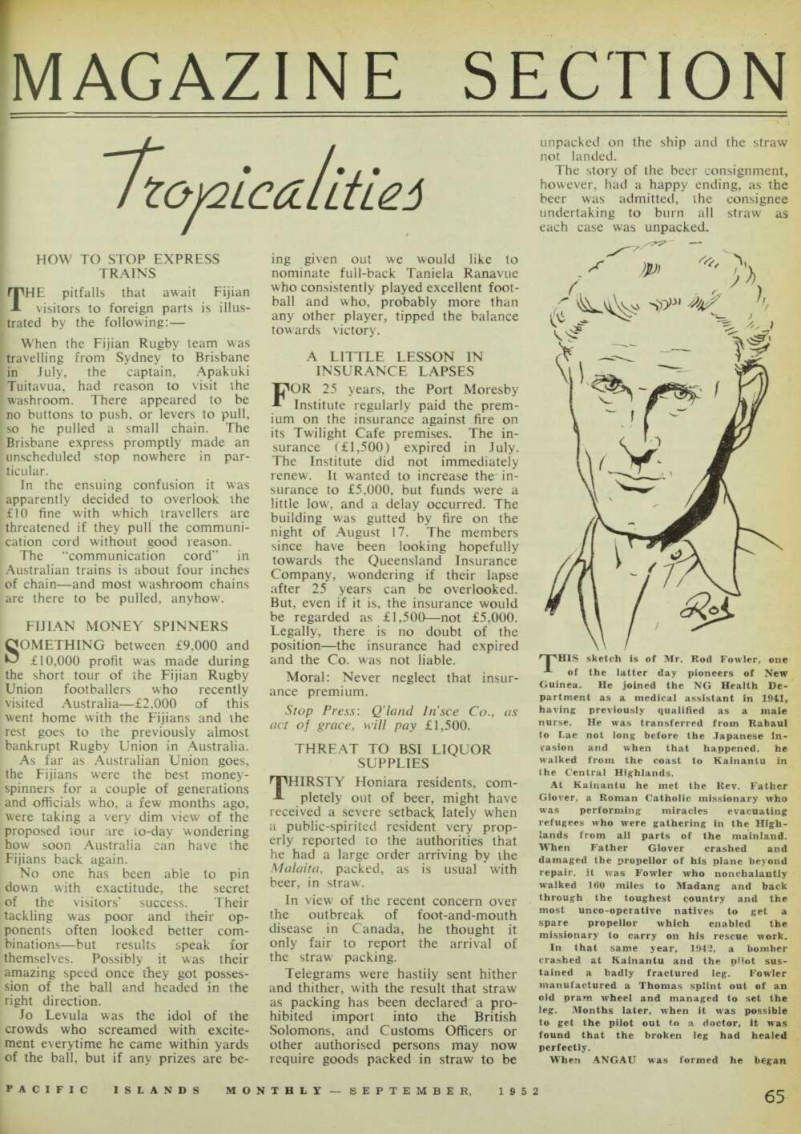
'T'HIS sketch is of Mr. Rod Fowler, one of the latter day pioneers of New Guinea. He joined the NG Health De partment as a medical assistant in 1941, having previously qualified as a male nurse. He was transferred from Rabaul to Lae not long before the Japanese In vasion and when that happened, he walked from the coast to Kainantu in the Central Highlands.
At Kainantu he met the Rev. Father Glover, a Roman Catholic missionary who was performing miracles evacuating refugees who were gathering in the High lands from all parts of the mainland.
When Father Glover crashed and damaged the propeller of his plane beyond repair, it was Fowler who nonchalantly walked 160 miles to Madang and hack through the toughest country and the most unco-opetative natives to get a spare propeller which enabled the missionary to carry on his rescue work.
In that same year, 1942, a bomber crashed at Kainantu and the pilot sus tained a badly fractured leg. Fowler manufactured a Thomas splint out of an old pram wheel and managed to set the leg. Months later, when it was possible to get the pilot out to a doctor, it was found that the broken leg had healed perfectly.
When ANGAU was formed he began
to train natives for orderly duties in native hospitals and In 1946 he began the job that still occupies him to-day he Commenced training native medical assistants at Lae. Over 200 natives have graduated under his guidance in the past six years. During this time he has com piled a reference book in Pidgin which he has illustrated himself.—DLC.
Mysterious Trunk
ORIOR to sailing from Auckland f° r Suva as navigator in the scow Scot, at the end of July, Cap tain Jack McK. Arnot told of an amusing prelude to his yacht voyage from England to New Zealand.
Captain Arnot, on Boxing Day, 1950, was lying off the Yacht Club at Chichester, when a heavy step sounded on deck, and a large man in a bowler hat appeared in the com panion-way of the Kimbala.
It was at the height of the missing Coronation Stone incident; and, when the visitor politely announced that he was from Scotland Yard, Captain Arnot jokingly remarked: “Oh, it’s alright, I haven’t got it!” Whereupon
the large man said suspiciously: “Then you know what I’ve come for?”
“We’ve had a report that you were seen shifting a large metal trunk aboard last evening” the Yard man continued, looking significantly at the offending trunk in a corner of the cabin.
The trunk contained nothing more interesting than yachting gear. But, as Captain Arnot remarked, the Yard was certainly leaving no pos sible escape avenues open at the time. Kimbala sailed according to plan.
Why Suva Cyclists
Look Hunted
Suva cyclists, except the very young and light of heart, are usually distinguished by their hunted ex pressions and the furtive way they hug the roadside, as if they had no right to be there. This is caused partly by Suva motorists (who re gard cyclists as something to be eliminated) and partly by Suva
pedestrians (who often have no footpaths and consequently dodge sc many cars that they have no time to notice stray bicycles).
Thus it happens that a certain European-owned bicycle, kept osten sibly for the illusion of pleasant, healthful exercise, is usually ridden by anybody except the owner.
Various Fijian members of the police force have the disturbing habit of referring to the machine as “our baisikeli”. Accordingly, it is formally borrowed for half an hour and may, or may not, return several days later —always with a , watertight reason for the delay. For three years it has been officially registered in the name of whatever policeman happened to have it when registration became im perative. The owner, however, had to find the 2/6.
Between police journeys, the bicycle becomes the quarry of various Government messengers whose de partments, always on the brink of destitution, have failed to provide such transport. All this goes on until something gets punctured or broken.
Said a police sergeant to the owner: “You could call it a paying concern—the owner pays the repair bills.”—J. K.
A Highlands Wedding
WHEN former Rabaul school teacher and Queensland beauty winner Jean Barnes wedded Patrol Officer Bruce Burge at Goroka, Cen tral New Guinea, in August, her mother flew from Brisbane for the ceremony.
Once upon a time, a matron might be expected to spend weeks in trav elling from an Australian metropolis to a station in the mountainous centre of New Guinea, and back again. Mrs. Barnes left home on Wednesday night, and was back in the family homestead on Sunday.
Miss Barnes went from Rabaul to open the new European school at Goroka—mark of continuing white penetration of the lovely New Guinea Highlands—but she reigned only six months. Education Director Groves has given a grim instruction that, in future, beauty contest winners shall not be selected for outpost stations. However, if the school has lost an efficient head, a lonely High lands outpost has gained a charming hostess.
Bully Is Murdered Again
Sydney Morning Herald of August 23 gives much space to a writer who thinks that the film now being made in Fiji by Warner Brothers, His
(Continued on Page 71)
Majesty O’Keefe, is the story of the famous old Pacific buccaneer, Bully Hayes. Then he proceeds to tell the story of Hayes, and produces I most remarkable farrago of no sense. Scores of so-called writers liave told what they allege to be the story of Bully Hayes; each has cop ied his facts from the other; each jxaggerates a little; until their his tory of the old pirate no more re sembles the real truth than it re sembles the story of O’Keefe. It is i pity; because the true story of iayes is one of the most dramatic ind colourful in the annals of the uneteenth century. He was murdered >y a sea-cook in 1877; and ever ince then, every year or two, he las been murdered in a literary sense sy more or less undeserving writers.
Fatoa In The News Again
pRAVELLERS reported in August P- that a court action is pend- Qg between the alleged owner of ertain salvage rights on Vatoa Is and, in the Southern Lau Group, pji, and the Royal New Zealand ur Force which it is reported, re ently used the island as a practice ombing range. The sum of £15,000 ras mentioned as damages claimed •om the RNZAF.
It will be recalled that three unerican vessels were wrecked on r atoa during the late War.
Vatoa first came into the news lore than 170 years ago. It was le only island of Fiji sighted and harted by Captain Cook, on his rst voyage.
Rom Copra To Carnations
J’OT many people have switched ’ from growing copra to growing amations for a living. But Mr. and Irs. George Purdy, once of Aoba, lew Hebrides, are doing just that at amborine Mountain, 36 miles from risbane.
The carnations are no ordinary looms; they are from imported iiropean stock and many of them e five inches across the flower and ith stems 2 ft 6 in. long. They are 1 highly perfumed.
The project has not been all plain iling, however. The two acres now )wering have been in full pro iction only seven months. There ere difficulties with windbreaks and rigation and too much rain in 1951 lied off a lot of the plants.
But the Purdy blooms are in !mand by high class florists roughout Australia and recently ustralia’s most popular periodical.
Women's Weekly, devoted a full page in colour to the Purdys and their exotic blooms.
Kava In Malaya
JUDGING by some recent press photographs of General Sir Ger ald Templer, he must feel that there are stranger things than terrorists in Malaya.
The occasion was the presentation to him by the Fijian Infantry Regi ment of a Tabua, or whale’s tooth, followed by the traditional yaqona ceremony. The General looks into the flowing bowl with what seems to be some trepidation—as well he might. One acquires, by degrees, a taste for yaqona, or kava.
The Fijians who took part in the ceremony, discarded jungle green for the occasion, and wore tradi tional Fijian costume.
Scots With A Jap Accent
THE first Japanese shipping service with Australia since the war began in July with the Osaka Maru, a 6,600 tonner of the Osaka Shosen Kaisha Line.
The officers and crew were most amiable although they ran against the full quota of Aussie prejudices and hates—it will be a long time be fore Australians can accept Japanese as blood-brothers.
Agents for the OSK are Mc- Ilwraith McEacharn, Ltd.—it is said that the polite Japs broke out in a sweat every time they had to pro nounce the name.
Of Moons And Lagoons—
And Hotel Accommodation
A LUSH romantic setting, with tropical palm trees, moonlight over blue lagoons, etc., and six pretty girls being rushed off their feet by 81 men. (What fun!) Recognise it? It is the Sydney Morning Herald’s description of Deuba Hotel, Fiji, where Warner Bros, are filming His Majesty O’Keefe. It is reported that the men in the company are queuing up to make dates with the girls. What has happened to the local talent, one wonders. There are more than six pretty girls in Fiji and Deuba cannot be said to be exactly off the beaten track.
The whole of the Deuba Hotel is being occupied by the film company.
This hotel was opened last year by the Philp brothers as something different in tourist resorts for Fiji and it was expected to be in full
operation this year. Although the film company is bringing extra money to Fiji, the withdrawal of Deuba from the ordinary tourist trade must be a blow to those whose job it is to find accommodation for Fiji’s overseas visitors during this the tourist season.
Accommodation is always a prob lem in Fiji but this year two Suva hotels were demolished in the Janu ary hurricane and Deuba is mono polised by the film makers.