New Timber Industry Around Rabaul
p. 29 · Read in the full issue
From Our Own Correspondent
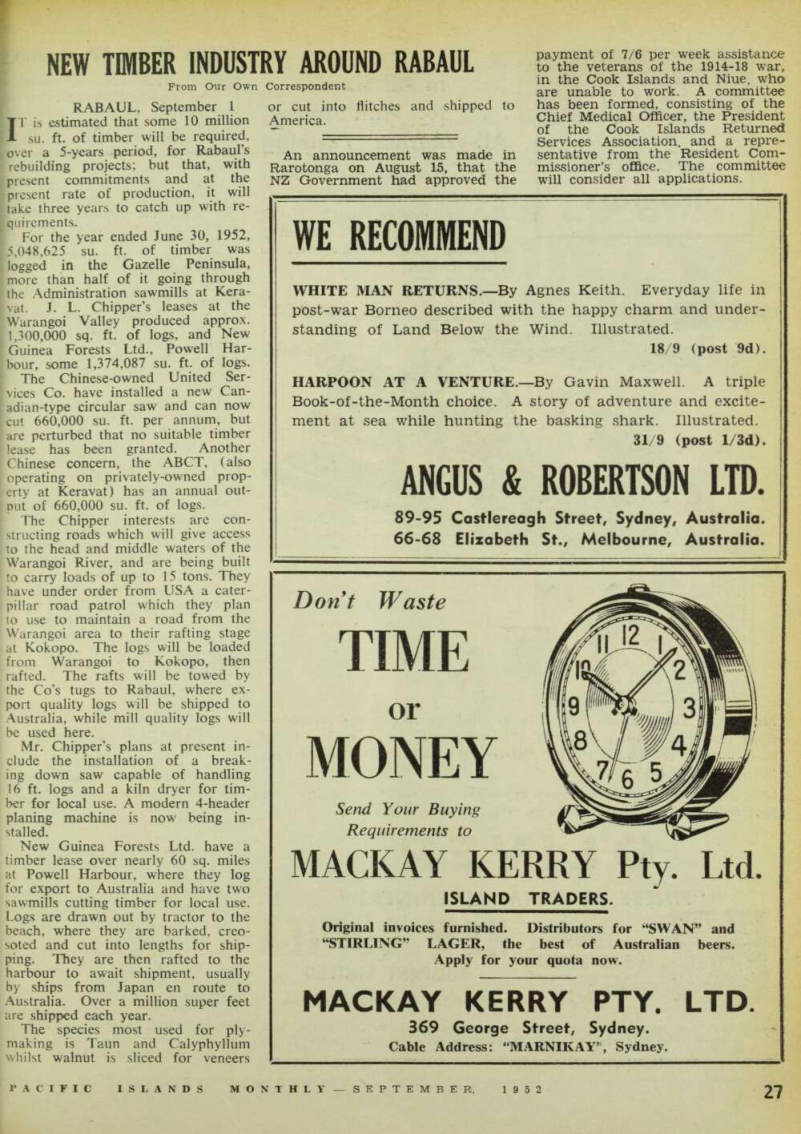
RABAUL, September 1 IT is estimated that some 10 million su. ft. of timber will be required, over a 5-years period, for Rabaul’s rebuilding projects; but that, with present commitments and at the present rate of production, it will take three years to catch up with re quirements.
For the year ended June 30, 1952, 5,048,625 su. ft. of timber was logged in the Gazelle Peninsula, more than half of it going through the Administration sawmills at Kera vat. J. L. Chipper’s leases at the Warangoi Valley produced approx. 1,300,000 sq. ft. of logs, and New Guinea Forests Ltd., Powell Har bour, some 1,374,087 su. ft. of logs.
The Chinese-owned United Ser vices Co. have installed a new Can adian-type circular saw and can now cut 660,000 su. ft. per annum, but are perturbed that no suitable timber lease has been granted. Another Chinese concern, the ABCT, (also operating on privately-owned prop erty at Keravat) has an annual out put of 660,000 su. ft. of logs.
The Chipper interests are con structing roads which will give access to the head and middle waters of the Warangoi River, and are being built to carry loads of up to 15 tons. They have under order from USA a cater pillar road patrol which they plan to use to maintain a road from the Warangoi area to their rafting stage at Kokopo. The logs will be loaded from Warangoi to Kokopo, then rafted. The rafts will be towed by the Co’s tugs to Rabaul, where ex port quality logs will be shipped to Australia, while mill quality logs will be used here.
Mr. Chipper’s plans at present in clude the installation of a break ing down saw capable of handling 16 ft. logs and a kiln dryer for tim ber for local use. A modern 4-header planing machine is now being in stalled.
New Guinea Forests Ltd. have a timber lease over nearly 60 sq. miles at Powell Harbour, where they log for export to Australia and have two sawmills cutting timber for local use.
Logs are drawn out by tractor to the beach, where they are barked, creo soted and cut into lengths for ship ping. They are then rafted to the harbour to await shipment, usually by ships from Japan en route to Australia. Over a million super feet are shipped each year.
The species most used for ply making is Taun and Calyphyllum whilst walnut is sliced for veneers
or cut into flitches and shipped to America.
An announcement was made in Rarotonga on August 15, that the NZ Government had approved the
payment of 7/6 per week assistance to the veterans of the 1914-18 war, in the Cook Islands and Niue, who are unable to work. A committee has been formed, consisting of the Chief Medical Officer, the President of the Cook Islands Returned Services Association, and a repre sentative from the Resident Com missioner’s office. The committee will consider all applications.